
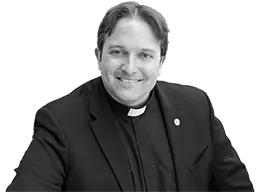
 Fr Matthew Charlesworth SJJesuit PriestSociety of JesusJesuit priest working in Southern AfricaFr. MatthewCharlesworthSJ
 Memorial of St John Berchmans, religious
Date: | Season: Ordinary Time after Easter | Year: C
First Reading: Daniel 5:1–6, 13–14, 16–17, 23–28
Responsorial Psalm: Daniel 3:62–67
| Response: Daniel 3:59b
Gospel Acclamation: Revelation 2:10c
Gospel Reading: Luke 21:12–19
Preached at: The Jesuit Institute in the Archdiocese of Johannesburg, South Africa.
Dear friends in Christ, our readings today offer one clear insight: when human strength wavers or pretends to be stronger than it is, God remains steady, and those who trust him can stand steady too. This simple line of truth runs through our readings.
Picture the scene in our first reading. A grand hall. Music. Wine. Belshazzar lifting a temple cup taken from Jerusalem, using what was sacred as if it were decoration. Then a hand appears and writes on the wall. No sound. No warning. Just writing. Suddenly the room grows still. When Daniel enters, he does not flatter. He does not soften. He simply explains the message: Mene, your days are numbered; Tekel, you have been weighed; Peres, your kingdom will be divided. Daniel speaks with the honesty of someone who knows that real authority belongs to God. This story invites each of us to pause and ask: if God were to write on the walls of my heart today, what would he say about the way I use my time, my influence, my relationships?
Rabbinical tradition often points out that Daniel’s strength is not in force but in faith. He does not shout. He stands. He does not argue. He tells the truth. He reminds us that pride, no matter how well disguised, cannot last.
The Psalm shifts us from that banquet hall to the heat of a furnace. The three young men stand in the flames, yet their words are not filled with fear. They bless God. They call the sun, moon, wind, and fire to join their praise. They see God in a place where most of us would see only danger. Ignatius teaches this way of seeing. He encourages us to look again at the places we avoid, the places that frighten us, and to ask: where is God already at work here?
This brings us to the Gospel. Jesus speaks plainly to his friends. Trials will come. They may face rejection, loneliness, accusation. Even those closest to them may misunderstand or turn away. Yet Jesus calls these moments “your opportunity to witness”. He promises that he himself will give them the words they need. They do not need sharp arguments. They need trust. The early Church learned this quickly. In Acts we hear how ordinary believers spoke with surprising clarity because the Spirit stood with them.
These words may feel close to many in South Africa today. Households face rising costs, limited job opportunities, the strain of crime, and a deep weariness that grows when promises of improvement come slowly or not at all. Students wonder how to build a future when the ground feels uncertain. Families feel the burden of caring for one another in the middle of instability. In a society marked by inequality and frustration, it is easy to wonder whether the writing on our national wall is hopeful or harsh.
Yet today’s readings lift our eyes. They remind us that God sees injustice and is not indifferent. We know that every person carries dignity, that the poor must be protected, and that the common good matters. In this land, where so many feel left out or weighed down, these teachings become practical invitations. They invite us to choose fairness in the small decisions of the day, to support those who struggle, to speak honestly against corruption, and to remain patient but firm in our hope for a society that reflects God’s justice.
The Jesuit saint we remember today, Saint John Berchmans, helps us understand this in a gentle way. He was not known for dramatic deeds. He did not face kings or write great books. He lived a short life as a young Jesuit, marked by simple faith, steady kindness, and careful attention to his daily duties. His holiness was found in doing small things well, with love, humility, and integrity. He teaches us that faithfulness is not measured by dramatic moments but by daily choices. He shows us that honest dedication, even in ordinary tasks, can become a quiet witness that strengthens others.
Imagine yourself walking beside Daniel as he enters that tense hall. Feel his calm. Notice how he trusts God more than he fears the king. Then step into the Gospel scene and listen to Jesus telling you that he will give you the strength you need for whatever lies ahead. Or sit beside the three young men in the furnace and notice how their peace grows from knowing they are not alone.
All these moments carry the same message: God does not promise that our lives will be free of difficulty, but he does promise that he will be with us. When we endure with him, our lives begin to shine with his presence.
So picture the wall of your own heart now. Picture Christ writing on it with care. Not warnings, but guidance. Words like trust, patience, courage. Let those words shape your steps this week.
Here are three questions for our prayer this evening:
- Where is Jesus asking me to trust him in a situation that feels beyond my strength?
- What challenge in my life might look different if I paused long enough to notice God already present within it?
- How is God inviting me to offer steady, simple support to someone in my community who feels weighed down or overlooked?
Source: https://sj.mcharlesworth.fr/homilies/2025-11nov-26-yc-ot-34/
This homily is shared for personal and pastoral use. Please attribute the author and do not alter the meaning when quoting. If you wish this homily to be translated - there is an option on the website which will allow you to translate it into the language of your choice.
Licenced under a Creative Commons Attribution-NonCommercial-NoDerivatives 4.0 International (CC BY-NC-ND 4.0) license.
The author does not speak for the Society of Jesus or for the Catholic Church.





In preparing this homily, I consulted various resources to deepen my understanding of today’s readings, including using Magisterium AI for assistance. The final content remains the responsibility of the author.