
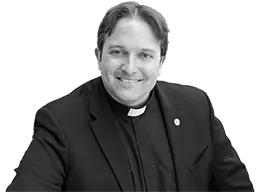
 Fr Matthew Charlesworth SJJesuit PriestSociety of JesusJesuit priest working in Southern AfricaFr. MatthewCharlesworthSJ
 Thursday of the 34th Week in Ordinary Time
Date: | Season: Ordinary Time after Easter | Year: C
First Reading: Daniel 6:12–28
Responsorial Psalm: Psalm 3:68–74
| Response: Psalm 3:59b
Gospel Acclamation: Luke 21:28
Gospel Reading: Luke 21:20–28
Preached at: the Chapel of Emmaus House in the Archdiocese of Harare, Zimbabwe.
Dear friends in Christ, today’s readings show us that when life presses in on all sides, God gives us strength to stand and the courage to look up again.
Our first reading from Daniel brings us back into the courage of Daniel. He is punished not for wrongdoing, but for prayer. He is lowered into the lions’ den, a cold and frightening place. Yet the real centre of the story is not the lions but the God who stays close. Daniel’s name means God is my judge, and that name becomes almost like a prayer in his heart. In the night, God sends an angel to silence the danger around him. At dawn the king sees that Daniel has been kept safe, and he learns what Daniel already trusted: God is faithful.
If we take a moment of Ignatian imagination, we can stand beside Daniel in that cave. We can feel the rough stone beneath our feet and hear the low breath of the lions. Many people in South Africa know this feeling in their own way: students unsure how to pay fees, families struggling with load shedding, workers facing unfair treatment, communities living with crime, neighbours stretched by rising prices. These situations are not small. They feel like lions too. The reading does not tell us to pretend the lions are gentle. It tells us that God enters the den with us.
The responsorial psalm from Daniel is like a song rising from the very heart of trouble. It calls on everything in creation to bless the Lord: sun and moon, fire and frost, night and day. This psalm belongs to the story of the three young men in the furnace who refused to bow to an unjust law. What is striking is that they praised God not after they were rescued, but while they were still in the flames. Their praise became a kind of inner strength. It was their way of saying that even when life is hard, God remains good, and dignity remains intact. Catholic Social Teaching reminds us of this truth: every person carries deep worth, whether they live in comfort or in difficulty. We see that dignity shining in many South African communities, especially in the way people help one another in townships and rural areas where resources are limited.
The Gospel from Luke brings us to a moment of sharp honesty. Jesus speaks about the fall of Jerusalem, which took place when Roman armies surrounded the city. He names real suffering and warns of days of distress. But his purpose is not to frighten; it is to anchor his disciples. After speaking of hardship, he tells them to stand up and raise their heads, because their redemption is near. He is teaching them a posture of faith: not shrinking back, but looking forward; not bending under fear, but standing with trust.
When we look at South Africa today, these words speak to us very directly. We know the weight of unemployment, the anxiety of political tension, the cost of living rising, the fear of crime, the tiredness that load shedding brings to households and clinics and schools. Jesus does not ask us to ignore any of this. He asks us to face it with courage and compassion. He asks us to stand with those who struggle. He asks us to be people whose presence gives hope to others. This is part of our call, especially as religious: to be steady when others feel shaken, and to lift the heads of those who are bowed down.
A single image ties the readings together: the lifting of the head. Daniel lifts his heart in prayer. The psalm lifts its voice in praise. Jesus lifts the eyes of his followers. And God lifts us when we grow weary. St Ignatius invites us in the Spiritual Exercises to place ourselves inside the Gospel scene. So imagine Jesus looking at you today and saying, Lift your head. Imagine him saying it to your community. Imagine him saying it to our country. When we lift our heads, we notice grace again. We notice small signs of life and courage. We remember that God is near.
So today’s message is gentle but firm: God is with us in the den, with us in the fire, and with us in the hard places of our lives. Hope is not pretending everything is fine. Hope is trusting that God walks with us and invites us to act with simple, faithful love where we are.
Let us take this into prayer with three questions:
- Where are the lions in my life, and how might God be giving me courage to face them?
- Who around me needs a small sign of encouragement from me this week?
- How is Jesus inviting me to lift my head and notice the hope he is planting in my life right now?
Source: https://sj.mcharlesworth.fr/homilies/2025-11nov-27-yc-ot-34/
This homily is shared for personal and pastoral use. Please attribute the author and do not alter the meaning when quoting. If you wish this homily to be translated - there is an option on the website which will allow you to translate it into the language of your choice.
Licenced under a Creative Commons Attribution-NonCommercial-NoDerivatives 4.0 International (CC BY-NC-ND 4.0) license.
The author does not speak for the Society of Jesus or for the Catholic Church.





In preparing this homily, I consulted various resources to deepen my understanding of today’s readings, including using Magisterium AI for assistance. The final content remains the responsibility of the author.