
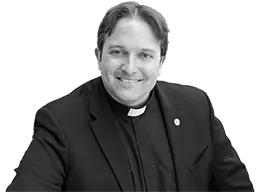
 Fr Matthew Charlesworth SJJesuit PriestSociety of JesusJesuit priest working in Southern AfricaFr. MatthewCharlesworthSJ
 Friday of the 34th Week in Ordinary Time
Date: | Season: Ordinary Time after Easter | Year: C
First Reading: Daniel 7:2–14
Responsorial Psalm: Daniel 3:75–81
| Response: Daniel 3:59b
Gospel Acclamation: Luke 21:28
Gospel Reading: Luke 21:29–33
Preached at: The Jesuit Institute in the Archdiocese of Johannesburg, South Africa.
Dear friends in Christ, as we reach the final days of our Church’s year, the Scriptures invite us to see our world with clarity and hope, and to trust that even when history bends and familiar things shift, God’s promise stands firm.
Throughout this week the liturgy has given us readings from Daniel, preparing us for this moment in the year when we look back, look around, and look ahead. Daniel lived in exile under powers that claimed permanence, and his visions remind us that no empire lasts forever. In today’s first reading four beasts rise from a stormy sea, each symbolising an empire: Babylon with its proud wings, the Medo-Persian kingdom, the Greek empire that broke into four parts, and the iron strength of Rome. The sea represents chaos, the forces that unsettle human dignity and peace. These beasts roar for a time, but they are not the final word.
The vision shifts when the Ancient of Days takes his seat and one like a Son of Man approaches. Dominion is given to him. His kingdom does not fade. This is the rhythm we have seen in all the Daniel readings of the week: human power rises and falls; God’s reign is steady. It is a fitting message as the liturgical year closes. Endings remind us that history is not in the hands of beasts but in the care of God.
The psalm shows praise rising from unlikely places. The young men in the furnace call creation itself to bless the Lord. Fire does not silence them; it sharpens their trust. Many here in South Africa know what pressure feels like: load shedding disrupting work, food prices rising, students carrying heavy expectations, families stretched thin. The psalm teaches us to look for quiet signs of hope even in difficulty, and to stand beside those whose voices are nearly lost.
In the Gospel from Luke Jesus turns our attention to a fig tree. No palace, no army, just a small branch softening as summer draws near. He tells us that God’s kingdom is revealed in signs like this: simple, small, easy to miss. As we end the liturgical year and prepare for Advent, this image is timely. Another cycle of grace completes itself. Another chance comes to notice where new life is pushing through. Jesus reminds us that his words endure, even when familiar structures fall away, as happened with the Temple a generation after he spoke.
Our Ignatian spirituality invites us to enter this scene with imagination. Picture yourself under the fig tree. Feel the branch, see the first leaf forming, and let Christ ask: Where is new life beginning in you? What tender shoot is trying to appear? The examen teaches us to notice where God has been quietly at work. Today’s Gospel is a gentle call to keep practising that attention.
The awareness and consequences of affirming the dignity of every person, especially the poor and vulnerable, is a sign of God’s kingdom taking root. When systems behave like beasts, devouring the weak, we are called to resist by small and steady acts of justice and compassion. A kind word, an honest decision, a hand offered to someone struggling can be like a leaf on the fig tree, hinting that summer is near.
So, dear friends, as this liturgical year concludes, Daniel urges us to trust God’s long view, the psalm teaches us to praise even in hardship, and Jesus invites us to watch for small signs of hope. Endings are not failures; they are invitations. They prepare the ground for new beginnings.
As you pray this week, you might reflect on three questions.
- Where do I see one small sign of God’s kingdom growing in my life or my community?
- What fear or pressure weighs on me, and how might I let Christ bring calm there?
- What simple act of justice or kindness can I offer that will help someone else sense that God is near?
Source: https://sj.mcharlesworth.fr/homilies/2025-11nov-28-yc-ot-34/
This homily is shared for personal and pastoral use. Please attribute the author and do not alter the meaning when quoting. If you wish this homily to be translated - there is an option on the website which will allow you to translate it into the language of your choice.
Licenced under a Creative Commons Attribution-NonCommercial-NoDerivatives 4.0 International (CC BY-NC-ND 4.0) license.
The author does not speak for the Society of Jesus or for the Catholic Church.





In preparing this homily, I consulted various resources to deepen my understanding of today’s readings, including using Magisterium AI for assistance. The final content remains the responsibility of the author.