
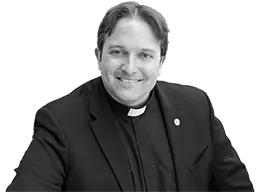
 Fr Matthew Charlesworth SJJesuit PriestSociety of JesusJesuit priest working in Southern AfricaFr. MatthewCharlesworthSJ
 Memorial of Sts Edmund Campion, Robert Southwell, priests, and companions, martyrs
Date: | Season: Advent | Year: A
First Reading: Isaiah 2:1–5
Responsorial Psalm: Psalm 122:1–9
| Response: I rejoiced when I heard them say: ‘Let us go to God’s house.’
Gospel Acclamation: Psalm 80:4
Gospel Reading: Matthew 8:5–11
Preached at: The Jesuit Institute in the Archdiocese of Johannesburg, South Africa.
Dear friends in Christ, today the Church invites us to see that God comes quietly to the humble, comes faithfully to the weary, and comes surprisingly to the outsider; and that Advent is the season in which our eyes learn again how to recognise him.
Our first reading from Isaiah, rises from a land bruised by loss. Jerusalem had been reduced to a remnant, the people shaken by their own missteps, leaning on worldly powers instead of the God who had carried them out of Egypt. Yet Isaiah speaks of a new dawn. He speaks of a branch, a tender shoot pushing through dry soil, the earliest sign that God is not finished with his people. Across Scripture this branch becomes an image of the Messiah, the one who will restore what has collapsed and gather what has scattered. The nations, Isaiah says, will stream uphill towards the mountain of the Lord. Picture that in your prayer as Ignatius would invite you to do: the dusty road, the crowds, the slow but certain movement of hope rising against the pull of gravity. And hear the hammering of swords turned into ploughs, spears reshaped into pruning hooks. It is the sound of fear giving way to peace, the sound every household in our country longs to hear as we navigate economic strain, social anxiety, and the daily temptation to despair. Isaiah hands us an image and whispers, Walk in its light even now.
The Psalm moves that image from mountain to city. I rejoiced when I heard them say, Let us go to God’s house. It is the cry of a pilgrim who has travelled far. It is the relief of reaching safe ground. It is the delight of discovering again that we are not meant to walk alone. The psalmist prays for the peace of Jerusalem. We pray for the peace of Harare, Bulawayo, Mutare, and every place where conflict curls at the edges of ordinary life. Peace is not passive. Peace is patient work. Peace begins when one person decides to speak truth without cruelty, to resist corruption without cynicism, to plant generosity where survivalism has taken root. Advent calls us to move like pilgrims towards that peace, even when the world feels stuck.
Into this longing steps the Gospel from Matthew. Here a centurion, a foreign officer, approaches Jesus. He carries authority, but he does not cling to it. He begins with a confession of need: Lord, my servant is suffering. No bargaining, no bravado, only compassion for another. In the ancient world, this alone was remarkable. A Roman soldier worries about a servant. A man with military power bows before a wandering teacher. And then he speaks the line that has become the heartbeat of Christian prayer: Lord, I am not worthy. With those words he steps into truth, and truth becomes freedom. The rabbis taught that God’s word contains the power to accomplish what it declares. The centurion understands this. One word from you, Lord, is enough. One word can cross any distance. One word can enter any house and heal what lies there.
Ignatius would ask us to enter this scene. Stand beside Jesus. Watch the centurion approach. Feel the hush that falls over the disciples as they witness unexpected faith. Let the humility of that moment soften your heart. Let it challenge you. For the centurion’s faith is not private. It is not about his own comfort. It is a faith for the sake of another, a faith that looks outward, a faith that mirrors the heart of God. At a time when so many in our country face unequal access to healthcare and education, when so many households struggle for stability, this Gospel asks us: Whom do you bring before Jesus? Whose suffering moves you enough to act, to pray, to speak?
And today we call to mind St Edmund Campion and the company of British Jesuit martyrs whose witness remains of particular devotion to those of us formed in the British Province. These were men who walked the roads of Elizabethan England knowing that truth could cost them everything. They ministered in hidden lofts and forest clearings, in safe houses lit only by candles, carrying the Eucharist beneath their cloaks. They wrote with clarity, preached with courage, and served with compassion. Many endured interrogations that aimed to break body and spirit. Yet they remained faithful not because suffering is noble, but because love is stronger than fear. Campion’s “Brag” was not a boast but a blessing. Robert Southwell wrote poems of hope while awaiting execution. Alexander Briant prayed for his torturers. Their faith flowered in shadows, just as Isaiah’s branch rises from unlikely ground.
Their witness speaks powerfully to us in South Africa, where many live quiet heroism each day: teachers who persist in overcrowded classrooms, nurses who tend the sick with patience despite limited resources, community workers who hold fragile neighbourhoods together, and young people who resist the weight of discouragement by choosing to study, to organise, to hope. The martyrs remind us that holiness often hides in ordinary duties carried out with extraordinary love. They show us that God’s word is never chained, and that the light Christ brings in Advent cannot be smothered by any darkness.
So the readings and the martyrs converge into one Advent truth: God draws his people together again. A mountain lifting our eyes. A city shaping our steps. A table wide enough for east and west, for Roman soldiers and Galilean fishermen, for persecuted Jesuits and weary pilgrims, for seekers from every land. Our hope for South Africa, too, rests not in sweeping gestures but in the small, steady acts that echo the faith of the centurion and the courage of these martyrs, acts that stitch communities together and remind us that renewal often begins in quiet places.
Let us remember this evening that God comes to the humble, the hopeful, and the courageous. God comes to those who say, Lord, only say the word. God comes to those who believe again in the slow work of peace. Advent is a season of small beginnings, but small beginnings in God’s hands become mighty things.
For your prayer this tonight, I offer three questions:
- Where is God inviting me to take one small step towards peace, and what resists that step within me?
- Whom do I need to carry to Jesus with the compassion of the centurion?
- What word from the Lord do I most need to trust, and how will I act on it today?
Source: https://sj.mcharlesworth.fr/homilies/2025-12dec-01-ya-at-01/
This homily is shared for personal and pastoral use. Please attribute the author and do not alter the meaning when quoting. If you wish this homily to be translated - there is an option on the website which will allow you to translate it into the language of your choice.
Licenced under a Creative Commons Attribution-NonCommercial-NoDerivatives 4.0 International (CC BY-NC-ND 4.0) license.
The author does not speak for the Society of Jesus or for the Catholic Church.





In preparing this homily, I consulted various resources to deepen my understanding of today’s readings, including using Magisterium AI for assistance. The final content remains the responsibility of the author.