
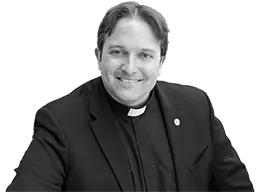
 Fr Matthew Charlesworth SJJesuit PriestSociety of JesusJesuit priest working in Southern AfricaFr. MatthewCharlesworthSJ
 2nd Sunday of Advent
Date: | Season: Advent | Year: A
First Reading: Isaiah 11:1–10
Responsorial Psalm: Psalm 72:1–2, 7–8, 12–13, 17
| Response: Psalm 72:7
Second Reading: Romans 15:4–9
Gospel Acclamation: Luke 3:4, 6
Gospel Reading: Matthew 3:1–12
Preached at: The Jesuit Institute in the Archdiocese of Johannesburg, South Africa.
Dear brothers and sisters in Christ, today we begin with a simple image: a small green shoot growing out of an old tree stump. It looks fragile, yet it refuses to die. That is the heart of Advent. When we see endings, God sees beginnings. When we lose hope, God plants it.
Isaiah gives us this picture. The royal family of David had been cut down—its glory gone, its future uncertain. But Isaiah says a new shoot will rise from Jesse’s stump. The Hebrew word netzer means a tender sprout—small, but determined. God does not throw away what is broken; God brings life out of what looks finished. That shoot is more than a symbol, it points to a person. In the same passage Paul later quotes, he tells us that this Branch—the netzer—is Christ himself, the hope of all nations (Rom 15:12). The promise is not vague; it has a name, a face, a future.
And Isaiah’s vision stretches further. The world he imagines is one where natural enemies live together without fear—wolf and lamb side by side, children safe near once-dangerous creatures. This is not fantasy. Isaiah is saying that when God’s justice shapes hearts and societies, peace becomes possible. Truth replaces fear. Fairness replaces domination. The Messiah does not bring peace by ignoring injustice; he brings peace by setting things right.
This speaks to us here in South Africa, where many feel more like stumps than shoots—worn down by rising costs, fraying trust, tired systems, and promises that disappoint. Isaiah reminds us that renewal does not begin with noise or power, but with faithfulness—honesty in business, respect in families, courage to protect the vulnerable. Catholic Social Teaching puts it clearly: peace is the fruit of justice, not the avoidance of conflict.
The Psalm deepens this vision. It does not praise a king for his armies or riches. It prays for a ruler who defends the poor, rescues the helpless, and treats people with dignity. Real worship does not end at the church doors; it continues where widows search for security, where parents struggle to feed children, where young people face the future with uncertainty. If we pray for God’s kingdom, we must live like we belong to it.
Paul then takes Isaiah’s hope and brings it into human relationships. He urges the Roman Christians—Jews and Gentiles, people divided by history and suspicion—to welcome one another as Christ has welcomed them. Paul is not offering a theory; he is asking for a miracle. This welcome is the quiet revolution of Advent.
In one parish I know, two neighbours had not spoken in years because of a land dispute. They came to the same Mass and avoided each other. One Advent, during a parish food drive for the homeless, they found themselves packing the same box for a family in need. What they could not solve alone, mercy softened. By Christmas, they were able to greet each other again. One small act—packing groceries—became a doorway for grace. That is Paul’s vision: strangers becoming family, old wounds loosening, hope practiced together.
Then Matthew takes us into the wilderness. John the Baptist appears like a lone voice without an echo—direct, unfiltered, urgent. He fulfills Isaiah’s prophecy: “Prepare the way of the Lord” (Isa 40:3). John strips away excuses. His call to repent is not a guilt-trip; it is an invitation to turn around. To let go of the habits that choke us. To make space for the Messiah.
John warns against religious showmanship—beautiful altars without generous hearts, correct words without compassion. His image of the axe at the root is not meant to threaten but to awaken: faith must bear fruit—kindness, justice, mercy. If it does not, something must change.
Yet John sees only the doorway. Jesus is the house beyond it. John expects fire that destroys. Jesus brings fire that purifies—burning away what wounds us, not who we are. John speaks of judgment; Jesus embodies mercy. Advent holds both truths: God is urgent, and God is gentle. We are called to change—and we are received with love.
For a moment, try to bring this insight into your own heart. Where is your stump? A broken relationship? A habit you cannot shake? A dream you have abandoned? And where is your shoot? That small tug toward honesty. That desire to forgive. That quiet nudge to help someone in need - there is goodness in everyone if we pay attention. The Spiritual Exercises teach us to notice where God is already at work—and to cooperate with that grace.
The message of these readings is simple: God restores what we offer in truth. Peace follows the path of justice. Hope grows where mercy is given space. Advent is not a season of idle waiting; it is a time to begin living the future God promises.
So I invite you today to ask God for two gifts:
Courage — to speak truth, mend what is broken, and take the first step.
Tenderness — to notice small beginnings of grace and protect them.
Because shoots become branches. Branches become shelter. Hope becomes a home.
As you pray this morning, consider:
- Where is God planting shoots of hope in my life, and how am I caring for them?
- What act of justice or mercy is God asking of me—especially for someone who feels forgotten?
- What change of direction is God inviting me to make so that Christ may walk more freely with me?
The world sees the stump. God sees the shoot. Advent invites us to see with God’s eyes—to trust that new life is not only possible, but already begun.
May the God of hope fill us with joy and peace as we prepare the way of the Lord. Amen.
Source: https://sj.mcharlesworth.fr/homilies/2025-12dec-07-ya-at-02/
This homily is shared for personal and pastoral use. Please attribute the author and do not alter the meaning when quoting. If you wish this homily to be translated - there is an option on the website which will allow you to translate it into the language of your choice.
Licenced under a Creative Commons Attribution-NonCommercial-NoDerivatives 4.0 International (CC BY-NC-ND 4.0) license.
The author does not speak for the Society of Jesus or for the Catholic Church.





In preparing this homily, I consulted various resources to deepen my understanding of today’s readings, including using Magisterium AI for assistance. The final content remains the responsibility of the author.