
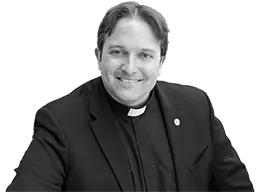
 Fr Matthew Charlesworth SJJesuit PriestSociety of JesusJesuit priest working in Southern AfricaFr. MatthewCharlesworthSJ
 Solemnity of the Immaculate Conception
Date: | Season: Advent | Year: A
First Reading: Genesis 3:9–15, 20
Responsorial Psalm: Psalm 98:1–4
| Response: Psalm 98:1
Second Reading: Ephesians 1:3–6, 11–12
Gospel Acclamation: Luke 1:28
Gospel Reading: Luke 1:26–38
Preached at: The Jesuit Institute in the Archdiocese of Johannesburg, South Africa.
Dear brothers and sisters in Christ,
The story of salvation begins with a woman. And today, we remember that it begins again—with another woman.
In the first reading from Genesis, God calls out to Adam, “Where are you?” Adam and Eve are hiding. They are ashamed. Something in the relationship between humanity and God has broken. But God does not turn away. He searches for them. He speaks to them. And in the middle of that moment of failure, He makes a promise: a woman’s offspring will crush the head of the serpent. That promise, first spoken in the garden, is fulfilled in Mary.
Mary is not just a good woman who loved God. She is the new Eve, as the early Church Fathers called her. Where Eve doubted God’s word, Mary believed it. Where Eve grasped at the fruit, Mary opened her hands in surrender. Where Eve’s disobedience brought death, Mary’s obedience brought life. But this obedience was not her achievement alone. God prepared her for it.
Today’s feast—the Immaculate Conception—reminds us that from the first moment of her existence, Mary was preserved from original sin. She was not spared redemption, but received it in a unique and perfect way. As the Church teaches, she was “preserved from all stain of original sin by the merits of her Son’s passion, foreseen by God.” The grace of Christ’s Cross was given to her in advance. Mary is the first to be fully redeemed, not because she earned it, but because she was chosen to bear the Redeemer. God prepared her so that she could freely and fully say “yes.”
The Psalm helps us hear the joy of this plan: “O sing a new song to the Lord, for he has done marvellous deeds. His right hand and holy arm have won the victory.” That new song begins in Mary. Her immaculate heart is the first sign that sin’s power is ending. Her life marks the beginning of the new creation. She is not just a private person of grace, but the mother of all the redeemed. Her “yes” opens the way for Christ’s coming—not only into her womb, but into the world.
St Paul’s letter to the Ephesians lifts our gaze to the purpose behind all of this. “God chose us in Christ before the foundation of the world, to be holy and blameless before him in love.” Mary is the first to live this vocation fully. In her, we see the destiny of the Church. She is the one in whom the Church is already holy. She shows us not only what God can do in one person, but what He desires to do in us all: to make us whole, to make us His, to make us saints.
In the Gospel the angel’s greeting reveals the depth of that holiness. “Hail, full of grace,” Gabriel says. The Greek word—kecharitōmenē—means someone who has been completely and enduringly filled with grace. It is used for no one else in Scripture. Mary’s heart, from the beginning, has been shaped by grace. That is why, when she is asked to bear the Son of God, she is free to say yes. She does not say it lightly. She asks questions. She listens. But she trusts.
And her yes changes everything.
Advent is a season of waiting—but not passive waiting. It is a time of preparation, of readiness. Mary shows us what that readiness looks like. It does not mean knowing the full plan. It means trusting the One who calls. Her yes was not a safe choice. It brought risk. It brought suffering. But it brought Christ into the world.
Her “yes” still brings Him today.
In South Africa, many live with fear and uncertainty—communities burdened by poverty, women carrying too much with too little support, young people uncertain about the future. In other places, like Gaza, families endure terror and grief, far from peace. In all these places, Mary is present. Her Magnificat is not only a prayer—it is a proclamation: “He has lifted up the lowly… filled the hungry with good things… remembered His mercy.” She stands with those who are forgotten. She intercedes for the wounded. She reminds us that God does not forget His people.
And she remains close to the Church. Mary’s grace didn’t remove suffering from her life, and it does not remove it from the Church. But it strengthens those who witness to Christ, often in quiet, hidden ways. Like her, we are called to be bearers of grace.
Mary’s Immaculate Conception is not just a truth about her. It is a sign of what God desires to do in us: to make us holy, to help us begin again. We may not be free from sin, but we are not without hope. We are not without grace.
So let us take her example to heart. Let her be not only our mother, but our model.
And I leave you with three simple questions to carry into your week. Let us take a moment of silence after each one:
- Where in my life do I believe grace cannot reach me?
- What quiet “yes” is God asking of me this Advent—even if I feel unprepared or afraid?
- How can I, like Mary, bring Christ to others—especially those who feel forgotten or alone?
Amen.
Source: https://sj.mcharlesworth.fr/homilies/2025-12dec-08-ya-at-02/
This homily is shared for personal and pastoral use. Please attribute the author and do not alter the meaning when quoting. If you wish this homily to be translated - there is an option on the website which will allow you to translate it into the language of your choice.
Licenced under a Creative Commons Attribution-NonCommercial-NoDerivatives 4.0 International (CC BY-NC-ND 4.0) license.
The author does not speak for the Society of Jesus or for the Catholic Church.





In preparing this homily, I consulted various resources to deepen my understanding of today’s readings, including using Magisterium AI for assistance. The final content remains the responsibility of the author.