
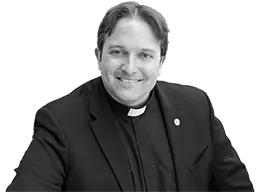
 Fr Matthew Charlesworth SJJesuit PriestSociety of JesusJesuit priest working in Southern AfricaFr. MatthewCharlesworthSJ
 Tuesday of the 2nd Week of Advent
Date: | Season: Advent | Year: A
First Reading: Isaiah 40:1–11
Responsorial Psalm: Psalm 96:1–3, 10–13
| Response: Psalm 40:10ab
Gospel Acclamation: Come, Lord! Do not delay. Forgive the sins of your people.
Gospel Reading: Matthew 18:12–14
Preached at: The Jesuit Institute in the Archdiocese of Johannesburg, South Africa.
Dear friends in Christ,
A shepherd sees one sheep missing. He leaves the rest and goes to find it. That simple image, which Jesus gives us in today’s Gospel, helps us understand everything else we hear in today’s readings. Advent is not only about waiting. It is about a God who comes looking for us—who brings comfort, who brings justice, who brings us home.
Our first reading today is from the Book of Isaiah. It was written at a time when the people of Israel were in exile. They had lost everything: their land, their temple, their freedom. But the message they receive is not one of punishment. It is one of reassurance. “Comfort, comfort my people,” God says. He doesn’t speak with threats or condemnation. He speaks gently. The original Hebrew phrase—speak to the heart—is the same phrase used when a husband speaks lovingly to his wife. God isn’t shouting. He’s drawing near.
And God’s message isn’t just that things will get better one day. It’s that he will come. He will make the road straight. He will gather the scattered. He will carry the lambs in his arms. God does not send someone else to do this work. He does it himself.
This is important. Because when people are suffering—when families go to bed hungry, when children grow up without hope, when older people feel forgotten—words alone are not enough. And yet, in many places here in Zimbabwe, all people receive are words. Promises. Excuses. What Isaiah tells us is that God does not act that way. He does not stay far off. He steps in. He gets involved.
In the Psalm today, we hear a song of joy. “Let the heavens rejoice and the earth be glad.” Why? Because the Lord is coming to rule the earth—with justice and fairness. This isn’t a threat. It’s good news. Because God’s justice is not like human justice. He does not crush the weak. He lifts them up. He does not side with the powerful. He listens to the cry of the poor.
It’s worth asking: Do we really want God to come as judge? If we’re honest, many people in power do not. Because God will not overlook corruption. He will not ignore those who have been exploited or abandoned. The Psalm reminds us that the coming of the Lord is a reason for creation itself to rejoice. Even the trees and the fields will be glad, because God will finally put things right.
And then we come to the Gospel. Jesus gives us a simple image: a shepherd with one sheep missing. And he says very clearly—God is like that shepherd. He does not accept that even one person should be lost. He notices. He goes looking. He rejoices when he finds the one.
This is not how the world works. The world says: “Don’t waste time on one. Focus on the many.” But God does not think that way. Each person matters. Each life matters. This parable should encourage anyone who feels forgotten or left out. And it should challenge those of us who are comfortable to ask: Who have we forgotten? Who have we stopped looking for?
In a country where many people live on the margins—economically, socially, or spiritually—we are reminded that no one is invisible to God. Not the child who can’t afford school fees. Not the widowed grandmother raising her grandchildren. Not the young man losing hope after years of unemployment. Each one matters.
Today, we also remember Saint Juan Diego. He was a poor man from Mexico who lived in the early 1500s. He was not educated. He was part of the Indigenous Nahua people. Every week he would walk long distances to attend Mass. One morning, on a hill called Tepeyac, he saw a woman filled with light. She spoke to him in his own language. She said she was the Mother of God, and she asked him to bring her request to the bishop: that a chapel be built where people could come and pray.
Juan Diego was unsure. He felt too small to do such a thing. And when he went to the bishop, he wasn’t believed. But he kept going back. Finally, as a sign, he gathered roses in his cloak, even though it was winter. When he opened the cloak, the flowers fell to the floor, and there on the cloth was the image of Our Lady. That image is still there today. It became a sign for his people that God had not forgotten them.
The message of Juan Diego’s life is simple: God speaks to the poor. God chooses the lowly. God doesn’t need great speakers or powerful leaders to do his work. He needs people who are willing to listen, to trust, and to act.
And so we return to the beginning: “Comfort, comfort my people.” That is our call. We are not here only to be comforted—we are called to be comfort for others. In this season of Advent, we prepare not only for Christ’s coming at Christmas, but for his coming into the lives of those who feel forgotten. We prepare the way by noticing the ones who have been left behind.
As you pray this week, I invite you to take time with the Gospel. Use your imagination as Ignatius teaches us. Picture the shepherd. Picture yourself as the lost sheep. Let yourself be found. And ask:
- When have I wandered far from God—and how might I allow him to carry me home?
- Who around me is struggling, and how might I be part of God’s search for them?
- What does it mean for me to speak to the heart—and who needs that voice from me today?
May we listen for the voice that calls us by name. And may we become part of the way God brings comfort to others. Amen.
Source: https://sj.mcharlesworth.fr/homilies/2025-12dec-09-ya-at-02/
This homily is shared for personal and pastoral use. Please attribute the author and do not alter the meaning when quoting. If you wish this homily to be translated - there is an option on the website which will allow you to translate it into the language of your choice.
Licenced under a Creative Commons Attribution-NonCommercial-NoDerivatives 4.0 International (CC BY-NC-ND 4.0) license.
The author does not speak for the Society of Jesus or for the Catholic Church.





In preparing this homily, I consulted various resources to deepen my understanding of today’s readings, including using Magisterium AI for assistance. The final content remains the responsibility of the author.