
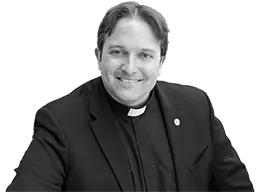
 Fr Matthew Charlesworth SJJesuit PriestSociety of JesusJesuit priest working in Southern AfricaFr. MatthewCharlesworthSJ
 3rd Sunday of Advent
Date: | Season: Advent | Year: A
First Reading: Isaiah 35:1–6a, 10
Responsorial Psalm: Psalm 146:6–10
| Response: Psalm 35:4 or Text
Second Reading: James 5:7–10
Gospel Acclamation: Isaiah 61:1
Gospel Reading: Matthew 11:2–11
Preached at: The Jesuit Institute in the Archdiocese of Johannesburg, South Africa.
Advent today teaches us how to wait without hardening, by learning to recognise God’s work in real and often modest acts of healing and justice.
Dear brothers and sisters in Christ, Gaudete, rejoice. The Church wears rose today not because the world is suddenly healed, but because the Lord is near, and because we are being trained to see how God comes to us even when life remains difficult.
Hold two scenes together. One is open and busy. People gather around Jesus, bringing the sick, the poor, and those who are worn down. The other is closed and silent. John the Baptist is in prison. Matthew 11:2–11 tells us plainly that John is no longer in the wilderness. He is behind locked doors. From that place he sends messengers to Jesus with a single, honest question: “Are you the one who is to come, or must we wait for another?” (Matthew 11:3).
John is despondent, and understandably so. Jesus has come, and yet the world still bears the marks of violence, fear, and injustice. Power still speaks the language of conquest. Innocent people still suffer. In South Africa, we see how easily force, corruption, and exclusion are used to secure advantage. John’s question is not a failure of faith. It is faith that refuses denial.
John also teaches us something important here. We are allowed to question as we wait. We are allowed to doubt when the promise of God seems slow to arrive. If faith never questioned, it would become a kind of sedation, a way of numbing ourselves to the world’s suffering. John’s question rises not from indifference, but from love for the truth.
Jesus receives that question without anger and without disappointment. He does not correct John’s tone. He does not defend himself. He simply says to the messengers: “Go and tell John what you hear and see” (Matthew 11:4). Then he lists what has been happening: the blind regain their sight, the lame walk, lepers are cleansed, the deaf hear, the dead are raised, and the poor have the good news proclaimed to them (Matthew 11:5).
This list is not random. It is Isaiah 35 brought to life in front of John’s question. Weak hands strengthened. Fearful hearts steadied. Bodies restored. Jesus answers Scripture with Scripture made flesh.
And yet something else must be noticed. Jesus has not healed all the blind. He has not raised all the dead. He has not ended poverty or violence. The world remains very much unredeemed. This incompleteness is not a failure. It is the shape of the Kingdom while it is still growing. God does not arrive as conquest. God arrives as leaven.
The first reading had already prepared us for this. Isaiah speaks to people shaped by exile and loss. He does not promise escape from history, but transformation within it. The desert blooms not overnight, but because God is present there. Sorrow and sighing do not disappear instantly, but they no longer have the final word.
The responsorial psalm gives us a way to test whether we are seeing clearly. God gives bread to the hungry. God lifts up those who are bowed down. God protects the stranger, the widow, and the orphan. This is not interior spirituality. It is public truth. It tells us where God is already at work and where God expects our attention.
The second reading then speaks directly to the strain of waiting. “Be patient… until the coming of the Lord” (James 5:7). James compares us to a farmer waiting for rain. The farmer works the soil faithfully, knowing growth is real even when invisible. James adds a warning that is quietly demanding: “Do not grumble against one another” (James 5:9). Long waiting can either deepen community or erode it.
Jesus then adds a sentence that exposes our expectations: “Blessed is the one who takes no offence at me” (Matthew 11:6). Blessed is the one who does not stumble because God refuses the way of domination. John once preached fire and judgement. Jesus chooses mercy first. This is not weakness. It is deliberate restraint.
Jesus does not come as one more powerful than John. He will also be arrested. He will also be executed. We might want a triumphant, invulnerable Messiah, but Jesus comes weak and exposed. A child in a manger. A man on a cross. He comes not to overpower humanity, but to gather it and transform it from within.
This matters because, as Fr David Neuhaus writes in his book, the way of conquest is still praised today, whether through violence, economic dominance, or the quiet crushing of the weak. Jesus rejects that way. He chooses the slow work of healing, forgiveness, and courage. He chooses to be leaven kneaded into human life.
If we learn to look this way, we begin to recognise the signs around us. The patience of a nurse in an exhausted clinic. The honesty of a worker who refuses a bribe. The courage of a teacher who does not give up on children who arrive hungry. The quiet faithfulness of families who keep going when systems fail them. These are not small things. They are real acts of resistance against the logic of conquest.
Ignatius of Loyola teaches us how to notice this. In the Examen, we ask where life was present today, and where it was resisted. We learn to see grace without denying pain. We do not close our eyes to what is broken, but we also refuse to miss what is being healed.
Jesus then speaks about John with deep respect. John is not a reed shaken by the wind. He is a prophet who stood firm. And yet Jesus says, “The least in the kingdom of heaven is greater than he” (Matthew 11:11). This is not a dismissal of John. It is a statement about grace. John’s greatness does not spare him prison, just as faithfulness will not spare us loss. The Kingdom Jesus brings is not about rank, but about participation in mercy.
At this altar, Christ comes to us not as a conqueror, but as bread. We receive him, and then we return to our lives, to our work, our families, our communities, and our country. We are sent to be leaven, trusting that God is at work even when the work is unfinished, until Christ comes again to bring to completion what now begins in mercy.
As we move into this week, carry these three Ignatian questions into prayer:
- Where am I struggling with disappointment or doubt, and can I speak honestly to God about it, as John did?
- What small but real signs of healing am I being invited to notice and trust, rather than waiting only for dramatic change?
- How can I wait patiently this week without turning against others, so that waiting deepens love rather than erodes it?
Source: https://sj.mcharlesworth.fr/homilies/2025-12dec-14-ya-at-03/
This homily is shared for personal and pastoral use. Please attribute the author and do not alter the meaning when quoting. If you wish this homily to be translated - there is an option on the website which will allow you to translate it into the language of your choice.
Licenced under a Creative Commons Attribution-NonCommercial-NoDerivatives 4.0 International (CC BY-NC-ND 4.0) license.
The author does not speak for the Society of Jesus or for the Catholic Church.





In preparing this homily, I consulted various resources to deepen my understanding of today’s readings, including using Magisterium AI for assistance. The final content remains the responsibility of the author.