
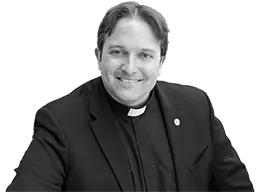
 Fr Matthew Charlesworth SJJesuit PriestSociety of JesusJesuit priest working in Southern AfricaFr. MatthewCharlesworthSJ
 Monday of the 3rd Week of Advent
Date: | Season: Advent | Year: A
First Reading: Numbers 24:2–7, 15–17a
Responsorial Psalm: Psalm 25:4–5ab, 6, 7bc, 8–9
| Response: Psalm 25:4
Gospel Acclamation: Psalm 85:8
Gospel Reading: Matthew 21:23–27
Preached at: The Jesuit Institute in the Archdiocese of Johannesburg, South Africa.
Today’s message is essentially about how God’s authority does not force us but invites us to be led.
Dear brothers and sisters in Christ, dear friends, Advent often begins not with an answer but with a question. Who will guide us when the way ahead is uncertain? Whose authority will we trust when the path is not clear?
Our first reading from the Book of Numbers is set in an unlikely place. Balaam is not part of Israel. He is a hired prophet, paid to curse God’s people. And yet, when he looks out over the tents of Israel, the Spirit of God comes upon him and blessing pours from his mouth. God speaks through someone on the margins, someone compromised, someone unexpected. That alone tells us something important about how God works. God’s authority is not confined to our structures or our expectations. It moves where it will.
Then comes the striking image: a star shall come out of Jacob. Not a weapon. Not an army. Not a decree. A star. In the ancient world a star signalled kingship, but it also meant guidance. A star does not shout. It does not compel. It shines. It invites movement. It draws travellers forward through the dark. This is how God’s authority often appears in Advent: quiet, patient, persistent. God does not force us into faith; God invites us to walk.
That longing to be guided shapes the prayer of today’s psalm: “Lord, make me know your ways. Teach me your paths. Lead me in your truth.” This is not the prayer of someone who has everything sorted out. It is the prayer of someone willing to learn. In Scripture, to know a way is not just to understand it, but to walk it. The psalm also asks God to remember mercy and to forget sin. Teach me again. Lead me again. It is a prayer shaped by humility, not control.
That prayer feels close to home. Many people in Zimbabwe know what it is to ask for guidance amid uncertainty: families trying to plan with rising costs, young people wondering whether education will lead to work, communities carrying the weight of broken systems and fragile institutions. The psalm does not promise quick solutions. It promises that God walks with those who seek truth with open hearts.
The Gospel from Matthew brings us into the Temple, the centre of religious life. Jesus has just overturned the tables, disrupted business as usual, and now he is teaching. The chief priests and elders approach him with a sharp question: “By what authority are you doing these things?” They are not asking because they want to learn. They are defending their position. For them, authority means control, permission, and protection of status.
Jesus responds as a rabbi would, with a question that exposes the heart of the matter. “The baptism of John — was it from heaven or from human origin?” This is not a change of subject. Jesus is placing himself firmly in the same stream as John the Baptist. John prepared the way. John called for repentance. John pointed beyond himself. To accept John’s authority would mean accepting the One to whom John pointed.
The leaders know they are trapped, not by Jesus, but by their own refusal to be honest. If they say John was from heaven, they must admit they refused God’s call to repentance. If they say John was merely human, they fear the people, who recognised John as a prophet. So they choose safety. “We do not know.”
This is the real failure in the scene. Not open hostility, but avoidance. Not disbelief, but refusal to be changed. Authority, when clung to, becomes fragile. Authority, when received from God, sets people free.
Matthew’s Gospel uses the word exousia — authority, power — again and again. Jesus teaches with authority. He heals with authority. He forgives sins with authority. But notice how that authority is exercised. It does not crush. It restores. It lifts the broken, frees the bound, and calls people into life. Even when Jesus later shares that authority with his disciples, it is not for domination, but for service — to teach, to heal, to reconcile.
Here Advent speaks directly to us. The real question is not whether Jesus has authority. The Gospel assumes that. The question is whether we will allow his authority to shape our lives. John called people to metanoia — a change of mind, a change of direction. That call still stands.
In the Spiritual Exercises, Ignatius invites us to place ourselves inside the Gospel scene. Imagine standing in the Temple. Hear the question being asked of you: “By what authority do you live?” What really guides your decisions? Fear of loss? Desire for approval? Habit and comfort? Or the quiet light of God’s call, shining like a star in the night?
God often guides us through uncertainty rather than around it. Trust grows not from having all the answers, but from staying faithful to the light we have been given.
This Gospel also presses on our shared life. When injustice is explained away, when the poor are asked to wait while others prosper, when young people feel unseen and unheard, the Church is asked again: “By what authority do you speak?” Our answer cannot be clever. It must be lived. God’s authority always bends towards mercy, dignity, and care for those pushed aside.
Advent does not end with everything resolved. It ends with a star still shining and a path still open. God is near. God is guiding. God is patient.
As we go into this week, I invite you to pray with three simple questions:
- Where in my life am I avoiding an honest answer because it might ask me to change?
- Whose voice really guides my decisions, especially when others are affected by them?
- What small step can I take this week to walk more faithfully in the way God is gently showing me?
Source: https://sj.mcharlesworth.fr/homilies/2025-12dec-15-ya-at-03/
This homily is shared for personal and pastoral use. Please attribute the author and do not alter the meaning when quoting. If you wish this homily to be translated - there is an option on the website which will allow you to translate it into the language of your choice.
Licenced under a Creative Commons Attribution-NonCommercial-NoDerivatives 4.0 International (CC BY-NC-ND 4.0) license.
The author does not speak for the Society of Jesus or for the Catholic Church.



In preparing this homily, I consulted various resources to deepen my understanding of today’s readings, including using Magisterium AI for assistance. The final content remains the responsibility of the author.