
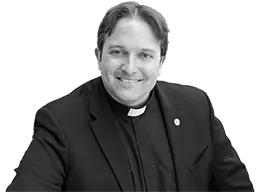
 Fr Matthew Charlesworth SJJesuit PriestSociety of JesusJesuit priest working in Southern AfricaFr. MatthewCharlesworthSJ
 19th December
Date: | Season: Advent | Year: A
First Reading: Judges 13:2–7, 24–25a
Responsorial Psalm: Psalm 71:3–4a, 5–6ab, 16–17
| Response: Psalm 71:8
Gospel Acclamation: O Root of Jesse’s stem, sign of God’s love for all his people: come to save us without delay!
Gospel Reading: Luke 1:5–25
Preached at: the Chapel of Emmaus House in the Archdiocese of Harare, Zimbabwe.
Dear brothers and sisters in Christ, dear friends, as Advent draws to its close, the Church asks us to slow down. These last days before Christmas are not loud. They are careful. They invite us to notice what is usually missed. God is at work, but not in ways that shout.
The Gospel now shifts from Matthew to Luke, and Luke begins not with a journey or a dream, but with routine. Zechariah is in the Temple, offering incense. He belongs to one of the twenty-four priestly divisions, and this moment — the offering of the tamid, the daily sacrifice — is likely the only time in his life he will ever do this. Morning and evening, day after day, Israel prays and waits. Nothing dramatic is expected. And that is precisely where God speaks.
This is already an Advent lesson. God enters not at the edge of the extraordinary, but in the middle of faithfulness. Zechariah is doing what he has always done. He is praying prayers that generations have prayed before him. And into that space of quiet obedience, the angel Gabriel appears.
Our first reading from the Book of Judges helps us hear this Gospel more clearly. Once again, God’s promise is spoken into a life marked by barrenness and waiting. The woman in Judges has no name and no child. In her world, that meant she carried both sorrow and shame. Yet she is the one who receives the word. Her son, Samson, will be set apart from the womb. Like John the Baptist after him, he will live under a form of consecration. His life will not be ordinary. But it will not be simple either. Samson will be strong, but conflicted. Called, yet flawed. Scripture does not clean him up for us. From the beginning, we learn that God works through real people, not ideal ones.
The Psalm gives us the voice of someone who has learned trust over time. “In you, O Lord, I take refuge.” This is not the prayer of excitement, but of memory. “From my mother’s womb you have been my strength.” Faith here is not about feeling certain. It is about looking back and recognising that God has been faithful before. Many of us know this rhythm from the Ignatian Examen: we look back, not to judge the day, but to notice where God was quietly present.
Back in the Temple, Gabriel tells Zechariah that his son will be consecrated from birth. He will drink neither wine nor strong drink. He will live like a Nazirite, set apart for God’s purpose. But more than that, he will be filled with the Holy Spirit and will come in the spirit of Elijah, turning hearts back again, preparing a people for the Lord’s coming. John will not be the centre of the story. His greatness will be that he points away from himself.
And yet Zechariah hesitates. He asks how this can be. It is an understandable question. He and Elizabeth are old. They have prayed for years and nothing has changed. Luke is careful to say they are righteous and blameless — faithful, not faithless. And still, Zechariah struggles to trust. Would any of us have done better?
His doubt is met with silence. For nine months, Zechariah cannot speak. This is not a punishment so much as a schooling. He must learn to listen. His name means “the Lord remembers.” Elizabeth’s name means “my God is abundance.” Before anything happens, their names already speak the truth. God has not forgotten. God is not withholding life. But Zechariah must let go of his need to manage the promise.
That long silence will eventually give way to song. When Zechariah’s voice returns, it returns as praise — the Benedictus, which the Church still prays every morning. Silence ripens into blessing. Waiting becomes worship.
Luke tells this story so that we recognise the pattern. We have heard it before: Abraham and Sarah, Hannah and Samuel. Promise first. Waiting next. Fulfilment later. Advent places us inside that rhythm again.
Ignatian prayer invites us to step into the scene. To imagine Zechariah learning patience in silence. Elizabeth waiting in hope, hidden from view. To ask ourselves where we are being invited to trust without proof, to wait without control.
For many in Zimbabwe today, waiting is not a spiritual exercise but daily life. Waiting for work. Waiting for medicine. Waiting for stability. The temptation is to believe that nothing is happening. Advent says otherwise. God is at work in the waiting. But that work is fragile. It needs protection. It needs communities that choose fairness, leaders who serve rather than take, and hearts that do not forget the poor. Quiet faith must grow into visible care.
These readings do not promise quick solutions. They promise presence. God works in long stretches of time, through ordinary faithfulness, through silence, through people who feel small.
In a few days, we will celebrate the birth of Christ. But before there is a child in a manger, there is an old priest who cannot speak, a woman who waits in hope, and a people learning to trust again. That is where Christmas begins.
As we continue these final days of Advent, let us carry these questions with us:
- Where in my life am I being asked to wait and trust, rather than push for control?
- Who around me is living in a long season of waiting, and how can I stand with them in practical ways?
- And what quiet work might God be doing in me now, preparing the way for Christ to be born anew?
Source: https://sj.mcharlesworth.fr/homilies/2025-12dec-19-ya-at-03/
This homily is shared for personal and pastoral use. Please attribute the author and do not alter the meaning when quoting. If you wish this homily to be translated - there is an option on the website which will allow you to translate it into the language of your choice.
Licenced under a Creative Commons Attribution-NonCommercial-NoDerivatives 4.0 International (CC BY-NC-ND 4.0) license.
The author does not speak for the Society of Jesus or for the Catholic Church.





In preparing this homily, I consulted various resources to deepen my understanding of today’s readings, including using Magisterium AI for assistance. The final content remains the responsibility of the author.