
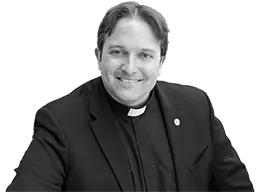
 Fr Matthew Charlesworth SJJesuit PriestSociety of JesusJesuit priest working in Southern AfricaFr. MatthewCharlesworthSJ
 Solemnity of Mary, Mother of God
Date: | Season: Christmas | Year: A
First Reading: Numbers 6:22–27
Responsorial Psalm: Psalm 67:2–8
| Response: Psalm 67:2a
Second Reading: Galatians 4:4–7
Gospel Acclamation: Hebrews 1:1–2
Gospel Reading: Luke 2:16–21
Preached at: the Chapel of Emerald Hill Children’s Home in the Archdiocese of Harare, Zimbabwe.
Dear brothers and sisters in Christ, as a new calendar year begins, the Church places before us a woman and a child and asks us to begin here.
We come into this year carrying many things. Relief that a difficult year has ended. Concern about what has not changed. Questions we do not yet know how to answer. The Christmas season does not push us forward too quickly. It keeps us close to the birth of Christ and insists that this is where time is healed, not by force, but by presence.
Our first reading from the Book of Numbers gives us one of the oldest blessings in the Scriptures. “The Lord bless you and keep you. The Lord let his face shine upon you.” In the Bible, the face is never just appearance. To turn one’s face towards another is to give attention, responsibility, and care. To turn away is to withdraw them. God promises that his face will remain turned towards his people, not because they are impressive or faithful enough, but because he chooses to remain with them.
On the first day of the year, this blessing carries weight. In Zimbabwe today, many people live with uncertainty about income, food, education, and health care. Many feel unseen by those who shape public life. This ancient prayer says something firm and concrete. God is not absent. God is not distracted. God’s attention is fixed on human life as it is actually lived.
Our psalm takes that blessing and places it within a wider horizon. “O God, be gracious and bless us,” the psalm begins, but always with a purpose beyond ourselves. God’s ways are meant to be known. God’s justice is meant to guide. The psalm links joy with fairness and fruitfulness with care for the earth. Where people are treated with dignity, life grows. Where power is used with restraint, communities endure.
This prayer presses gently on our choices. It touches how we speak about those who survive through informal work, how we treat those who leave home in search of safety or opportunity, how we use land and resources that must sustain more than one generation. Blessing is not measured by words spoken over us, but by the kind of life that takes shape among us.
Saint Paul, writing to the Galatians brings us to the centre of today’s feast. “When the fullness of time had come, God sent his Son, born of a woman.” God does not act from a safe distance. God enters human life fully. He is born into vulnerability, dependence, and limitation. Paul insists on this because everything depends on it. If God truly becomes human, then human life is taken seriously, not symbolically, but in reality.
When Paul speaks of the fullness of time, he is not saying that God acted once and then stepped back. The same careful attention that brought Christ into the world has also shaped our own lives. None of us arrived here by accident. The events, decisions, and even the disruptions that led us to this place and this moment were not random in God’s sight. The God who entered history through Mary has also been present in the slow and often uneven story of our own becoming.
This is why the Church dares to call Mary Mother of God. The title was defended at the Council of Ephesus not to make claims about Mary apart from Christ, but to protect the truth about Christ himself. The child Mary bore is one person, not two. He is fully God and fully human. Mary is not the mother of a human part of Jesus, nor of a temporary role God once played. She is the mother of the person who is God the Son. To deny that title would be to suggest that God never truly entered our flesh, never truly shared our condition.
By affirming Mary as Mother of God, the Church makes a strong and costly claim. God has taken a human face from a human mother. God has accepted dependence. God has entered history without reserve. Nothing genuinely human is now beneath God’s concern.
The Gospel from Luke shows us what this looks like on the ground. The shepherds arrive in haste. They speak freely of what they have seen. Then they return to their work, carrying the news into ordinary life. Mary remains. Luke tells us that she keeps these events and reflects on them.
Mary does not try to make sense of everything at once. She does what the moment requires. She cares for the child. She listens. She remembers. Luke says she keeps these things and reflects on them. This is not escape. It is attention. In Ignatian prayer we are taught to stay with what is given, not with what we wish were clearer. Mary shows us a faith that does not hurry God, a faith that remains steady when understanding comes slowly.
On the eighth day the child is circumcised and named Jesus, God saves. Luke is careful to tell us this. God does not step around the Law. He places himself under it. He submits to the covenant of his people. Mary does not choose the name. She receives it. She accepts that her child’s life will be shaped by a purpose larger than her own hopes. This is not resignation. It is trust grounded in reality.
This is a wise way to begin a year. By paying attention to what is before us. Resisting the urge to force clarity too quickly. Allowing God’s work to unfold in time. Mary teaches us how to stand at the beginning of something unknown without panic and without illusion.
Today also marks the World Day of Peace, and Pope Leo XIV invites the whole Church to receive peace as a gift, not a strategy. In his message for this year, he reminds us that peace is first a reality that must dwell within us before it can shape the world. He speaks of a peace that is unarmed and disarming, born of the risen Christ’s greeting, “Peace be with you!” — a peace that resists violence and fear, overcomes division, and calls each of us to conversion of heart and dialogue with others. Pope Leo insists that peace cannot be imposed as a policy or an armament, but must grow where human beings learn to see one another not as threats, but as neighbours made in God’s image. This way of peace, rooted in Christ’s presence among us, asks that we guard it in our hearts and act on it in our families, communities, and nations.
As this year opens, the Christmas season leaves us with a demanding image. God’s face turned towards the world, visible in the face of a child, reflected in the steady gaze of his mother. If that gaze shapes how we look at others, especially those who are tired, poor, or easily ignored, then this feast will not fade. It will shape how we live.
Let us carry three questions into the days ahead.
- Where, at the beginning of this year, do I need to trust that God is present, even where I feel uncertain or worn down?
- Who in my daily life needs my attention and care in a way that reflects God’s blessing?
- Like Mary, what experiences do I need to hold patiently, allowing their meaning to unfold rather than forcing quick answers?
Source: https://sj.mcharlesworth.fr/homilies/2026-01jan-01-ya-ct-02/
This homily is shared for personal and pastoral use. Please attribute the author and do not alter the meaning when quoting. If you wish this homily to be translated - there is an option on the website which will allow you to translate it into the language of your choice.
Licenced under a Creative Commons Attribution-NonCommercial-NoDerivatives 4.0 International (CC BY-NC-ND 4.0) license.
The author does not speak for the Society of Jesus or for the Catholic Church.





In preparing this homily, I consulted various resources to deepen my understanding of today’s readings, including using Magisterium AI for assistance. The final content remains the responsibility of the author.