 Fr Matthew Charlesworth SJJesuit PriestSociety of JesusJesuit priest working in Southern AfricaFr. MatthewCharlesworthSJ
 2nd Sunday in Ordinary Time
Date: | Season: Ordinary Time before Easter | Year: A
First Reading: Isaiah 49:3, 5–6
Responsorial Psalm: Psalm 40:2, 4, 7–10
| Response: Psalm 40:8a, 9a
Second Reading: 1 Corinthians 1:1–3
Gospel Acclamation: John 1:14a, 12a
Gospel Reading: John 1:29–34
Preached at: the Chapel of Emmaus House in the Archdiocese of Harare, Zimbabwe.
Dear brothers and sisters in Christ,
today we are being asked to notice the Lamb who walks quietly among us, and to decide whether we will pay attention and follow.
There is a sound many of us know well, especially outside the cities. It is the small bell tied around the neck of a sheep or a goat, heard early in the early morning or just before sunset. It is not loud. It does not compete with the noise of the day. But if you stop and listen, it tells you where the flock is and where the shepherd has gone. It helps you find your way home before night comes. All the readings today move at that pace. God does not force our attention. God calls, waits, and walks ahead, trusting that some will hear.
The first reading, from the prophet Isaiah, is spoken to a people who are tired and unsure of themselves. Israel has returned from exile, but life has not turned out as hoped. Hopes have faded. Daily life is harder than expected. Into that moment God speaks not first about tasks, but about identity. “You are my servant… I formed you in the womb.” Before anything is achieved, before anything goes wrong, there is a call. The servant does not choose this role. He is shaped for it, quietly and patiently. Even the name Israel, one who struggles with God, reminds us that being chosen does not mean life becomes simple. It means the struggle now has a direction.
At first, the servant’s task sounds limited: to bring back Jacob, to gather the scattered people. But God will not accept a small vision. “It is too little,” the Lord says. Too little to repair only what belongs to you. Too little to care only for those who are already close. The servant is made a light to the nations, so that salvation may reach the ends of the earth. Israel already walked with some light, however fragile. Others sat in deeper darkness, trapped by fear, false hopes, and despair. So the light does not wait for them to come looking. It goes out to them. Light does not argue. Light makes it possible to see.
That matters where we live. Where wealth and poverty sit side by side, where young people wait years for work, where clinics are full and patience runs thin, God does not answer with drama. He sends people who stay, who listen, who act faithfully in small and steady ways.
Our Psalm takes this calling into the body and the heart. “I waited, I waited for the Lord.” This is not killing time. It is listening closely. Then comes the line, “You have opened my ear.” The image behind it is physical and demanding. A servant who chose to belong for life had his ear pierced at the doorpost. It was a sign that he was no longer his own. “I delight to do your will,” the psalmist says. This is not forced obedience. It is chosen belonging. God’s will is no longer something imposed from outside. It is taken inside, written on the heart.
This is close to the heart of Ignatian prayer. Before we decide, we pay attention. Before we act, we notice what is happening within us. The daily Examen trains us to see where we rushed ahead of God and where we avoided him. In a world that rewards speed and strong opinions, the psalm teaches us to listen first. The bell is quiet. If we fill every moment with noise, we will miss it.
Paul’s opening words carry the same tone. He calls the community saints, not because they are impressive, but because they are called. Grace comes first. Peace grows when we stop resisting what God is already doing. Paul himself is sent not because he pushed his way forward, but because God chose him. The Church is not a group of the successful. It is a people gathered by grace and sent out again.
Then the Gospel of John brings us to the river. John the Baptist sees Jesus walking towards him and says, “Behold the Lamb of God who takes away the sin of the world.” Not the powerful figure many expected. Not the one who would defeat enemies by force. The Lamb.
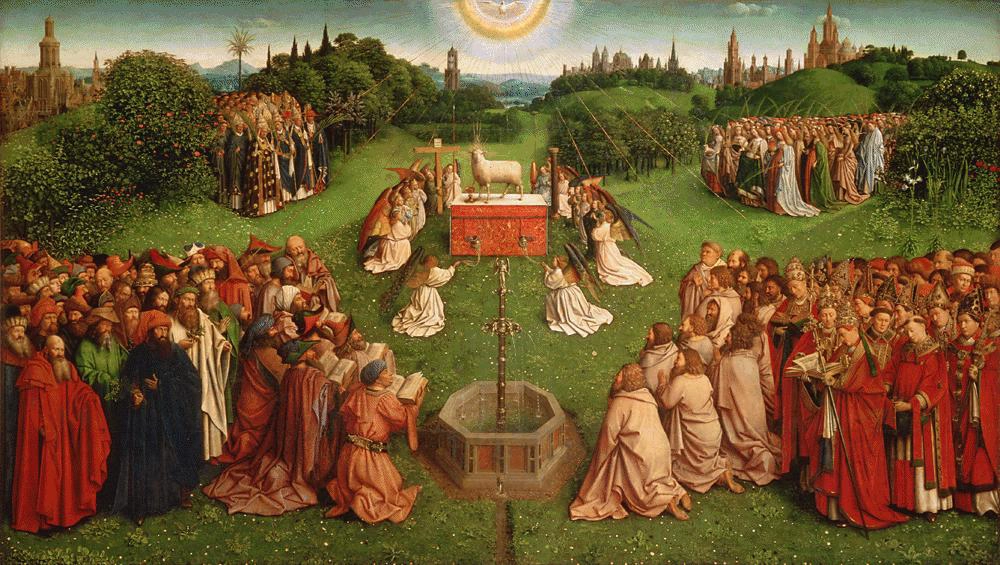
The Ghent Altarpiece, also called the Adoration of the Mystic Lamb, 1432, Jan van Eyck, Hubert van Eyck.
Some of you may have seen a famous painting, Adoration of the Mystic Lamb 1432, from a cathedral in Belgium. In it, people from every walk of life stand in a green field, all facing the same direction. At the centre is a Lamb. It is standing, alive, and from its chest blood flows into a cup on a small altar. No one is shouting. No one is pushing. Everything depends on that Lamb. Everyone is drawn towards it.
That is the Lamb John points to. The one who gives life by giving himself. The one who does not threaten or impress, but stands firm and lets others come close.
Returning to the Gospel, this Lamb stands in the water with everyone else. He does not stay apart. He steps into the river. He receives a baptism meant for repentance, though he has nothing to repent of. He waits his turn. John admits he did not recognise him at first. Knowing someone is not the same as understanding who they are. Only when the Spirit comes down and remains does John see clearly. The Spirit does not come and go. The Spirit stays.
Here we are invited to use our imagination. Stand by the Jordan. Feel the water around your feet. Hear the crowd talking. Watch Jesus move forward. Notice what happens inside you. Does his closeness make you feel at ease, or uneasy? Do you want him near, or at a safe distance? Pay attention to that response. God often speaks there.
This Lamb takes away sin by carrying it. He does not pretend it is harmless. He does not destroy those caught in it. He stays with it and bears it. He refuses to answer cruelty with cruelty or fear with fear. In places marked by corruption, violence, and exclusion, this way is slow and costly, but it is the only way that does not leave more damage behind.
And then the focus turns to us. If we recognise the Lamb, we cannot stay on the riverbank. Light received must be passed on. A sound heard must be followed. The servant’s work becomes ours, not to fix everything, but to stand where Christ stands, among those who are tired, ignored, or unsure. In universities where cynicism feels safer than hope, in parishes tempted to settle for comfort, in communities shaped by old wounds, the Lamb still walks ahead.
This path is not easy. It asks us to give up control, to be patient when results are slow, to choose mercy again and again. But it is the road that leads to life. As we come to the altar today, the Lamb given to us once more, let us listen carefully and trust him enough to move.
As we go into the week ahead, let us ask ourselves simply and honestly:
- Where am I being asked to slow down and really listen?
- Who near me needs presence more than advice?
- What small, real step can I take this week so that someone else is not left in the dark?
In preparing this homily, I consulted various resources to deepen my understanding of today’s readings, including using Magisterium AI for assistance. The final content remains the responsibility of the author.
← Back