
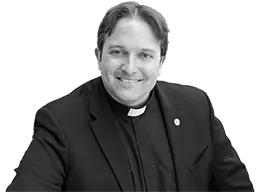
 Fr Matthew Charlesworth SJJesuit PriestSociety of JesusJesuit priest working in Southern AfricaFr. MatthewCharlesworthSJ
 Tuesday of the 2nd week in Ordinary Time
Date: | Season: Ordinary Time before Easter | Year: A
First Reading: 1 Samuel 16:1–13
Responsorial Psalm: Psalm 89:20–22, 27–28
| Response: Psalm 89:21a
Gospel Acclamation: Ephesians 1:17–18
Gospel Reading: Mark 2:23–28
Preached at: the Chapel of Emerald Hill Children’s Home in the Archdiocese of Harare, Zimbabwe.
Dear brothers and sisters,
Samuel is grieving, and God names it plainly. “How long will you mourn Saul?”, Not because grief is wrong, but because it can quietly fix our eyes on what is finished. Samuel’s sorrow has become a way of standing still. God sends him forward, not to a throne room but to a household, not to certainty but to discernment. The future will not be obvious. It will have to be recognised.
When Samuel arrives in Bethlehem, he does what experience has trained him to do. He looks for the tallest, the strongest, the one who looks the part. This is not foolishness. It is how leadership usually works. But God interrupts that logic with a correction that is meant to educate, not embarrass. You look at appearance. I look at the heart. This is not a rejection of judgement, but a warning about how easily judgement settles for what is visible and measurable.
One by one, the sons are presented. Each refusal narrows the field until Samuel is forced to ask a different kind of question. Is there anyone else. The answer is telling. There is one more, but he is with the sheep. David is not overlooked by mistake. He is occupied with work that is necessary and unremarkable. He is not preparing for greatness. He is being faithful where he is. When he is brought in, God does not hesitate. Anoint him. This is the one. David is chosen before he is ready, before he has proved anything, because God’s call does not reward achievement. It creates responsibility.
The psalm gives us language for this way of choosing. I have found David my servant. God finds him. David does not put himself forward. He does not claim a role. He receives one.
In the Gospel, the issue is not rebellion but interpretation. Jesus and his disciples are hungry. They pluck grain as they walk. The concern raised is about the Sabbath. At the time of Jesus, this was a serious and sincere question. Faithful Jews debated carefully what counted as work on the Sabbath, not to burden people, but to honour God. Over time, these interpretations became detailed and cautious, so that even small actions could be read as violations.
Jesus responds as a teacher within that tradition. He argues from Scripture, not against it. He recalls David eating the sacred bread because hunger does not become sinful because it occurs on the wrong day. Within Jewish thinking itself there was already an awareness that the preservation of life could take precedence over ritual restriction. Jesus brings that principle back into view.
When he says that the Sabbath was made for humanity, he is not weakening the law. He is clarifying its purpose. Rest is meant to restore life, not to supervise it. And when he says that the Son of Man is lord of the Sabbath, he is stating that God’s authority is exercised in favour of human dignity, not at its expense.
The saints we remember today lived with that same clarity. Saint Fabian did not seek leadership, but he accepted responsibility when it came. In a time of persecution, he did not adapt the faith to make it safer or quieter. He remained where he was placed, and that fidelity cost him his life.
Saint Sebastian lived under an authority that demanded total loyalty. He served without spectacle, supported those who were suffering, and refused to allow obedience to erase conscience. He did not seek confrontation, but when loyalty to Christ and loyalty to Rome came into conflict, the matter was settled without evasion.
David, the disciples, Fabian, Sebastian. None of them are judged by appearance or technical correctness, but by the orientation of the heart. God looks for fidelity rather than display. Law, rightly understood, protects that fidelity. When it ceases to do so, it must be read again in the light of life.
The Gospel’s lesson this morning is not dramatic. It is exacting. It teaches us how to see more accurately, how to interpret more carefully, and how to remain faithful without needing to be visible, impressive, or secure. It asks us to trust that God is at work not only in what is obvious, but in what is hidden and patiently lived.
As we turn to prayer, these questions may be worth pondering in our hearts.
- Where might I still be looking at appearances instead of the heart.
- When does my concern for order lose sight of life.
- And where am I being asked to remain faithful, simply and without display.
Source: https://sj.mcharlesworth.fr/homilies/2026-01jan-20-ya-ot-02/
This homily is shared for personal and pastoral use. Please attribute the author and do not alter the meaning when quoting. If you wish this homily to be translated - there is an option on the website which will allow you to translate it into the language of your choice.
Licenced under a Creative Commons Attribution-NonCommercial-NoDerivatives 4.0 International (CC BY-NC-ND 4.0) license.
The author does not speak for the Society of Jesus or for the Catholic Church.





In preparing this homily, I consulted various resources to deepen my understanding of today’s readings, including using Magisterium AI for assistance. The final content remains the responsibility of the author.