
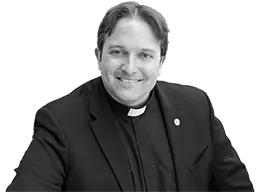
 Fr Matthew Charlesworth SJJesuit PriestSociety of JesusJesuit priest working in Southern AfricaFr. MatthewCharlesworthSJ
 Friday of the 2nd week in Ordinary Time
Date: | Season: Ordinary Time before Easter | Year: A
First Reading: 1 Samuel 24:3–21
Responsorial Psalm: Psalm 57:2–4, 6, 11
| Response: Psalm 57:2a
Gospel Reading: Mark 3:13–19
Preached at: the Chapel of Emmaus House in the Archdiocese of Harare, Zimbabwe.
Some of the most important moments in life are quiet ones. No audience. No applause. Just a choice made in the dark. Those moments shape who we are becoming.
David is in such a moment today. He is hiding in a cave, tired and hunted. Saul, the king who has been trying to kill him, walks in alone and defenceless. Outside are three thousand soldiers. Inside, David has the advantage. His men whisper what most people would say. This is your chance. End it now. They even dress their advice in religious language, as if the situation itself proves that God wants Saul dead.
David does not accept that reading. He has learned that not every opportunity is a command from God. He moves quietly, cuts off a corner of Saul’s cloak, then feels a sharp sense of unease. Even that small act feels wrong. The cloak stands for the man. To damage it is already to cross a line. David understands that if he kills Saul, he will win the throne but lose his soul. So he stops. He will not take power by violence. He leaves judgement to God.
Early Christians read this scene with deeper eyes. They saw the cave not only as a hiding place, but as something like a tomb. A place of darkness where death seems near. And yet, from that darkness comes mercy, not killing. Saul walks out alive. David walks out free. Life, not death, has the final word. In that sense, the cave quietly points forward to Christ’s tomb, where God will once again refuse to let violence have the last say.
This is why the psalm fits so well. I take refuge in you, Lord, until the storm passes. It is not the prayer of someone in control. It is the prayer of the Church, learning to trust God in the middle of danger. The psalm speaks of waking the dawn with praise. Even before things are resolved, worship continues. Faith does not wait for safety.
When Saul leaves the cave, David comes out, bows low, and speaks with respect. He shows the torn piece of cloth. Proof that he could have killed him but chose not to. Even Saul is shaken. He knows this kind of restraint is rare. In that world, and often in ours, enemies are finished off, not spared. David shows that mercy is not weakness. It is strength under control.
The Gospel takes us to another place of decision. Jesus goes up a mountain. In Scripture, mountains are places of prayer and listening. Like Moses before him, Jesus withdraws before acting. He prays. Then he calls those he wants. They do not choose him. He chooses them.
He chooses twelve, echoing the twelve tribes of Israel. God is gathering his people again. But notice who is chosen. Ordinary men. Mixed characters. People who will misunderstand, argue, deny, and one who will betray. Jesus knows this. Judas is not an accident. His presence tells us that God’s saving plan is not fragile. Even human failure is drawn into the larger mystery of Christ’s death and resurrection.
Before they are sent out to preach or heal, they are called simply to be with Jesus. That comes first. Relationship before mission. Prayer before action. This is how the Church is formed. Not by force or clever plans, but by people shaped slowly by staying close to the Lord.
Today the Church also remembers Mary and Joseph at the time of their betrothal. Joseph faces his own quiet crisis. He has the legal power to protect himself and expose Mary. Instead, he pauses. He listens. He chooses mercy before he understands everything. Like David, he refuses to act out of fear. That simple, hidden obedience makes room for God’s saving work to enter the world.
All of this speaks clearly to our own time. In Zimbabwe today, patience is thin. Pressure is heavy. When people feel trapped, the temptation is to cut corners, to justify harshness, to believe that the ends excuse the means. Scripture says otherwise. God does not need our violence, our dishonesty, or our bitterness to bring about his purposes. In fact, those things only deepen the wounds.
For us as Jesuits, this touches the heart of discernment. Not confusing opportunity with God’s will. Not acting from impulse or anger. Staying with the Lord long enough for our desires to be purified. Listening within the Church, not trusting only our own interpretations. David, Jesus, and Joseph all show the same discipline: they wait, they pray, they trust God with outcomes they cannot control.
There is also a wider horizon. The cave and the mountain both point beyond this life. God is our refuge now, and finally. The apostles, with all their flaws, are promised a place in God’s kingdom. That is hope for sinners like us. God does not wait for perfection before calling us. He calls us so that, over time, we may be changed.
So we take three questions into prayer this morning.
- Where might I be mistaking a convenient opportunity for God’s will?
- How am I making space simply to be with the Lord before trying to act for him?
- Who is God asking me to treat with mercy now, trusting him with the future?
Source: https://sj.mcharlesworth.fr/homilies/2026-01jan-23-ya-ot-02/
This homily is shared for personal and pastoral use. Please attribute the author and do not alter the meaning when quoting. If you wish this homily to be translated - there is an option on the website which will allow you to translate it into the language of your choice.
Licenced under a Creative Commons Attribution-NonCommercial-NoDerivatives 4.0 International (CC BY-NC-ND 4.0) license.
The author does not speak for the Society of Jesus or for the Catholic Church.




In preparing this homily, I consulted various resources to deepen my understanding of today’s readings, including using Magisterium AI for assistance. The final content remains the responsibility of the author.