
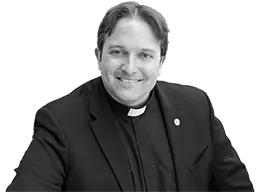
 Fr Matthew Charlesworth SJJesuit PriestSociety of JesusJesuit priest working in Southern AfricaFr. MatthewCharlesworthSJ
 Memorial of Sts Timothy and Titus, bishops
Date: | Season: Ordinary Time before Easter | Year: A
First Reading: 2 Timothy 1:1–8
(Proper)
Responsorial Psalm: Psalm 96:1–3, 7–8a, 10
(Proper) | Response: Psalm 96:3
(Proper)
Gospel Acclamation: 2 Timothy 1:10
Gospel Reading: Mark 3:22–30
Preached at: the Chapel of Emmaus House in the Archdiocese of Harare, Zimbabwe.
In this morning’s readings we meet a moment many of us recognise. You do something that loosens another person’s chains, something that gives back dignity or hope, and instead of thanks you meet suspicion. Motives are questioned. Labels are fixed. That is where today’s Gospel begins. Jesus has healed, freed, made room for life, and the scribes come down from Jerusalem with their judgement already formed. They say he is possessed. They say the good he does is driven by Beelzebul himself.
Jesus answers with calm and reason. A kingdom divided against itself cannot stand. Evil does not heal its own wounds. No one breaks into a strong man’s house unless the strong man has first been tied up. What they are seeing is not darkness dressed up as light, but light unbinding darkness. Their problem is not lack of evidence. It is refusal to see what is in front of them.
Then comes the hard saying about blasphemy against the Holy Spirit. This is not about passing doubt or words spoken in fear. It is about a resolute refusal. The Spirit is how God is present and at work in the world. To blaspheme the Spirit is to see God’s life-giving work and decide to call it evil, or pointless, or dangerous, and to refuse to recognise it for what it is. It is the slow closing of the inner door. God does not refuse forgiveness. Forgiveness waits. But love does not force its way in. A heart locked tight cannot be healed from the outside.
This danger did not belong only to the scribes. It appears whenever religious life becomes defensive rather than discerning, when control replaces trust, when certainty drowns out listening. In Zimbabwe today, many people are tired of promises and wary of words. Yet grace still shows itself in small, stubborn ways: women organising food together, young people teaching one another skills, parishes holding on despite shortage and strain. The temptation is to dismiss these signs as too small, too political, too untidy. Jesus’ warning remains both sharp and kind. Be careful what you name as suspect. You may be naming the work of the Spirit.
This brings us to Saints Timothy and Titus. They belong to the fragile first generation after the apostles. Paul was gone or nearly gone. The Church was young, scattered, and open to division. Timothy was sent to Ephesus, a busy city full of competing ideas. Titus was sent to Crete, known even then for its rough independence and loose morals. Neither task was easy. Neither man was chosen because he was forceful or imposing. Timothy seems to have been young and hesitant. Titus was trusted as a steady organiser, someone who could hold people together without crushing them.
The letters show a Church learning how authority could be exercised in communion, with real leadership grounded in listening and prayer. Authority was being shared, not guarded. Leadership was becoming local and communal. Elders were appointed not as lone rulers, but as servants, keeping communities faithful and united. Timothy is reminded that the gift he received was not fear, but strength shaped by love and self-control. Titus is asked to bring order, not by silencing local voices, but by helping many voices become one witness.
This matters for us now. The Church’s move towards greater synodality is not a new fashion. It is a return to this early way of being Church. Walking together. Listening carefully. Deciding prayerfully. Synodality is not endless talk, and it is not the hierarchy stepping aside from its responsibility. It is the proper way for leaders to exercise their task: by listening deeply, praying honestly, and receiving confirmation through the faith of the people of God. Timothy and Titus did not lead by command alone. They listened, encouraged, corrected, and trusted that God was already at work among the people. Their task was not to replace the Spirit, but to recognise the Spirit and act in faith.
For a Jesuit community, this should sound familiar. Ignatian spirituality resists haste and suspicion. It teaches us to notice movements of the heart, to test spirits gently, to trust that God works through prayer, conversation, and shared reflection, and that in prayer, confirmation will come. Synodality rests on the same confidence. The strong man has already been bound, even when fear, poverty, and mistrust still shout loudly. We do not need to clutch control in order to remain faithful.
Let us picture the scene once more. Jesus stands in the middle of accusation and misunderstanding, free and unafraid. Timothy and Titus stand in uncertain communities, learning how to lead without dominating. The same Spirit breathes through all of it. The real danger is not failure or weakness, but refusing to see that breath when it comes.
As we take this into our prayer today, I leave you with three questions.
- Where might I be confusing caution with faithfulness, or control with care, and so resisting the Spirit’s quiet work?
- Whose voice in our community or in our society am I tempted to dismiss rather than to listen to, especially when it comes from the margins?
- What gift of leadership or service has God placed in me, not for my own standing, but for the building up of others, that I am being asked to use with trust and humility today?
Source: https://sj.mcharlesworth.fr/homilies/2026-01jan-26-ya-ot-03/
This homily is shared for personal and pastoral use. Please attribute the author and do not alter the meaning when quoting. If you wish this homily to be translated - there is an option on the website which will allow you to translate it into the language of your choice.
Licenced under a Creative Commons Attribution-NonCommercial-NoDerivatives 4.0 International (CC BY-NC-ND 4.0) license.
The author does not speak for the Society of Jesus or for the Catholic Church.





In preparing this homily, I consulted various resources to deepen my understanding of today’s readings, including using Magisterium AI for assistance. The final content remains the responsibility of the author.