
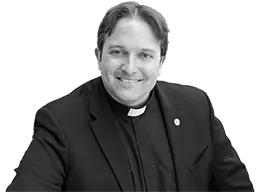
 Fr Matthew Charlesworth SJJesuit PriestSociety of JesusJesuit priest working in Southern AfricaFr. MatthewCharlesworthSJ
 Tuesday of the 3rd week in Ordinary Time
Date: | Season: Ordinary Time before Easter | Year: A
First Reading: 2 Samuel 6:12b–15, 17–19
Responsorial Psalm: Psalm 24:7–10
| Response: Psalm 24:8
Gospel Acclamation: Matthew 11:25
Gospel Reading: Mark 3:31–35
Preached at: the Chapel of Emmaus House in the Archdiocese of Harare, Zimbabwe.
David does not march into Jerusalem as a hero. He is dancing. His dancing is not for show. It is what happens when fear loosens it’s grip. For a long time, the Ark had stayed where it was, and David carried the memory of what went wrong. Now he sees that the road is open again. God has not turned away. Relief and trust move through him, and his body says what his words cannot.
What David is given here is consolation, not excitement, but the quiet knowledge that God has not withdrawn. This is the seccond attempt to bring the Ark home. The first ended in shock. David learned then that God cannot be handled or rushed. This time the Ark is carried on human shoulders. After only a few steps, sacrifice is offered. The pace is slow. Nothing is forced. Somewhere along that road, tension eases. David stops guarding himself. He dances because he knows again where he stands with God.
His dancing is not accidental. It is chosen. It comes from knowing that God is present and that the people are not abandoned. The joy is steady and real. David does not protect his status or his image. He lets himself be seen as he is. God is near, and that is enough.
The psalm today gives words to that moment. “Lift up your heads, O gates… that the King of glory may come in.” As the Ark enters the city, the gates open for God, not because God needs permission, but because the people are ready to receive him. David dances because the King of glory is not distant. He is coming among them.
This is something the African Church understands deeply. When we dance in worship, we are not entertaining God. We are praying with our whole bodies. Feet, hands, voices, breath all join the praise. Like David, we dance not to draw attention to ourselves, but because God is close. In a land that has known struggle and loss, that dance becomes an act of faith. It says that God has not abandoned us. It says that joy still has a place among us.
The Ark was kept in a tent, a fragile shelter for a holy mystery. It was a sign that God chose to stay close to a people who were still learning how to live the covenant. God travelled with them, sharing their uncertainty and their hope. That same pattern runs through our faith. God does not remain distant. God chooses closeness, even vulnerability. Our tabernacles still echo that truth. But the deeper challenge is this. If God chooses to dwell among us, then God’s presence must also be recognised in people, especially where life is wounded or pushed aside.
That is what the Gospel brings into focus. Jesus is teaching inside a crowded house. His family stands outside, calling for him. They want him back in familiar territory, back within safe boundaries. Jesus does not reject them, but he widens the meaning of belonging. He looks at those listening and says that family is not decided by blood or background, but by doing the will of God. To belong to him is not about origin. It is about response.
This is not a rejection of Mary. She stands at the very heart of what Jesus means. Her yes to God was not spoken once and forgotten. It shaped her whole life. She stayed faithful through confusion, danger, silence, and grief. She belongs because she trusted God’s promise and never withdrew her consent. In that sense, she mirrors David’s second journey. Both learned that faithfulness is not about control, but about staying open to God’s way.
Today, this image of inside and outside meets a solemn memory. We remember the victims of the Holocaust. We remember Jewish men, women, and children who were forced outside the human family and destroyed by hatred. The Church is clear. Antisemitism is a sin against God and against humanity. Jesus himself was Jewish. Our faith is rooted in God’s covenant with Israel, a covenant God has not withdrawn.
At the same time, we must speak carefully and honestly. Rejecting antisemitism does not mean turning land, nation, or power into something holy. It does not mean blessing any form of nationalism that closes itself off or justifies the suffering of others. God does not belong to one people alone. Whenever religion is used to draw hard borders, to exclude, or to deny dignity, we have stepped away from the way of Jesus. The will of God is known by its fruits. Justice, mercy, and care for the vulnerable.
That challenge is close to home. In Zimbabwe, many feel forgotten. Resources are stretched. Families are under strain. It is easy to pull back, to look after only our own. Jesus offers another way. He invites us into a family shaped not by fear, but by faithfulness. A family where listening leads to action, and action leads to life.
St Angela Merici lived this way. She trusted that God works through ordinary people in ordinary places. She gathered women and formed them not behind walls, but in the middle of everyday life. From that vision came the Ursulines, devoted to educating girls who were often overlooked and given little chance. Angela believed that quiet faithfulness, lived together, could change the world. She did not seek control or recognition. She sought to do the will of God, one careful step at a time. What begins as careful steps becomes freedom of movement. When people know that God is with them, they do not need to tighten their grip. They can move, give, and make space. That is how trust shows itself.
So today’s image is simple and strong. A slow procession. Careful steps. A people who dance because God is near. A circle that keeps widening.
As we carry this word into the week ahead, let us pray with three questions, in the spirit of Ignatius.
- Where am I still trying to control God instead of trusting God?
- Who might I be keeping outside the circle through fear, habit, or silence?
- What small act of justice or mercy is God asking of me now?
Lord, teach us David’s joy, Mary’s yes, and Angela’s faithful steps. Open our circle and keep us close to your will. Amen.
Source: https://sj.mcharlesworth.fr/homilies/2026-01jan-27-ya-ot-03/
This homily is shared for personal and pastoral use. Please attribute the author and do not alter the meaning when quoting. If you wish this homily to be translated - there is an option on the website which will allow you to translate it into the language of your choice.
Licenced under a Creative Commons Attribution-NonCommercial-NoDerivatives 4.0 International (CC BY-NC-ND 4.0) license.
The author does not speak for the Society of Jesus or for the Catholic Church.





In preparing this homily, I consulted various resources to deepen my understanding of today’s readings, including using Magisterium AI for assistance. The final content remains the responsibility of the author.