
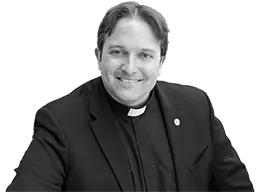
 Fr Matthew Charlesworth SJJesuit PriestSociety of JesusJesuit priest working in Southern AfricaFr. MatthewCharlesworthSJ
 Memorial of Sts. Paul Miki, Religious, and Companions; Bl. Charles Spinola, Sebastian Kimura, Priests, and Companions; Bl. Peter Kibe Kasui, Priest, and Companions, Martyrs
Date: | Season: Ordinary Time before Easter | Year: A
First Reading: Sirach 47:2–11
Responsorial Psalm: Psalm 18:31, 47, 50–51
| Response: Psalm 18:47b
Gospel Acclamation: Luke 8:15
Gospel Reading: Mark 6:14–29
Preached at: the Chapel of Emmaus House in the Archdiocese of Harare, Zimbabwe.
Before the party even begins, it helps to remember who Herod is. This is Herod Antipas, not a great king but a client ruler, dependent on Rome, anxious about his position, skilled at survival rather than leadership. He lives close to power but never fully secure in it. He fears the crowd, Rome, and above all the loss of face. Into that anxious space steps John the Baptist, speaking plainly about right and wrong, about marriage, about repentance. It is that kind of truth, spoken without flattery, that unsettles Herod most.
It begins, as so much trouble often does, with a party. Music in the background, wine poured freely, laughter growing louder as the night wears on. Herod wants to impress. He wants to look generous, powerful, admired. Instead, he ends up trapped by his own pride. A promise slips out before his conscience can catch up. And while the celebration carries on upstairs, John the Baptist sits below, in a dark cell, alone with God and the truth he has already spoken.
That is the Gospel scene this morning. Not thunder or miracles, but discomfort. Herod knows John is a righteous man. He senses that John speaks for God. He listens, even protects him for a while. But admiration is not conversion. When the moment comes to choose, Herod chooses his reputation over his integrity. He would rather silence a prophet than risk embarrassment in front of his guests. It is an uneasy mirror. How often do we read the room before we listen to our conscience, adjusting our words so that we can keep our place at the table?
Sirach sets another life alongside this one. David also lived close to power, sometimes dangerously close. Yet he is remembered here not first as king or warrior, but as a shepherd chosen by God. His hands learned the harp before they held a sword. Praise shaped him before command did. When danger came, his strength did not come from being admired or feared, but from knowing who had called him and who sustained him.
The psalm gives the heart of the matter in plain speech. The Lord is our rock and our refuge, the one who saves. Not applause. Not status. Not being seen to succeed. God alone.
The martyrs we remember this morning lived that truth in different ways, at different moments, but with the same freedom. Paul Miki, a Jesuit scholastic born in Japan, was crucified on a hill overlooking Nagasaki in 1597. From the cross, he preached calmly, forgiving those who were killing him and professing his faith in Christ. His witness was public, spoken aloud, offered in full view of the crowd.
Others lived their fidelity more quietly and for much longer. Charles Spinola arrived in Japan full of hope, only to spend years imprisoned, weakened by hunger and mistreatment, constant in prayer and in care for those around him, until he was finally executed. Sebastian Kimura served patiently as a priest, knowing the risks, remaining with his people until arrest and death came. Peter Kibe Kasui belonged to a later generation. Trained abroad, he chose to return secretly to Japan, disguised and hunted, enduring severe torture rather than deny Christ. Their paths were not the same. Some died quickly, others slowly. Some spoke before crowds, others suffered in hidden cells. What united them was not a taste for heroism, but a decision made long before the end about where their lives belonged. Herod’s banquet ended in silence and blood, his promises dissolved by morning. Their witness, born in cells and on crosses, still speaks.
Ignatius would invite us to pause here and imagine. Stand with one of them. Perhaps with Paul Miki on the cross, the wind off the sea, the murmur of the crowd below. Or with Charles Spinola in a dark prison, body failing, prayer still alive. Notice the fear that must have been there. Then notice something deeper still. There is a quiet freedom. No bargaining. No performance. No need to manage appearances. They are free because they are no longer negotiating with the truth. Their confidence is not in survival, but in Christ, who loosens fear’s grip. Life rests in God’s hands, our rock who saves, and nothing essential can be taken away. Ask what desire is strongest in that place: the desire to survive, to be admired, or to belong wholly to Christ.
After the martyrs came a long silence. The priests were gone, the sacraments vanished, public worship disappeared. If you have seen the film Silence (based on Endō’s book of the same name), you glimpse something of that cost and confusion. And yet the faith did not die. Ordinary believers, later called the hidden Christians, kept praying, baptising their children, passing on the name of Jesus and the memory of Mary for generations without priests or churches. Almost everything was taken away, but not what mattered most. Truth, once received, proved stronger than fear, and faith endured not by spectacle, but by quiet fidelity.
Most of us will never face a cross or a torture chamber. But we know the smaller tests well. The moment when honesty costs comfort. The choice to stay silent because speaking feels risky. In religious life, and especially within Jesuit communities, it can be tempting to value smooth relationships over difficult truth, discretion over discernment. We know the pull of harmony, the desire not to unsettle the room. Like Herod, we can recognise what is right and still step away from it.
The martyrs remind us that courage is not improvised. It grows slowly, through prayer, through friendship with Christ, through ordinary, faithful decisions made when no one is watching. David learned it with a harp in his hands. John the Baptist lived it in the quiet of a prison cell. The Christians of Japan learned it in hidden communities, over years of risk and trust, long before the final moment arrived.
God does not ask us to be fearless. He asks us to be faithful. And he promises to be our stronghold when the voices around us grow loud and demanding.
As we pray this morning, let us sit with these questions:
- Where am I choosing silence because I fear losing approval or comfort?
- What habits are shaping my freedom, and which are quietly shrinking it?
- When I listen beneath the noise of expectation, whose voice am I really following?
Source: https://sj.mcharlesworth.fr/homilies/2026-02feb-06-ya-ot-04/
This homily is shared for personal and pastoral use. Please attribute the author and do not alter the meaning when quoting. If you wish this homily to be translated - there is an option on the website which will allow you to translate it into the language of your choice.
Licenced under a Creative Commons Attribution-NonCommercial-NoDerivatives 4.0 International (CC BY-NC-ND 4.0) license.
The author does not speak for the Society of Jesus or for the Catholic Church.




In preparing this homily, I consulted various resources to deepen my understanding of today’s readings, including using Magisterium AI for assistance. The final content remains the responsibility of the author.