
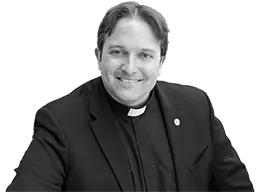
 Fr Matthew Charlesworth SJJesuit PriestSociety of JesusJesuit priest working in Southern AfricaFr. MatthewCharlesworthSJ
 Monday of the 5th week in Ordinary Time
Date: | Season: Ordinary Time before Easter | Year: A
First Reading: 1 Kings 8:1–7, 9–13
Responsorial Psalm: Psalm 132:6–10
| Response: Psalm 132:8a
Gospel Acclamation: Matthew 4:23
Gospel Reading: Mark 6:53–56
Preached at: the Chapel of Emmaus House in the Archdiocese of Harare, Zimbabwe.
In our readings this morning we hear how the priests have to stop because God’s presence fills the Temple, while in the Gospel people press forward just to touch the edge of Jesus’ clothing. Ignatius would invite us not to rush past these scenes, but to stand inside them, to notice what stirs in us, and to ask whether this nearness of God brings consolation, or whether it meets some quiet resistance in our hearts.
In the first reading, we hear how they carried the Ark slowly that day, not because the distance was long or because the stone tablets were heavy, but because God’s presence was becoming unmistakably real. When the Ark was placed in the heart of the Temple, the cloud came down and filled the space so completely that the priests could not continue their rituals. God’s presence interrupted even the work being done for God.
That cloud is not meant to confuse or frighten us. In the Scriptures it is how God’s glory is shown. It is God’s weight, God’s reality pressing into the world. The same cloud appeared on Mount Sinai and filled the tent in the desert. Now it fills the Temple. It shows that God is truly present, but it also reminds the people that God cannot be controlled, explained, or used. Like a cloud, it reveals itself while also concealing what lies within. Solomon puts it plainly. The Lord chooses to dwell in thick darkness. God is close, but never at our disposal.
The psalm turns this truth into prayer. Rise up, O Lord, and go to your resting place, you and the ark of your might. Let your priests be clothed with righteousness. Let your faithful shout for joy. God’s presence is not just something to admire. It calls for lives shaped by faithfulness, justice, and joy.
The Church has carried this understanding across the centuries. A medieval spiritual writer spoke of prayer as entering The Cloud of Unknowing, not because God is absent, but because God is always greater than our ideas. Ignatius would say something similar in his own way. When prayer draws us outward in trust, generosity, and service, that movement comes from God. When it closes us in on fear or control, something else is at work.
Then the Gospel shows us a change. There is no cloud. There is no Temple. Instead there is a shoreline, a crowd, and sick people lying on mats. Mark draws our attention to a small but important detail. They ask to touch not just Jesus’ cloak, but the tassels on it.
Those tassels were required by the Law, as God commanded through Moses (Numbers 15:37–40; Deuteronomy 22:12). They were sewn onto the corners of a Jewish garment, with a blue thread running through them. As the person walked, the tassels brushed against the body. They were meant to remind the wearer, again and again, to remember God’s commandments, to remember who they belonged to, and to live faithfully. The blue thread pointed the heart toward heaven.
Jesus wears them. That matters. He does not set the Law aside. He lives it fully and quietly, without turning it into a burden for others. When people reach out to touch the tassels, they are not looking for magic. They are reaching for a life they recognise as faithful and close to God.
Earlier in the Gospel, a woman who had been bleeding for many years touched Jesus’ garment and was healed. Jesus told her that her faith had saved her. Mark uses the same word here. It means both to heal and to save. People are not only cured physically. They are restored to dignity, to relationship, to life.
This shows us where the cloud has gone. In the Old Testament, God’s glory fills a place so strongly that people have to step back. In the Gospel, that same glory is present in a human life so fully that people can come close and be healed. The mystery has not disappeared. It has come nearer.
This matters for us. We no longer look for God only in buildings or dramatic signs. We look for God where people are being cared for, lifted up, and restored. In Zimbabwe today, many people carry heavy burdens quietly. They are not asking for explanations. They are reaching out for signs that faith is real and can be trusted.
In a few moments we will come forward to receive Christ in the Eucharist. As the tassels brushed against the body day after day, reminding a faithful Israel of God’s covenant, so Christ touches us here. Not explained. Not controlled. Simply given.
As we pray this morning, here are three questions to ponder:
- Where in my life am I being invited to trust a God I cannot fully control?
- What daily habits quietly shape my faith so that others can rely on it?
- When people reach out to me in need, what do they actually find?
Source: https://sj.mcharlesworth.fr/homilies/2026-02feb-09-ya-ot-05/
This homily is shared for personal and pastoral use. Please attribute the author and do not alter the meaning when quoting. If you wish this homily to be translated - there is an option on the website which will allow you to translate it into the language of your choice.
Licenced under a Creative Commons Attribution-NonCommercial-NoDerivatives 4.0 International (CC BY-NC-ND 4.0) license.
The author does not speak for the Society of Jesus or for the Catholic Church.





In preparing this homily, I consulted various resources to deepen my understanding of today’s readings, including using Magisterium AI for assistance. The final content remains the responsibility of the author.