
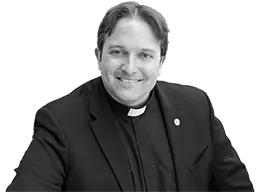
 Fr Matthew Charlesworth SJJesuit PriestSociety of JesusJesuit priest working in Southern AfricaFr. MatthewCharlesworthSJ
 Thursday of the 5th week in Ordinary Time
Date: | Season: Ordinary Time before Easter | Year: A
First Reading: 1 Kings 11:4–13
Responsorial Psalm: Psalm 106:3–4, 35–37, 40
| Response: Psalm 106:4a
Gospel Acclamation: James 1:21bc
Gospel Reading: Mark 7:24–30
Preached at: the Chapel of Emmaus House in the Archdiocese of Harare, Zimbabwe.
Brothers and sisters,
If you ever walk on a hill and look down at a city, you can see everything at once. The roads, the houses, the churches, the markets. In Solomon’s time there was a hill facing Jerusalem. On one side stood the Temple, the place built for the living God. On the other side, Solomon built shrines to foreign gods.
Imagine that. The Temple shining in the sun. And just across from it, smoke rising to idols.
Solomon did not start out badly. When he was young, God asked him what he wanted. He asked for wisdom. Not money. Not fame. Not military power. Wisdom. God was pleased. But as he grew older, Solomon married many foreign women for political reasons. Slowly, he began to worship their gods. He built shrines for them. He tried to keep everyone happy.
That is how it happens. No one wakes up and says, “Today I will betray God.” It begins small. A compromise. A choice that seems harmless. A way to fit in. Solomon did not lose his kingdom in one day. He drifted.
One of those false gods, Molech, was worshipped with child sacrifice. That is how serious idolatry becomes. When we worship the wrong thing, someone pays the price. In our country today, the idols are not statues. They are money without honesty. Power without service. Tribal pride without unity. When leaders choose corruption, children go hungry. When adults choose selfishness, the young lose hope. Every false god still demands a victim.
Solomon had great intelligence, but he could not control his heart. He let his desires and his politics lead him. God told him the kingdom would be divided. Not completely, because God was still faithful to his promise to David. But there would be consequences. Choices matter.
Now look at the Gospel. Jesus goes into Tyre, a Gentile area. He wants some quiet. But a mother finds him. Her daughter is very sick. She falls at his feet and begs.
Jesus says something that sounds hard. “Let the children be fed first. It is not right to take the children’s food and throw it to the dogs.” In those days, Jews sometimes spoke of Gentiles in that way. It reflected a deep divide. Israel saw itself as God’s children. Others were outsiders.
Here we need to be careful. Jesus is true God and truly human. He grew up in a Jewish village. He learned its language, its humour, its habits. His mission was first to Israel. When he speaks about children and dogs, he is naming the real tension of his time. But this moment does not end with a wall. It becomes a doorway.
The woman’s reply is more than clever. She stands there not as an argument, but as a mother. She does not deny who she is. She does not pretend to be someone else. She simply asks for mercy. “Even the dogs under the table eat the children’s crumbs.”
In that moment, we see something beautiful. Jesus does not cling to a boundary. He recognises faith. He recognises love. He recognises trust. What could have stayed a cultural divide becomes an opening. Jesus shows why he has come, not to protect old lines, but to stretch them wide. The mercy of the Father is bigger than anyone expected.
Her daughter is healed.
Now place the two stories side by side. Solomon had everything and drifted away from God. This woman had almost nothing, yet she moved closer. Solomon built altars on a hill. She knelt on a floor. Solomon tried to manage politics. She trusted.
It is worth asking: who or what truly has first place in my heart? When I make decisions, what matters most to me? Success? Approval? Comfort? Control?
Look at your daily choices. Where do you give your best attention? What do you get most upset about losing? What fills your daydreams? These quiet details tell the truth. They show where your altar stands.
The real question is not simply whether I say I believe in God. The real question is what I actually live for. What shapes my decisions? What do I fear losing? What do I chase after? The heart slowly bends towards whatever it loves most.
In Zimbabwe today we need people who will not drift like Solomon. We need people who will not bow to the idols of corruption or tribal hatred. We need people who will widen the table, not shrink it.
In prayer this week, imagine standing on that hill near Jerusalem. Look at the Temple. Then look at the shrines. Which one is stronger in your life?
Then imagine yourself as that mother. Kneeling before Jesus. What are you asking for? Are you ready to trust him fully?
Here are three questions to take into your prayer this morning:
- What small compromise am I allowing in my life right now?
- Who do I treat as if they do not belong?
- What is one honest prayer I need to keep saying to Jesus, even if the answer takes time?
Source: https://sj.mcharlesworth.fr/homilies/2026-02feb-12-ya-ot-05/
This homily is shared for personal and pastoral use. Please attribute the author and do not alter the meaning when quoting. If you wish this homily to be translated - there is an option on the website which will allow you to translate it into the language of your choice.
Licenced under a Creative Commons Attribution-NonCommercial-NoDerivatives 4.0 International (CC BY-NC-ND 4.0) license.
The author does not speak for the Society of Jesus or for the Catholic Church.





In preparing this homily, I consulted various resources to deepen my understanding of today’s readings, including using Magisterium AI for assistance. The final content remains the responsibility of the author.