
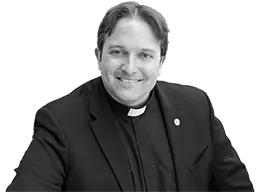
 Fr Matthew Charlesworth SJJesuit PriestSociety of JesusJesuit priest working in Southern AfricaFr. MatthewCharlesworthSJ
 Friday of the 5th week in Ordinary Time
Date: | Season: Ordinary Time before Easter | Year: A
First Reading: 1 Kings 11:29–32, 12:19
Responsorial Psalm: Psalm 81:10–11b, 12–15
| Response: Psalm 81:11a, 9a
Gospel Acclamation: Acts 16:14b
Gospel Reading: Mark 7:31–37
Preached at: the Chapel of Emmaus House in the Archdiocese of Harare, Zimbabwe.
This morning we hear how a kingdom can fall apart because a king will not listen; and how a man can be made whole because he learns to hear. Between a torn cloak and opened ears lies the choice before us today: to harden our hearts and live divided, or to let Christ open us and hold us together.
In the first reading the prophet Ahijah meets Jeroboam outside Jerusalem. He is wearing a new cloak. Without a speech, without a crowd, he tears it into twelve pieces. Ten pieces he gives to Jeroboam. One he leaves for the house of David.
The kingdom did not collapse in a single day. Its roots lay earlier, in Solomon’s divided heart. He built the Temple, yes. But he also built altars to other gods. He prayed, but he also compromised. He loved the Lord, but not with his whole heart.
What Ahijah enacted in symbol later unfolded in history, as he had warned, and as history later showed when Rehoboam ignored sound advice. The elders urged patience and mercy. They told him to lighten the burden on the people. But he chose the harsher voices. He chose pride over prudence. And in that refusal to listen, the kingdom split. A failure to hear became a fracture that lasted generations.
A divided heart leads to a divided people.
The psalm today sounds like a father speaking to stubborn children. “Listen to me. I am the Lord your God. Open your mouth and I will fill it.” It is simple. Listen. Trust. Obey. But they would not listen. So God says he let them follow their own plans.
We know what that looks like. We have seen it in our country. We have seen leaders speak of unity while protecting their own power. We have seen money meant for clinics and schools diverted to tighten control and shield those in office from the very people they are meant to serve. We have seen graduates with good degrees standing on street corners selling airtime because there is no work. We have seen families divided by politics, suspicion, and fear.
When we stop listening to God and to one another, the fabric tears. Tribe against tribe. Party against party. Rich against poor.
Now the Gospel shifts the scene. We are far from Jerusalem, in Gentile territory, at the Decapolis. Some people bring to Jesus a man who cannot hear and can barely form words. They beg him to lay his hand on him.
Jesus does something striking. He leads the man away from the crowd. He stands close to him. He places his fingers in the man’s ears. He touches his tongue with spittle. He looks up to heaven, sighs, and speaks one word in his own language: Ephphatha. Be opened.
And immediately the man hears. Immediately his speech becomes clear.
Notice the link between the two readings. In the first, the kingdom is torn because a king would not listen. In the Gospel, a man is healed when his ears are opened. Listening holds things together. Refusing to listen breaks them apart.
Ignatius asks us to listen closely in prayer. In imaginative contemplation he invites us to watch Jesus, to hear his voice. Today, imagine yourself as that deaf man. Feel the touch of Christ. Hear him say, Be opened.
Let us ask ourselves: Where am I not listening? Where have I closed my ears because the truth is uncomfortable? Where have I decided too quickly that I already know enough? Where is God speaking, and I am not paying attention?
But notice the tongue too. The man hears, and then he speaks plainly. Christ does not open our ears so that we may become quiet observers. He opens them so that we may become truthful witnesses. In a world where many stay silent to protect themselves, the disciple is called to speak with courage and charity, to defend the vulnerable, and to work for reconciliation.
If we do not listen deeply, we will speak shallow words. If we truly listen, our speech will change.
The torn cloak in the first book of Kings is a warning. The opened ears in Mark are a promise.
Christ is still saying Ephphatha to his Church in Zimbabwe. Be opened. Open your ears to my Word. Open your ears to the poor. Open your ears to one another. Open your mouth to speak truth with charity. Open your mouth to defend the dignity of those who are overlooked.
If we let him open us, the torn fabric can be stitched. Not by slogans. Not by power. But by converted hearts.
As we pray this morning, take these questions into your prayer:
- Where have I stopped listening, either to God or to someone close to me?
- What hard truth am I avoiding speaking, out of fear or comfort?
- What small step can I take this week to help mend a tear in my community or in our country?
Lord, say Ephphatha to our Church and nation: open what is closed, that we may hear, speak, and unite in your love. Amen.
Source: https://sj.mcharlesworth.fr/homilies/2026-02feb-13-ya-ot-05/
This homily is shared for personal and pastoral use. Please attribute the author and do not alter the meaning when quoting. If you wish this homily to be translated - there is an option on the website which will allow you to translate it into the language of your choice.
Licenced under a Creative Commons Attribution-NonCommercial-NoDerivatives 4.0 International (CC BY-NC-ND 4.0) license.
The author does not speak for the Society of Jesus or for the Catholic Church.





In preparing this homily, I consulted various resources to deepen my understanding of today’s readings, including using Magisterium AI for assistance. The final content remains the responsibility of the author.