
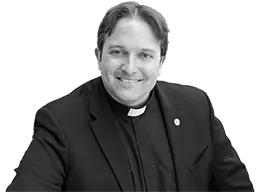
 Fr Matthew Charlesworth SJJesuit PriestSociety of JesusJesuit priest working in Southern AfricaFr. MatthewCharlesworthSJ
 Memorial of Sts Cyril, monk, and Methodius, bishop
Date: | Season: Ordinary Time before Easter | Year: A
First Reading: 1 Kings 12:26–32, 13:33–34
Responsorial Psalm: Psalm 106:6–7b, 19–22
| Response: Psalm 106:4a
Gospel Acclamation: Matthew 4:4b
Gospel Reading: Mark 8:1–10
Preached at: the Chapel of Emmaus House in the Archdiocese of Harare, Zimbabwe.
Every one of us builds something to feel safe. A plan. A structure. A circle we can manage. Today the Scriptures ask a simple question. When pressure comes, do we tighten our grip out of fear, or do we open our hands in trust? One path tries to control God and people. The other trusts God and feeds those who are faint on the road. That choice shapes kingdoms, communities, and our Jesuit life in Zimbabwe now.
Jeroboam’s problem was political. The kingdom had split. He ruled the north. Rehoboam ruled in the south, where Jerusalem and the Temple stood. Three times a year the people were meant to go to Jerusalem for the great feasts. That meant Jeroboam’s subjects would cross into his rival’s territory to pray. Their religious loyalty might slowly become political loyalty.
He feared losing his throne. God had promised him security if he remained faithful. But promise requires trust, and trust felt dangerous.
So he built alternative centres of worship at Bethel and Dan, marking the borders of his kingdom. As if to say: this is far enough. Worship will stay within our territory. God will stay within our system.
He set up golden calves. Not because he wanted new gods, but because the calf was a familiar symbol of divine strength in the surrounding cultures. He even used the words once spoken at Sinai: “Here are your gods who brought you up out of Egypt.” The old sin returned in a new form. When trust weakens, we reach for something we can see.
Jeroboam was not rejecting the Lord outright. He was reshaping worship to secure himself. He appointed his own priests. He created his own feast. He even offered sacrifice himself. The more anxious he became, the more control he gathered.
Scripture says simply, “This thing became a sin.” He adjusted the worship of the living God to serve his fear. He trusted strategy more than covenant.
The psalm explains it: “They forgot the God who had saved them.” When memory fades, substitutes appear.
We know this temptation. In Zimbabwe, where politics and religion easily mix, where many young people struggle for work and dignity, there is pressure to align faith with power or to soften it for safety. Even as a small Jesuit community, we can be tempted to protect structures and influence. Jeroboam’s pressure was real. But his solution hollowed out the faith he meant to defend.
Then we move to the wilderness. Four thousand people. Three days. No food. This time largely Gentile territory. Jesus crosses boundaries. He gathers those who are far off. “I have compassion for the crowd… if I send them away hungry, they will faint on the way.”
Jeroboam saw a threat. Jesus sees hunger.
The disciples ask the practical question: “How can one feed these people with bread here in the desert?” It is our question too.
In The Chosen, the scene simply shows what Mark describes. The disciples count the loaves. Jesus breaks the bread and places it in their hands. They expect it to run out. Instead, there is more. It multiplies as it is given. The miracle unfolds through hands that are still learning to trust.
Mark tells us that Jesus takes the seven loaves, gives thanks, breaks them, and gives them to the disciples to distribute. He does not feed the crowd alone. What comes from him passes through them. All eat. All are satisfied. There is abundance.
Then he sends them away and gets into the boat. No spectacle. No self-promotion. The people were fed. That was enough.
The detail about the road matters. Jesus worries that they will faint “on the way”. Faith is not a moment. It is a journey. Our country is on a journey. Our vocation is a journey. Some stretches are dry and demanding. Energy runs low. Hope feels fragile.
In The Lord of the Rings, the Fellowship are given lembas, a simple waybread. Small and plain, yet enough for a day’s march. It does not remove danger. It gives strength for the next step. That is what Jesus is doing. He feeds people for the road.
The Eucharist is our waybread. It looks small. It seems insufficient. Yet it sustains. It keeps us from collapsing on the road of service and justice.
Notice how the miracle happens. The bread passes from hand to hand. No one eats alone. The gift is shared, and so is the responsibility.
Here the Church learns synodality at its source. Not as a slogan. Not as another committee. But as a way of walking together under Christ. Listening. Discerning. Serving side by side. Authority as service. Each one involved.
Jeroboam concentrated worship around himself. Jesus entrusts the work to his friends. He allows grace to pass through imperfect hands.
In a society where many feel unheard, this matters. If we are to feed people on the road, we must also walk with them on the road. Synodality begins there. Not in documents, but in shared listening and shared responsibility. Not in control, but in communion.
Saints Cyril and Methodius lived this trust. In a tense political world, they did not tie the Gospel to one power or one language. They gave the Word to the Slavic peoples in their own tongue. They crossed borders. They fed a people so they could walk the road of faith in their own land.
The contrast is clear. Jeroboam tightens his grip and shrinks God to fit his fear. Jesus opens his hands and feeds the world.
As we come to the Eucharist, our bread for the road, we are invited to loosen our grip. To trust promise more than policy. To begin with compassion rather than calculation. To place what little we have in Christ’s hands and let him bless, break, and give it.
We know the prayer of St Ignatius. To give and not count the cost. To labour and not seek reward. That is the opposite of Jeroboam’s calculation. That is the road of Christ. And on this day of St Valentine, we are reminded that real love is not possession or control, but self-gift. It opens the hand. It risks trust. It breaks itself for others.
This morning, let us bring these questions into our prayer:
- Where am I tightening my grip instead of trusting?
- When I look at the needs of our country, do I see a threat to manage or a hunger to feed?
- What small loaves has the Lord placed in my hands that he is asking me to share?
Source: https://sj.mcharlesworth.fr/homilies/2026-02feb-14-ya-ot-05/
This homily is shared for personal and pastoral use. Please attribute the author and do not alter the meaning when quoting. If you wish this homily to be translated - there is an option on the website which will allow you to translate it into the language of your choice.
Licenced under a Creative Commons Attribution-NonCommercial-NoDerivatives 4.0 International (CC BY-NC-ND 4.0) license.
The author does not speak for the Society of Jesus or for the Catholic Church.





In preparing this homily, I consulted various resources to deepen my understanding of today’s readings, including using Magisterium AI for assistance. The final content remains the responsibility of the author.