
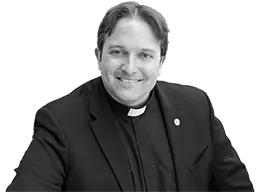
 Fr Matthew Charlesworth SJJesuit PriestSociety of JesusJesuit priest working in Southern AfricaFr. MatthewCharlesworthSJ
 6th Sunday in Ordinary Time
Date: | Season: Ordinary Time before Easter | Year: A
First Reading: Sirach 15:15–20
Responsorial Psalm: Psalm 119:1–2, 4–5, 17–18, 33–34
| Response: Psalm 119:1b
Second Reading: 1 Corinthians 2:6–10
Gospel Acclamation: Matthew 11:25
Gospel Reading: Matthew 5:17–37
Preached at: the Chapel of Emmaus House in the Archdiocese of Harare, Zimbabwe.
This morning the Lord places something simple before us. A choice.
Sirach speaks plainly. If you choose, you can keep the commandments. Before you are fire and water, life and death. God does not force our hand. He gives us freedom and takes us seriously.
That freedom is gift and burden. It means we cannot hide behind circumstances. In Zimbabwe the economy tightens, jobs are scarce, systems strain. It is easy to say, what choice do I have? Yet the Word comes closer than the market, closer than politics, and says: choose. Choose honesty when a lie would help. Choose fairness when favour would profit you. Choose to defend the one who has no defender.
Freedom means we can choose life. It also means we can choose badly. We protect our own and ignore others. We justify small compromises. We tell ourselves that what benefits my circle must be good. Scripture is honest about this. The same freedom that allows generosity allows selfishness. The remedy is not shame but conversion. When we choose wrongly, grace does not withdraw. The Spirit calls us back. Repentance is a return to life.
And we do not choose alone. As Paul says, the Spirit searches everything, even the depths of God. That Spirit is given to us. Freedom is real, but it is strengthened from within. We cooperate with grace already at work.
The first Christians faced their own tension. They loved the Law of Moses. Then Gentiles followed Christ without those customs. Had the past been abandoned? Jesus answers clearly: I have not come to abolish the Law, but to fulfil it. Not one letter will pass away. The Law was always meant to form hearts.
The psalm teaches us how to pray: Teach me your statutes. I will walk at liberty, for I have sought your precepts. Obedience is not slavery. It is freedom rightly ordered. When the Law is kept without love, it dries out. It becomes form without life, a body without breath.
Paul points us to a deeper wisdom. The rulers did not recognise it, or they would not have crucified the Lord of glory. God’s wisdom is seen on the cross. It does not crush. It gives itself. It absorbs violence rather than returning it.
That is the wisdom Jesus applies in the Gospel. He moves from action to motive.
You have heard it said, you shall not kill. But I say to you, whoever is angry with his brother will be liable. Murder begins in contempt. It begins when we decide someone no longer matters.
We cannot hear this without thinking of Ukraine or Gaza. Cities destroyed. Families displaced. Children buried. Nations speak of defence and strategy. Yet Jesus begins deeper. When a people becomes only an enemy, when suffering is justified as necessary, we lose something of our own humanity. We deny the image of God in them, and we wound it in ourselves.
War has many causes. But long before the first shot is fired, the other has been reduced to a threat. Anger, when organised, becomes violence. And when violence is sustained by profit, when economic interests shape political decisions, the moral wound deepens. The commandment not to kill challenges not only individuals, but the systems that normalise destruction.
Yet hope is not absent. Ordinary people cross battle lines to deliver food and rescue children. These acts do not dominate headlines, but they matter. They show that even in wounded places, grace is at work. The Spirit has not withdrawn. Mercy is still possible.
Jesus then makes it personal. If you bring your gift to the altar and remember that your brother has something against you, go first and be reconciled. Worship and relationship cannot be separated.
We cannot pray for peace abroad while there is silence at our own table. We cannot speak about justice and ignore the spouse, child, sibling, or friend we have wounded. The sign of peace asks whether we are willing to make the call, to listen, to admit we were wrong. At this altar, reconciliation is not an idea but a gift; the Body we receive binds us again to the brothers and sisters we may have wounded.
Jesus then speaks of adultery. Whoever looks with lust has already committed adultery in the heart. A person is not an object to be used. Adultery breaks trust and weakens families. What was legally permitted in his time was not always just.
There is a connection here. Lust treats a person as a means. Unchecked power can do the same.
We have seen it before in Scripture. Saul clung to power in fear. Solomon allowed desire to divide his heart. David took another man’s wife and arranged her husband’s death. When desire rules, whether sexual or political, others are reduced to instruments, valued only for their usefulness.
Not everything that is legal is just. Systems may follow rules and still harm the weak. The Gospel asks: does this serve the common good? Does it protect the vulnerable?
Decisions are often defended as protecting family, tribe, party, loyal supporters. Loyalty is not evil. Providing for one’s family is good. But the Gospel asks whether our love is wide enough. What benefits my circle may burden many.
A leader may act with sincere intentions. He may believe he is stabilising those close to him. These are not evil motives. But the harder question remains: is this the best choice for the whole nation? Christian conscience must move from what is good for some to what is just for all.
The more people we lead, the heavier the responsibility. Authority widens the circle of responsibility and demands a wider love. It is not enough to choose what is good. We must ask what is better, and then what is best. Saint Ignatius taught that the good can become the enemy of the better, and the better the enemy of the best. Discernment seeks what most serves God’s greater glory and the true good of all.
As a nation, like each of us, we face choices that shape the future. Power is necessary. But in the Gospel, authority is given for service, not self-interest. Without limits, transparency, and truthfulness, power drifts. That is why Jesus says: let your yes be yes and your no be no.
Trust sustains both families and societies. When promises are made lightly and broken easily, something deep erodes.
There is a way of living the faith that asks only: is this a sin? Can I stay within the line? Jesus asks for more. He calls for a righteousness that goes beyond minimal compliance. Love seeks what truly gives life.
The same choice stands before us. Fire and water. Life and death. We may not decide the fate of nations, but we decide whether we will feed resentment or build peace, whether we will narrow love to our circle or widen it.
The cross shows us the wisdom of God. It refuses the logic that violence creates peace. In Christ, justice and mercy meet.
As we come to the altar, we receive the Lord who answered hatred with forgiveness. He strengthens our freedom through his Spirit. He calls us to choose life.
So as we pray this morning, let us ask ourselves:
- Where am I feeding anger instead of building peace?
- Whom have I reduced to a label rather than seeing as a person loved by God?
- Where is the Spirit inviting me to choose not only what is good for me, but what is best for the common good?
Source: https://sj.mcharlesworth.fr/homilies/2026-02feb-15-ya-ot-06/
This homily is shared for personal and pastoral use. Please attribute the author and do not alter the meaning when quoting. If you wish this homily to be translated - there is an option on the website which will allow you to translate it into the language of your choice.
Licenced under a Creative Commons Attribution-NonCommercial-NoDerivatives 4.0 International (CC BY-NC-ND 4.0) license.
The author does not speak for the Society of Jesus or for the Catholic Church.





In preparing this homily, I consulted various resources to deepen my understanding of today’s readings, including using Magisterium AI for assistance. The final content remains the responsibility of the author.