
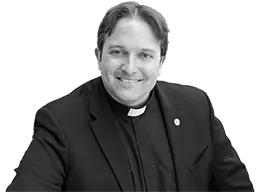
 Fr Matthew Charlesworth SJJesuit PriestSociety of JesusJesuit priest working in Southern AfricaFr. MatthewCharlesworthSJ
 5th Sunday of Lent
Date: | Season: Lent | Year: A
First Reading: Ezekiel 37:12–14
Responsorial Psalm: Psalm 130:1–8
| Response: Psalm 130:7
Second Reading: Romans 8:8–11
Gospel Acclamation: John 11:25a–26
Gospel Reading: John 11:1–45
Preached at: the Chapel of Emmaus House in the Archdiocese of Harare, Zimbabwe.
Today’s Gospel begins in a graveyard and ends with a man coming out into the light. That is our Lenten journey. We bring to God the parts of our life that feel closed up, tired, numb, or dead, and Jesus comes near enough to call us out. Before we reach Jerusalem, before we reach the cross, Jesus stands before a tomb and shows us who he is, and reveals to us who we really are.
He knows where he is going. Jerusalem is close now, and so is danger. The disciples know that, and they are afraid. They remember what happened the last time he was there. They know there are people who want him dead. So when Jesus says, “Let us go to Judea again,” this is not a small trip. He is walking towards danger. He is walking towards the cross. And still he goes. He goes because love is stronger than fear. He goes because some things must be done, whatever they cost.
So he comes to Bethany, to a house full of sorrow. Martha comes out to meet him and says, “Lord, if you had been here, my brother would not have died.” She does not soften it. She puts the wound into words and places it before him.
Most of us have prayed like that. Lord, if you had been here, this would not have happened. If you had been here, why did this have to be so hard? Martha confronts Jesus directly.
Jesus lets her speak. He does not cut across her grief. He takes her further. Martha speaks about the resurrection on the last day, and Jesus says, “I am the resurrection and the life.” He does not give her an explanation. He gives her himself. The answer to the grave is Jesus, standing there in front of her.
John wants us to see more than a miracle here. He gives us a sign. This is not only about one dead man being brought back. It is about Jesus showing who he is. He is not simply a man who fixes a crisis. He is the Lord of life, and this sign leads straight towards his own death and resurrection.
That is why the Church gives us this Gospel just before Holy Week. Over these last Sundays of Lent, the Church has been leading us towards Easter step by step: living water for the thirsty woman, sight for the blind man, and now life for the dead Lazarus. These are signs of baptism. In baptism Christ washes us, opens our eyes, and raises us up. He brings us out of the tomb and into the life of God. And the psalm gives us words for such a journey: “Out of the depths I cry to you, O Lord.” We wait for the Lord more than watchmen wait for morning, because with the Lord there is mercy and fullness of redemption.
That is Ezekiel’s vision too. Israel feels finished. Dry. Scattered. Like bones in the dust. In exile the people felt buried, cut off, worn down. And God says, “I will open your graves and have you rise from them.” God is not speaking only to one person. He is speaking to a whole people. He breathes life back into what has been crushed.
In Romans, Paul says the Spirit of God dwells in us and gives life. There are two ways to live. One is turned in on itself, ruled by fear, appetite, pride, and self-protection. The other is life in the Spirit, where a person is opened by God and made able to trust, to love, to give, to breathe again. One is like living in a room with the windows nailed shut. The other is like the first air in the morning when the window is opened. A Christian is not simply someone who says the right words. A Christian is someone in whom the Spirit of God lives.
Bethany is not far from us. It mirrors our worries, our grief, and the wars of our world. We are living through a time when the powerful choose war, and the poor bear the cost. We see it in Gaza and across Palestine, in Lebanon, in Ukraine, in Sudan, and now in the widening war around Iran, with Gulf countries also being drawn into the danger. Pope Leo XIV has urged those responsible for the conflict in the Middle East to agree to a ceasefire and reopen paths of dialogue, and he has appealed again and again for peace in other war-torn places.
In such a world, this Gospel does not permit cheap hope. Jesus does not deny the tomb. He stands before it, and he calls for life.
And before he calls Lazarus out, he weeps. He knows what he is about to do, and still he weeps. That is worth noticing. Jesus stands there in tears. He does not explain sorrow from a safe distance. He walks into it. He is not afraid of the smell of death. He stands at the tomb of his friend, and he stays there.
Then Jesus shouts, “Lazarus, come out!” And Lazarus comes out alive, but still wrapped up. His feet are tied. His face is covered. He has breath again, but he cannot yet move freely. Then Jesus says to the people standing there, “Unbind him, and let him go.”
There is something striking about those cloths. Lazarus comes out still wrapped in the signs of death. He is alive again, but he is not yet free. But when Jesus rises, the burial cloths are left behind. Lazarus returns to this life. Jesus rises beyond the reach of death. Lazarus is a sign, not the final resurrection itself. The Lord who calls him from the tomb is the same Lord before whom all shall rise, and before whom everything hidden will be brought into the light.
Then Jesus turns to the others: “Unbind him, and let him go.” Jesus gives life, but asks the community to help remove what still binds. That is the work of the Church. Not only to speak about resurrection, but to actively help set the living free. To unbind!
Sometimes what binds people is easy to see: addiction, lies, bitterness, greed. Sometimes it is harder to see: shame, fear, old wounds, the quiet habit of giving up. Sometimes people are tied up by the names others give them, by exclusion, by being treated as a burden and not as a brother or sister. Jesus says, unbind him. Not stand back and talk. Not wrap the cloths tighter with judgement. Unbind him!
For that is mercy. It is justice too. To tell the truth, to defend the poor, to refuse corruption, to make room for those pushed aside, to help others breathe more freely: this too is part of the christian work of unbinding. Resurrection is not only private comfort for religious people. It must reach the family table, the street, the school, the parish, the clinic, the places where people are carrying more than they can admit.
So the question becomes simple. What gives life now? A visit to the sick. Patience with a difficult brother. Honest work. A call to someone who is alone. A lie refused. A word of hope to someone who feels buried. This is how grave clothes begin to loosen.
As we move towards Holy Week, the Church wants us to hear two things together. Jesus is walking towards his own death. And before he enters his own tomb, he stands before ours and calls us out.
Lazarus comes out stumbling, blinking, still wrapped up, needing help. There is comfort in that. Jesus does not wait for him to come out looking strong. He simply says, come out as you are.
That is our hope. Not that we can move the stone on our own. Not that we have never needed the tomb. But that Christ comes near, calls us by name, and does not leave us where he found us.
And perhaps that is the grace to ask for this week: Lord, call me out. Call out what has gone numb in me. Call out what I have buried. Call out what I have given up on. And where I see someone else still wrapped in grave cloths, give me the mercy not to judge, but to help set them free.
Three questions for prayer this week.
- What part of my life feels closed up like a tomb?
- Whom am I being asked to help unbind?
- And what in me must die now, so that Christ’s life may breathe more freely in me before Easter?
Source: https://sj.mcharlesworth.fr/homilies/2026-03mar-22-ya-lt-05/
This homily is shared for personal and pastoral use. Please attribute the author and do not alter the meaning when quoting. If you wish this homily to be translated - there is an option on the website which will allow you to translate it into the language of your choice.
Licenced under a Creative Commons Attribution-NonCommercial-NoDerivatives 4.0 International (CC BY-NC-ND 4.0) license.
The author does not speak for the Society of Jesus or for the Catholic Church.




In preparing this homily, I consulted various resources to deepen my understanding of today’s readings, including using Magisterium AI for assistance. The final content remains the responsibility of the author.