
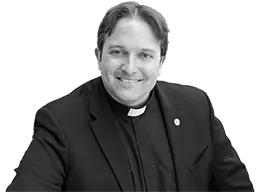
 Fr Matthew Charlesworth SJJesuit PriestSociety of JesusJesuit priest working in Southern AfricaFr. MatthewCharlesworthSJ
 5th Sunday of Easter
Date: | Season: Easter | Year: A
First Reading: Acts 6:1–7
Responsorial Psalm: Psalm 33:1–2, 4–5, 18–19
| Response: Psalm 33:22
Second Reading: 1 Peter 2:4–9
Gospel Acclamation: John 14:6
Gospel Reading: John 14:1–12
Preached at: the Chapel of Emmaus House in the Archdiocese of Harare, Zimbabwe.
There is one image that holds all the readings today. It is the image of a house. Not a perfect house, but a real one. A place where people live together, where meals are shared, where burdens are noticed, where there is room for those who might otherwise be left outside. Jesus says, “In My Father’s house there are many dwelling places.” That is not only about heaven at the end. It is also about the kind of Church He is building now. A place with many rooms. A place where no one should be forgotten.
The first reading from Acts begins with a problem. The Church is growing, but there is trouble inside it. The Greek-speaking widows are being neglected in the daily distribution of food. They are being missed. Passed over. Left waiting. It is a very human scene. The early Church was full of grace, but it was not free of tension. Even there, people could be ignored.
And this is worth noticing, because it tells the truth about the Church. The Church is holy because Christ is holy. But the people in the Church are still learning how to love. So there are times when the Gospel is preached well, but not lived well. Here, the widows do not need fine words. They need food. They need fairness. They need to know they matter.
And the apostles respond well. They do not pretend the complaint is small. They do not cover the wound with pious language. They gather the community, they listen, and they act. They appoint seven men to make sure the neglected are cared for. It is simple, but it is deeply Christian. Where there is neglect, the Church must not look away. Where there is unfairness, the Church must not defend itself first. It must first become just.
That speaks directly to us. People know what it is to be left at the back of the queue. The poor know it. Widows know it. The young looking for work know it. Migrants know it. Families trying to survive know it. Sick people know it. And sometimes even in the Church, those with education, money, confidence, or connections are heard first, while others wait too long to be noticed. Acts tells us plainly that when that happens, something has gone wrong. The Body of Christ cannot be healthy if some members are quietly starved.
Then Saint Peter gives us another image. He says Christ is the living stone, rejected by men but chosen by God. And He says that we too are living stones, being built into a spiritual house.
That is a strong and comforting image. We are not loose stones scattered on the ground. We are being built into something. And not dead stones, but living ones. Stones with scars, weight, shape, and history.
A living stone is not smooth and polished. It has rough edges. It has been worn by wind and rain. That sounds like us. Some of us are carrying grief. Some are tired. Some are anxious about the future. Some are disappointed in the Church. Some are trying to believe, but only just. And Peter says: even so, you are being built into God’s house.
That is good news. God does not wait for us to become flawless before He uses us. He builds with ordinary people. He builds with wounded people. He builds with people the world rejects. The stone the builders rejected became the cornerstone. That is Christ. So those who feel cast aside should never think they are outside God’s plan. God can begin right there.
Then we come to the Gospel, and it is one of the gentlest moments in John. Jesus says, “Do not let your hearts be troubled.” He says that because their hearts are troubled. He can see their fear. Thomas does not know where Jesus is going. Philip still wants to see the Father. They are trying to follow, but they do not understand.
That is close to our own lives. Many of us want a clear map from God. We want prayer to give us exact answers. We want the future to open neatly in front of us. But not all our searching leads to life. Not every desire tells the truth. Some desires draw us towards God, but others pull us in on ourselves and slowly lead us towards ruin. That is why we need discernment. That is why we need to stay close to Jesus, who is the way, the truth and the life. Jesus does not hand the disciples a map. He gives them Himself.
That is the heart of the Gospel. Christianity is not first a method or a list of instructions. It is life with Jesus, who leads us to the Father. To know the way, stay close to Him. Walk with Him. Listen to Him. Watch what He notices. Let Him lead.
That is also close to the spirit of Saint Ignatius. Ignatius teaches us not only to think about Jesus, but to stay with Him. To place ourselves in the Gospel scene. To hear His voice. To notice what is happening in our own hearts as He speaks. Prayer is not a tool for getting things done. It is a moment of love, a meeting with God, where we try to see Him and let ourselves be seen by Him, just as we do when we visit those we love. So today we might place ourselves in that upper room. The air is heavy. The disciples are worried. Then Jesus says quietly, “Do not let your hearts be troubled.” Not as a rebuke, but as a gift. Trust Me. Stay with Me. I will not lose you.
And this consolation is not only for comfort. It is also for construction. The Risen Christ strengthens His people so that the Church becomes a dwelling, built by the Spirit, with Christ as the cornerstone.
And then comes that beautiful line: “In My Father’s house there are many dwelling places.” There is room in God. Room for the strong and the weak. Room for the sinner trying again. Room for the one who doubts. Room for the one who has failed. Jesus does not speak of a cramped house with the doors shut. He speaks of a house with many rooms. He goes ahead of us to prepare a place, and He draws us to Himself.
The Church must look like that. The Church must sound like that. The Church must make that promise believable.
So we have to ask a hard question: who is still missing from the table? Who is still being neglected in the daily distribution? The poor? The young? Those carrying grief in silence? Those who have failed and think there is no place left for them? Today’s Gospel is clear. If there are many rooms in the Father’s house, then we must not live as keepers of a narrow door.
The psalm says that the eyes of the Lord are upon those who hope in His love. God sees. He sees the widow. He sees the one who feels forgotten. He sees the family stretched by money worries. He sees the student carrying hidden fear. He sees the child learning too early how hard life can be. God sees, and because God sees, we must learn to see.
So the readings leave us with one clear picture: a house being built. Christ is the cornerstone. We are the living stones. The poor must not be forgotten. The troubled must not be abandoned. The searching must not be mocked. The house has many rooms, and Jesus Himself is the way into it.
So perhaps our prayer this week can be very simple. Lord, where is my heart troubled? Who is being neglected near me? And what stone am I being asked to become in Your house?
For prayer this week:
- When I hear Jesus say, “Do not let your hearts be troubled,” what fear in me is He touching?
- Who around me is being overlooked, and what small, concrete act of care is God asking of me?
- If I am a living stone in God’s house, what rough edge in me still needs the Lord’s patient shaping?
Source: https://sj.mcharlesworth.fr/homilies/2026-05may-03-ya-et-05/
This homily is shared for personal and pastoral use. Please attribute the author and do not alter the meaning when quoting. If you wish this homily to be translated - there is an option on the website which will allow you to translate it into the language of your choice.
Licenced under a Creative Commons Attribution-NonCommercial-NoDerivatives 4.0 International (CC BY-NC-ND 4.0) license.
The author does not speak for the Society of Jesus or for the Catholic Church.





In preparing this homily, I consulted various resources to deepen my understanding of today’s readings, including using Magisterium AI for assistance. The final content remains the responsibility of the author.