
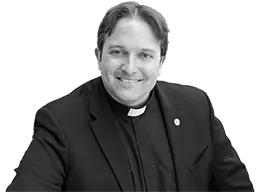
 Fr Matthew Charlesworth SJJesuit PriestSociety of JesusJesuit priest working in Southern AfricaFr. MatthewCharlesworthSJ
 18th Sunday in Ordinary Time
Date: | Season: Ordinary Time after Easter | Year: A
First Reading: Isaiah 55:1–3
Responsorial Psalm: Psalm 145:8–9, 15–18
| Response: Psalm 145:16
Second Reading: Romans 8:35, 37–39
Gospel Acclamation: Matthew 4:4b
Gospel Reading: Matthew 14:13–21
Preached at: the Chapel of Emerald Hill Children’s Home in the Archdiocese of Harare, Zimbabwe.
Dear brothers and sisters in Christ, we can all imagine being hungry.
Most of us have felt hunger. We know how an empty stomach can make it hard to think about anything else. Thankfully, many of us also know that food will come. We may have to wait, but we do not expect hunger to become permanent.
Yet many people in our country do not have that assurance. Hunger is a daily worry for the parent trying to make a small monthly budget cover rent, transport, school costs and food. It is the child trying to study for examinations while hungry, reading the same line again and again because an empty stomach will not let their mind settle.
But hunger is not only about food. A young person can hunger for the love of a parent who is no longer there. A grandparent can hunger for someone to listen to them. We can hunger for work, for safety, for forgiveness, for justice, for hope, for peace or for a place where we belong.
The readings today tell us that God sees every kind of hunger. He does not send the hungry away. He comes near to us, feeds us, and asks us to help him do the same for others.
Our first reading from the Prophet Isaiah begins like the call of a vendor in a market: “Come to the water. Come, buy and eat.”
Yet this is a strange market. Those with no money are welcome. Water, milk and wine are offered without payment. Water gives life, milk feeds the young, and wine speaks of joy. God is saying, “Come to me. I know what you need. I will not turn you away because you are poor.”
Isaiah was speaking to people wounded by exile. They had lost their homes, their security and much of their hope. So God asks, “Why spend your money on what is not bread, and your labour on what does not satisfy?”
That question is asked of us.
What takes our time, energy and attention? What promises happiness but leaves us empty? We can spend our lives chasing status, protecting our image, or holding on to anger, while the person beside us is hungry for one kind word or a morsel to eat.
God calls us away from what fills our days but empties our hearts.
Our Psalm this morning uses a simple image: “You open wide your hand, O Lord.”
God’s hand is open. Yet God often feeds people through human hands: through the hands of a farmer, a teacher, a grandmother sharing a small pension, a student helping a younger child, or an elder who gives someone time and listens.
God opens his hand. The question is whether we will open ours.
In our second reading St Paul names the things that frighten us: trouble, hunger, danger and death. Paul knew such trials. He had been beaten, imprisoned, rejected and threatened.
He does not say that believers will never suffer. He says that suffering cannot separate us from the love of Christ.
Through these trials, Paul says, we triumph “by the power of him who loved us”. Our confidence is not in our own strength. Trouble may surround us. Hunger may weaken us. Death may come near. But none of these can come between us and the love of God made visible in Jesus Christ.
Paul reaches for the widest language he can find: neither death nor life, neither the present nor the future, neither height nor depth, nor any created thing. Nothing can break Christ’s hold on us.
This is our victory: not that we avoid suffering, but that even within suffering we remain held, loved and accompanied by Christ. Death does not have the final word, and we are never alone. God became human for us, entered our suffering, carried our sorrow, and opened for us the way to life.
In Matthew’s Gospel, Jesus has just heard that John the Baptist has been killed. He goes away by boat to find a quiet place. He is grieving. He knows that sorrow needs silence, and that those who care for others also need time to pray.
But when he reaches the shore, the crowd is already there waiting for Him.
We are told that Jesus sees them and has compassion for them. He sees their hunger, sickness and tiredness. Their suffering moves him - even in his own grief, and his compassion leads him to act.
The disciples see the same people, but they see a problem. It is late. The place is deserted. There is not enough food. Their answer sounds sensible: “Send them away.”
We can empathise with the disciples. Sometimes the need before us feels too large. We too are tired. We too fear that what we have will not be enough. So we say, perhaps silently, “Let someone else deal with it.”
But Jesus says, “They need not go away. You give them something to eat.”
The disciples answer, “All we have with us is five loaves and two fish.”
Only five loaves. Only two fish. Only a small pension. Only a little time. Only me.
Jesus does not complain about what they lack. He says simply, “Bring them here to me.”
Jesus takes the bread, blesses it, breaks it and gives it. These actions point us towards the Eucharist. In the Eucharist, by the consecration, Christ truly becomes present under the species of bread and wine, so that we receive Him as nourishment - and then are sent to share that nourishment with others. The miracle is not the Mass, but it prepares us to recognise the way Christ gives himself: received, blessed, broken and shared for the life of others.
The miracle begins when the disciples stop saying, “This is all we have,” and begin saying, “This is what we bring.” And they begin to share.
Everyone eats. Everyone is satisfied. And the miracle is that there are twelve baskets left over. Matthew tells us that women and children were also there. They may not have been included in the official number, but they were included in the meal. At the table of Jesus, those whom society fails to count are still seen, welcomed and satisfied.
This morning we receive Christ in the Eucharist, but we should not receive him while sending others away. Christ gives himself to us and asks us to become nourishment for others.
Not only to give money, but to give time. Not only to give food, but to give our attention. Not only our advice, but also our patience. Not only what we own, but something of who we are, however small.
Now of course, we cannot feed everyone, but we must not use that as an excuse to feed no one. We may not heal every orphaned heart, but we can learn a child’s name. We may not remove every burden from an elderly person, but we can help to carry one, we can try to listen, for as the saying goes: a burden shared is a burden halved.
Our offering may be small. But small is not the same as useless.
When we place what we have into the hands of Jesus, a child can be fed, an old person can be remembered, a lonely person can find a family, and an ordinary table can become a sign of the Kingdom of God.
As we pray this week, let us ask:
- Whom have I wanted to send away because their need inconveniences me?
- What small gift is Jesus asking me to bring to him?
- How will I allow Christ to bless that gift and use it to feed someone else?
Source: https://sj.mcharlesworth.fr/homilies/2026-08aug-02-ya-ot-18/
This homily is shared for personal and pastoral use. Please attribute the author and do not alter the meaning when quoting. If you wish this homily to be translated - there is an option on the website which will allow you to translate it into the language of your choice.
Licenced under a Creative Commons Attribution-NonCommercial-NoDerivatives 4.0 International (CC BY-NC-ND 4.0) license.
The author does not speak for the Society of Jesus or for the Catholic Church.





In preparing this homily, I consulted various resources to deepen my understanding of today’s readings, including using Magisterium AI for assistance. The final content remains the responsibility of the author.