
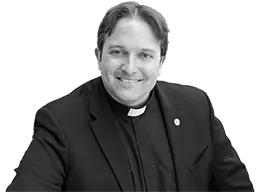
 Fr Matthew Charlesworth SJJesuit PriestSociety of JesusJesuit priest working in Southern AfricaFr. MatthewCharlesworthSJ
 22nd Sunday in Ordinary Time
Date: | Season: Ordinary Time after Easter | Year: A
First Reading: Jeremiah 20:7–9
Responsorial Psalm: Psalm 63:2–6, 8–9
| Response: Psalm 63:2b
Second Reading: Romans 12:1–2
Gospel Acclamation: Ephesians 1:17–18
Gospel Reading: Matthew 16:21–27
Preached at: the Chapel of Emerald Hill Children’s Home in the Archdiocese of Harare, Zimbabwe.
There are times when doing the right thing feels good. And there are times when doing the right thing feels terrible. That is where Jeremiah is in the first reading today.
Jeremiah had been called by God to speak honestly to his people. What he had to say was not pleasant. He found himself continually crying out, “Violence and destruction!”, warning them where their injustice and unfaithfulness were leading.
Eventually, people became tired of hearing him.
Just before the passage we hear today, Jeremiah has been beaten. A priest named Pashhur has him arrested and put in the stocks at the Temple. Jeremiah has been trying to serve God — and this is where it has brought him: humiliation, pain, people laughing at him, even friends waiting for him to fail.
And Jeremiah turns to God and says, in effect: This is not what I thought I was signing up for.
The NRSVCE puts it very directly: “O Lord, you have enticed me, and I was enticed; you have overpowered me, and you have prevailed.”
Jeremiah feels that God called him into this, and now he is discovering how much it costs. He does not pretend everything is fine. He is angry. He is hurt. He complains to God.
And in that complaining, there is also a kind of faith, because Jeremiah has not stopped talking to God. Sometimes prayer may simply be: Lord, I do not understand. Or even: Lord, I am angry with you. God can always cope with our honesty.
Jeremiah eventually decides: Enough. I am not doing this anymore. He says: “I will not mention him, or speak any more in his name.”
But then comes that wonderful image: “Within me there is something like a burning fire shut up in my bones.” Jeremiah says he grows weary trying to hold it in — and he cannot.
Something deep within Jeremiah still thirsts for God and for what is true. Perhaps that is why the Psalm gives us the words: “For you my soul is thirsting, O Lord my God.” Jeremiah may be angry with God, but he cannot simply walk away from God.
And perhaps we know something of that.
Imagine a meeting at work or at school where someone who is not there is being blamed unfairly. Everyone knows the story is incomplete, but nobody wants to interrupt. Speaking up may make the room uncomfortable. It may even make you unpopular. And yet something within you says: This is not right.
You speak, not because you enjoy conflict, but because truth and charity require it. Afterwards you may wonder whether it was worth it. That is a small glimpse of what faithfulness can cost.
And it brings us to Peter.
Last Sunday, Peter got the answer exactly right. Jesus asked, “Who do you say that I am?” Peter answered, “You are the Messiah, the Son of the living God.”
But today Jesus tells him what being the Messiah will mean. He will go to Jerusalem. He will suffer. He will be killed. And he will be raised on the third day.
Peter says: “God forbid it, Lord! This must never happen to you.”
We can understand him. Peter loves Jesus and does not want him to suffer. But there is something deeper happening here.
Peter wants a Messiah without the cross. He wants God to save the world without suffering, without self-giving, without the apparent defeat of Calvary.
And Jesus responds with very strong words: “Get behind me, Satan!”
Peter is not consciously trying to oppose God. But his words become an obstacle to Jesus’ mission, tempting him away from the path he has come to walk.
Then Jesus says: “If any want to become my followers, let them deny themselves and take up their cross and follow me.”
We need to be careful about what that means. Our cross is not every hardship we experience. Jesus is not saying that suffering is good, and he is certainly not telling people simply to accept abuse or injustice.
Nor, when Jesus says “deny themselves,” is he asking us to deny who we are, as though following Christ meant erasing ourselves or becoming somebody else whom we imagine God might prefer.
God’s grace meets us in the facts: in the truth of our innermost being, in the reality of our situation, and in the relationships in which we actually live. Grace begins there — not with some imaginary version of ourselves, but with the person we really are and the life we are really living.
Of course, that does not mean that everything we find within ourselves is automatically God’s will. Our desires have to be discerned. Some need to be purified, healed or let go.
But God is not our rival. God desires our life and our freedom. In the Ignatian tradition, we bring our desires honestly before God and ask for the freedom to recognise what leads us towards greater truth and love. And as that freedom grows, God’s deepest desire for us and our own deepest, truest desire can begin to meet.
Pope Francis, speaking about the Spiritual Exercises, described this as the meeting of “God’s desire and the desire of our own heart.”
So taking up our cross does not mean becoming less ourselves. Paradoxically, it is part of becoming more truly the person God created us to be.
And the cross is first of all his cross: Christ giving himself completely in love and obedience to the Father, passing through suffering and death into resurrection. Our cross is the cost of following him in that self-giving love when fidelity becomes costly.
Sometimes that means forgiving when it would be easier to remain angry. Sometimes it means speaking honestly when silence would protect us. Sometimes it means staying beside someone when love asks patience and sacrifice. Sometimes it means living chastely: learning to love without possessing or using another person, and allowing our desires to be shaped by what truly honours ourselves and the other.
That is where Saint Paul’s words matter:
“Do not be conformed to this world, but be transformed by the renewing of your minds, so that you may discern what is the will of God — what is good and acceptable and perfect.”
And perhaps this is precisely what Jesus means when he tells Peter: “You are setting your mind not on divine things but on human things.”
A Messiah should win. A Messiah should triumph. A Messiah certainly should not be crucified.
But Jesus is teaching Peter — and us — to see differently. Following Christ means allowing God to renew our minds and reshape our desires, so that we begin to recognise what is truly good.
Jesus asks: “For what will it profit them if they gain the whole world but forfeit their life?”
It is possible to gain a great deal and still lose something more important. We can gain money and lose our peace. We can gain popularity and lose ourselves. We can win an argument and damage a relationship.
So perhaps the question is not simply: What can I gain?
But: What is God teaching me to desire?
Jeremiah had to discover that painfully. Peter had to discover it slowly. And we learn it over a lifetime.
Sometimes we will be like Peter and get it wrong. Sometimes we will be like Jeremiah and tell God we have had enough. But Christian discipleship does not depend simply upon our own courage or determination.
That is why what we do here this morning matters.
In this Eucharist, Christ does not merely tell us to take up the cross. He gives himself to us. The one who asks us to give our lives in love is the one who first gives his life for us.
Saint Paul tells us today to “present your bodies as a living sacrifice, holy and acceptable to God.” Here at this altar, we receive Christ’s self-giving love so that, little by little, that same love can become the shape of our own lives.
So perhaps our prayer today can be very simple:
Lord, renew my mind. Teach me to recognise what is good. Give me the courage to follow you when faithfulness is costly.
And deepen within me the desire of today’s Psalm:
“For you my soul is thirsting, O Lord my God.”
Source: https://sj.mcharlesworth.fr/homilies/2026-08aug-30-ya-ot-22/
This homily is shared for personal and pastoral use. Please attribute the author and do not alter the meaning when quoting. If you wish this homily to be translated - there is an option on the website which will allow you to translate it into the language of your choice.
Licenced under a Creative Commons Attribution-NonCommercial-NoDerivatives 4.0 International (CC BY-NC-ND 4.0) license.
The author does not speak for the Society of Jesus or for the Catholic Church.





In preparing this homily, I consulted various resources to deepen my understanding of today’s readings, including using Magisterium AI for assistance. The final content remains the responsibility of the author.