
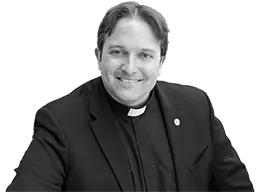
 Fr Matthew Charlesworth SJJesuit PriestSociety of JesusJesuit priest working in Southern AfricaFr. MatthewCharlesworthSJ
 Wednesday of the 22nd Week in Ordinary Time
Date: | Season: Ordinary Time after Easter | Year: A
First Reading: 1 Corinthians 3:1–9
Responsorial Psalm: Psalm 33:12–15, 20–21
| Response: Psalm 33:12
Gospel Acclamation: Luke 4:18
Gospel Reading: Luke 4:38–44
Preached at: Our Lady of the Wayside Parish, Mount Pleasant in the Archdiocese of Harare, Zimbabwe.
Many people in Zimbabwe who have opened a tap and found no water know how important water is for life. Saint Paul uses that same simple image today.
“I planted, Apollos watered, but God gave the growth.”
A farmer prepares the soil and plants. Another person waters. But neither can command the seed to grow. Life itself is God’s gift.
Paul uses this image because the Christians of Corinth are divided. Some say, “I belong to Paul.” Others, “I belong to Apollos.” Jealousy and quarrelling have entered the Church.
Paul tells them: you have forgotten who you belong to.
The field does not belong to Paul or Apollos. The field belongs to God.
That is worth remembering in our Church, our families and even our politics. We can become so attached to our group, our leader or our party that we defend our side even when it is wrong.
Paul says: we are servants. God alone is Lord.
Some plant. Some water. God gives the growth.
The psalm teaches the same trust: “Our soul is waiting for the Lord.”
The farmer works, but he knows his limits. He cannot pull the crop out of the ground. Christian faith is like that. We work. We take responsibility. But we remember that not everything belongs to us or is under our control.
In the Gospel, Jesus enters Peter’s house. Peter’s mother-in-law is sick with fever. Jesus heals her, and immediately she gets up and begins to serve.
Her healing becomes an opportunity for service.
That is what grace does. God gives us strength so that we can strengthen others. God gives us life so that we can give life.
Later, people bring their sick to Jesus, and Luke says that Jesus lays his hands on them one by one.
Jesus sees the person, not simply the crowd.
During this Season of Creation, the Church asks us to look at creation with that same care.
This year the theme is “Living Water”, and Pope Leo XIV has asked us this September to pray “for the care of water”. Water is God’s gift, not simply a commodity.
We understand that very well in Zimbabwe.
Many of us have installed boreholes because the public water system has failed. After paying for the borehole, pump and tank, we may still have to buy bottled drinking water.
Pope Francis wrote in Laudato Si’: “Access to safe drinkable water is a basic and universal human right.”
Yet when public water fails, private water becomes profitable. Boreholes become business. Bulk water becomes business. Bottled water becomes business. Unseen monopolies can grow around something that should serve everyone. And the heavy trucks transporting water damage roads that are already struggling.
There is nothing wrong with honest business. But something is wrong when failure of the common good becomes an opportunity for a few to make great profits.
Water should give life before it gives profit.
Caring for water also means protecting rivers and wetlands, respecting building codes, and expecting planners not to allow building on flood plains.
A wetland is not useless land. A flood plain is not wasted land.
This week the terrible disaster in Nepal and Tibet has reminded us why. Water, ice, rock and mud swept through river valleys, killing many people. We cannot prevent every natural disaster. But creation has limits, and when we ignore those limits, people suffer.
That brings painfully to mind our own disaster on Lake Kariba.
The government-owned Mbuya Nehanda ferry was meant to carry about 90 people. Government later said that about 180 were on board when it capsized. Many people died.
There was a limit.
But somehow the limit stopped mattering.
And perhaps that is the deeper issue. A ferry has a limit. A river has a limit. A wetland has a purpose. An underground water table cannot be pumped without end.
When everything becomes something to use, sell or profit from, we begin to ignore limits. And when limits are ignored, ordinary people usually pay first.
The poor.
The person on the ferry.
The family buying bottled water because nothing comes from the tap.
So yes, we must do our part. We must care for water, protect rivers and wetlands, and respect the limits built into creation.
But government must do its part too.
We should hold our government, the governing party, our councils and every political party that asks for our support accountable for the common infrastructure of this country.
Where is the responsibility?
Where is the accountability?
Those are not un-Christian questions. They are questions about the common good.
We ask them not with hatred, but with truth. Not with violence, but with courage.
Our faith does not teach us simply to become better at surviving failure.
Paul says, “I planted, Apollos watered, but God gave the growth.”
Our task is to plant well, to water well, and to protect what God has entrusted to us. The field belongs to God, and every person in it is precious to him.
So let us ask ourselves:
- Where have I allowed loyalty to my group or my party to become more important than truth?
- Where am I ignoring the limits God has placed in creation, in other people, or even in myself?
- And what can I do this week, peacefully and honestly, to serve the common good rather than simply protecting my own interests?
Source: https://sj.mcharlesworth.fr/homilies/2026-09sep-02-ya-ot-22/
This homily is shared for personal and pastoral use. Please attribute the author and do not alter the meaning when quoting. If you wish this homily to be translated - there is an option on the website which will allow you to translate it into the language of your choice.
Licenced under a Creative Commons Attribution-NonCommercial-NoDerivatives 4.0 International (CC BY-NC-ND 4.0) license.
The author does not speak for the Society of Jesus or for the Catholic Church.





In preparing this homily, I consulted various resources to deepen my understanding of today’s readings, including using Magisterium AI for assistance. The final content remains the responsibility of the author.