
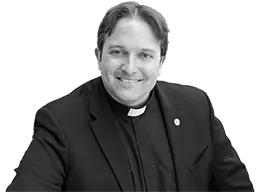
 Fr Matthew Charlesworth SJJesuit PriestSociety of JesusJesuit priest working in Southern AfricaFr. MatthewCharlesworthSJ
 23rd Sunday in Ordinary Time
Date: | Season: Ordinary Time after Easter | Year: A
First Reading: Ezekiel 33:7–9
Responsorial Psalm: Psalm 95:1–2, 6–9
| Response: Psalm 95:8
Second Reading: Romans 13:8–10
Gospel Acclamation: 2 Corinthians 5:19
Gospel Reading: Matthew 18:15–20
Preached at: Our Lady of the Wayside Parish, Mount Pleasant in the Archdiocese of Harare, Zimbabwe.
Early one morning, a man went to draw water from the village well. He lowered the bucket, pulled it up, and found only mud at the bottom. He tried again. Still mud. At first he thought, “This is my problem. I came too late.” Then his neighbour arrived with two containers. Then a child came, sent by her mother. Then an old woman came slowly, carrying a small bucket. Within minutes, everyone understood. This was not one man’s problem. The well was drying up. The whole village would have to face it together.
That is the truth behind today’s readings. We belong to one another. My words can heal or wound. My choices can help or harm. The way we treat land, water, food, and one another affects the poor first, and then everyone else.
So the message today is simple: because we belong to one another, God asks us to listen, to speak the truth with mercy, and to care for the earth we share.
In the first reading, God tells Ezekiel that he is a watchman or a sentry. A watchman keeps watch for the people. If danger is coming, he must warn them. If he stays silent, he has failed them.
Ezekiel is not asked to speak because he is better than others. He is asked to speak because others matter. A warning can be an act of love. A parent warns a child not to touch fire. A doctor warns a patient about a serious illness. A friend says, “Be careful, this road will hurt you.” That is not condemnation. That is care.
We need that kind of courage. We need people who can speak when someone is being harmed, when addiction is destroying a family, when money meant for the poor is being stolen, when a community is becoming cold or dishonest.
During the Season of Creation, we are also asked to watch over the earth. We must speak when water is wasted, when rubbish blocks drains, when trees are cut down carelessly, and when poor families suffer because food is scarce or too expensive. Care for creation is not separate from care for people. It is love made more practical.
Here in Zimbabwe, people know the value of water. We know the worry of dry ground and poor harvests. Many families struggle to provide food, school fees, medicine, and work. So caring for creation is not a hobby for people with extra time. It is a fundamental part of loving our neighbour.
Loving our neighbour also means being responsible citizens. We cannot care for the poor and stay silent when public money is misused, when services fail, when water is unsafe, or when leaders forget the people they are meant to serve. Holding government accountable is not rebellion. It is part of justice. Christians should not be violent or hateful, but neither should we be afraid to speak the truth publicly. We need brave, honest, peaceful citizens who ask fair questions, refuse corruption, protect the weak, and work for the common good - and hold their leaders to this same standard.
The Psalm says, “O that today you would listen to his voice. Harden not your hearts.” A hard heart says, “That is not my problem.” It hears the pain of another person and looks away.
But God says, “Listen.” Listen to his voice. Listen to the person you find difficult. Listen to the poor. Listen to what is happening around us. A dry well tells us something. A city dependent on boreholes tells us something. A hungry family tells us something. A quarrel in community tells us something. Even silence at a family meal can tell us something.
But before we correct anyone else, we must first listen to God. We can say something true in a way that wounds. We can be right, but proud. We can speak about justice and still have no mercy. So we must ask ourselves, “Lord, where is my own heart hard? Where do I need to change?”
St Paul gives us the rule for Christian life: “Love your neighbour as yourself.” He says that all the commandments are gathered into love. If I love my neighbour, I will not steal, lie, exploit, or do harm. Love refuses to treat another person as disposable.
So we ask, “Who is my neighbour?” My neighbour is the person I like, and the person I avoid. My neighbour is the brother or sister whose habits test my patience. My neighbour is the worker I may not notice. My neighbour is the family without enough food. My neighbour is the young person looking for work. My neighbour is also the child who will live after us and inherit the earth we leave behind.
To love our neighbour as ourselves also means receiving ourselves as God’s beloved children. We need mercy, rest, truth, and help. Without these, service can become bitterness. A person who has received God’s mercy is freer to give mercy.
In the Gospel, Jesus becomes very practical. If your brother or sister sins against you, go and speak to them alone. Do not begin with gossip. Do not begin by gathering support against them. Do not begin with cold silence. Go to the person. Speak directly. Speak privately. Speak with the hope of healing the relationship.
But we must be careful when we do this. Jesus is not telling someone who is unsafe to confront an abuser alone. In cases of abuse, violence, fear, or serious imbalances of power, sufficient protection is needed. The responsibility belongs especially to those who can protect, investigate, and act justly. Truth, safety, and justice are all part of Christian love.
But for ordinary day-to-day conflicts, Jesus gives us a clear path to pursue towards reconciliation and peace. First, we should try to speak with them alone. If that does not work, take one or two wise people with you. If that still does not work, involve the community. The aim is not to win the argument. The aim is to win back your brother or sister.
That is the heart of the Gospel. Not to shame them. Not to defeat them. Not to prove that you are better. But to win them back, to restore what has been damaged.
This is useful in family life, parish life, community life, and work. Many conflicts grow because people speak to everyone except the person involved. Resentment then spreads. Stories become larger. Hearts close. This evening Jesus gives us a better way: speak the truth, but speak it with mercy and love.
This also helps us care for God’s creation around us. We should not only complain about the big, existential problems facing our world - and there are many of those. We can begin instead with personal simple choices. For instance, how do we use water? How much food do we waste? Do we keep our shared places clean? Do we plant and protect trees? Do we think of the poor when we make decisions?
Notice the beautiful promise Jesus makes in the Gospel: “Where two or three meet in my name, I shall be there with them.” I really believe that Christ is present when two people pray before a hard conversation. He is present when a community meets honestly. He is present when a family decides to waste less. He is present when a few people choose peace instead of resentment.
The man at the well first thought the dry bucket was his own problem. Soon he saw that the whole village was involved. Tonight the Lord tells us the same thing: my brother’s or sister’s life concerns me; my neighbour’s suffering concerns me; the poor concern me; the earth God made concerns me.
So let us ask:
- Where have I stopped listening?
- Who is Jesus asking me to approach with truth and mercy?
- What simple action can I take this week for the poor and for the earth we share?
May Christ soften our hearts, open our ears, and teach us to love in practical ways. Amen.
Source: https://sj.mcharlesworth.fr/homilies/2026-09sep-06-ya-ot-23/
This homily is shared for personal and pastoral use. Please attribute the author and do not alter the meaning when quoting. If you wish this homily to be translated - there is an option on the website which will allow you to translate it into the language of your choice.
Licenced under a Creative Commons Attribution-NonCommercial-NoDerivatives 4.0 International (CC BY-NC-ND 4.0) license.
The author does not speak for the Society of Jesus or for the Catholic Church.





In preparing this homily, I consulted various resources to deepen my understanding of today’s readings, including using Magisterium AI for assistance. The final content remains the responsibility of the author.