
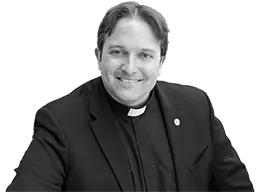
 Fr Matthew Charlesworth SJJesuit PriestSociety of JesusJesuit priest working in Southern AfricaFr. MatthewCharlesworthSJ
 26th Sunday in Ordinary Time
Date: | Season: Ordinary Time after Easter | Year: A
First Reading: Ezekiel 18:25–28
Responsorial Psalm: Psalm 25:4–9
| Response: Psalm 25:6a
Second Reading: Philippians 2:1–11 or 2
Gospel Acclamation: John 10:27
Gospel Reading: Matthew 21:28–32
Preached at: Our Lady of the Wayside Parish, Mount Pleasant in the Archdiocese of Harare, Zimbabwe.
Today’s readings call us to conversion: each of us must answer for our response to God, and together we are called to take on the mind of Christ.
In our first reading, we hear: “When a wicked man turns away from the wickedness he has committed and does what is lawful and right, he shall save his life.” Ezekiel reminds us that our past does not have to determine our future. The wicked can turn back to God and live; and those who have done what is right must not presume that past goodness means they no longer need to remain faithful. The prophet’s invitation is simple and urgent: “Turn and live.”
Ezekiel challenges a proverb that blamed the parents for the children’s suffering: “The parents have eaten sour grapes, and the children’s teeth are set on edge.” He insists that we cannot use the past—or other people’s wrongdoing—to excuse our own choices. Each of us is responsible for the way we respond to God. And each of us, every day, is invited to turn towards the Lord, in whom we find life.
In the Gospel, Jesus tells the story of two sons. One says no to his father, but later changes his mind and goes to work. The other says yes, but does not go. The difference is not in what they say, but in what they do. Jesus addresses this parable to the chief priests and elders, who have questioned his authority. He begins with a question: “What do you think?” He invites them to judge the two sons—and then turns their answer back on them.
They recognize that the son who actually goes to work does the father’s will. But Jesus tells them that tax collectors and prostitutes, who believed John and changed their minds, are entering the Kingdom of God ahead of them. The parable is pointed, but its challenge is not only for Jesus’ first hearers. It asks each of us: am I willing to let God’s word change my mind and the way I act?
The story is a familiar one: actions speak louder than words. But it also warns us against using it simply to condemn other people. The chief priests and elders could see clearly what the sons ought to do, yet they did not recognize the truth about their own response. So we should ask not only, “Who are the two sons?” but also, “Where am I in this story?” Do I promise more than I carry out? Have I said no to God, but now feel the invitation to turn back and begin again? Or am I resisting a truth God is asking me to accept?
The Gospel leaves room for conversion. The first son changes his mind and goes. That is the same hope we heard about last week, when the workers who came at the eleventh hour were welcomed into the vineyard. It is also the hope we see in the thief on the cross, who turned to Jesus at the end of his life. When someone turns back to God, the past does not have the last word. God forgives, and the person is called to begin living differently.
There is a beautiful connection between the verbs in today’s readings. Ezekiel speaks of turning away from wrongdoing and doing what is right. The psalm asks God to teach and lead us in his ways. Paul urges us to look to the interests of others and to take on the mind of Christ. And in the Gospel, one son changes his mind and goes to work. Turn, teach, lead, look to others, go: the readings describe conversion not merely as a feeling or a promise, but as a new direction that becomes visible in what we do.
In our second reading, St Paul reminds us that faith is not something we live in isolation. He calls the Philippians to be united, humble, and attentive to one another. To have the mind of Christ is, on one level, to imitate him: to let his way of living become the pattern for our own. But it means something more as well. Through faith and baptism, we share in Christ’s life. We are called to let his Spirit shape us from within, opening our lives, our hearts, and our minds to God.
Paul points us especially to Christ’s humility and self-giving love. Jesus humbled himself and became obedient, even to death on a cross. In the Eucharist, we encounter Jesus in this act of self-giving love. As we celebrate and share in it, we are invited and strengthened to put on his mind and become more like him—not only in what we believe, but in how we treat one another.
And that is the challenge running through today’s readings: it is not enough simply to say the right words. We have to back up our words with actions. In a few moments, we will say the Creed together and profess our faith. These are very fine words. But when we profess belief in the forgiveness of sins, we must ask ourselves whether we are willing to begin the hard work of forgiving—and to ask God for the grace to do it. St Ignatius reminds us that love is found more in deeds than in words.
The Gospel gives us two challenges: do not despair of conversion, and do not mistake good words for obedience. Jesus has come to call and heal those who know they need him. The Eucharist is not a reward for the perfect; it is food and medicine for those who need the Lord’s help. And none of us is called to respond alone. We belong to a community in which we can encourage one another, support one another, and help one another live the faith we profess.
Today, as we mark the World Day of Migrants and Refugees, Pope Leo XIV asks us to remember especially migrant and refugee children. He calls us to listen to each child’s story, recognize each child’s dignity, and make welcome and care a lasting practice in our communities.
One way of putting that call into action is to recall the four verbs Pope Francis gave us: welcome, protect, promote, and integrate. They ask more of us than kind words: to receive people with dignity, safeguard them from harm, support their gifts and development, and help them find a place in the community. These, too, are ways of doing the Father’s will—not only saying yes, but going to work.
Let us ask the Holy Spirit to help us put our words into action. May we take on the heart and mind of Christ, so that we can serve others and, together, bring his charity, love, and mercy into the world.
Amen.
Source: https://sj.mcharlesworth.fr/homilies/2026-09sep-27-ya-ot-26/
This homily is shared for personal and pastoral use. Please attribute the author and do not alter the meaning when quoting. If you wish this homily to be translated - there is an option on the website which will allow you to translate it into the language of your choice.
Licenced under a Creative Commons Attribution-NonCommercial-NoDerivatives 4.0 International (CC BY-NC-ND 4.0) license.
The author does not speak for the Society of Jesus or for the Catholic Church.





In preparing this homily, I consulted various resources to deepen my understanding of today’s readings, including using Magisterium AI for assistance. The final content remains the responsibility of the author.