
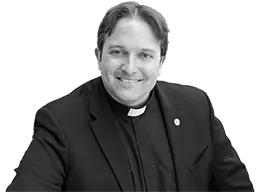
 Fr Matthew Charlesworth SJJesuit PriestSociety of JesusJesuit priest working in Southern AfricaFr. MatthewCharlesworthSJ
 27th Sunday in Ordinary Time
Date: | Season: Ordinary Time after Easter | Year: A
First Reading: Isaiah 5:1–7
Responsorial Psalm: Psalm 80:9, 12–16, 19–20
| Response: Psalm 5:7a
Second Reading: Philippians 4:6–9
Gospel Acclamation: John 15:16
Gospel Reading: Matthew 21:33–43
Preached at: the Chapel of Emmaus House in the Archdiocese of Harare, Zimbabwe.
The great mistake made by the tenants in today’s Gospel is not that they fail to work the vineyard. Their deeper mistake is that they begin to behave as though the vineyard belongs to them.
That may be the thread running through all our readings today: the difference between receiving something as a gift and grasping it as a possession.
The vineyard belongs to another. The tenants have been entrusted with it. They are expected to cultivate it, care for it and hand over its fruit. But gradually they forget that they are tenants. They begin to think like owners. Finally, when they see the son coming, they say: “This is the heir. Come, let us kill him and have his inheritance.”
They want to possess what can only ever be received.
Jesus is taking up the image we heard from Isaiah. God carefully prepares his vineyard. He clears the stones, plants good vines, builds a watchtower and digs the winepress. Then comes one of the saddest questions in Scripture: “What more was there to do for my vineyard that I have not done in it?”
God has given everything that was needed. But instead of good grapes, the vineyard produces wild grapes.
Isaiah tells us what those bad grapes are. God looked for justice and found bloodshed. He looked for righteousness and heard the cry of those who were suffering.
And in Hebrew there is a bitter play on words. The word for justice sounds like the word for bloodshed, and the word for righteousness sounds like the word for a cry of distress. It is as though God says: “I planted one thing, and what came back sounded almost the same, but was its terrible opposite.”
That is the measure of the vineyard. Not simply whether it looks religious, but whether it produces justice, goodness and life.
We should also be careful about how we hear this Gospel. The parable confronts the religious leaders Jesus is addressing. It is not a warrant for Christians to condemn the Jewish people or to imagine that God rejected Israel and replaced it with us. Jesus speaks within Israel, as one of Israel’s prophets.
But the parable turns the question back on us. If the vineyard is entrusted to us now, what kind of tenants are we?
The Church is entrusted to us. Our communities and ministries are entrusted to us. And on this final day of the Season of Creation, we might also say that the earth itself has been entrusted to us.
It does not belong to us.
In Zimbabwe, land carries enormous historical and emotional weight. Land means livelihood, memory, identity and inheritance. We know what can happen when land, wealth and power become entangled with fear and possession. Yet Scripture reminds us: “The earth is the Lord’s and all that is in it.”
We are tenants.
That does not make us passive. Tenants have responsibilities. We cultivate the vineyard, protect it and make it fruitful. But its fruit is never meant only for ourselves.
The same is true of the Church.
Those of us who have lived religious life for many years know something about this. Our vows are meant to teach us non-possession. Poverty reminds us that what we have is gift. Chastity reminds us that other people are never our possessions. Obedience reminds us that our plans and preferences are not absolute.
And yet it is possible to take vows of non-possession and still become possessive: about our ministries, our positions, our institutions, even our memories of how things used to be.
We can begin saying, without words: this is our vineyard.
And God continues sending messengers: younger people, the poor, people whose experience of the Church is difficult for us to hear. The question is whether we remain capable of listening.
But today’s Gospel is not simply a warning. It contains an extraordinary turn.
The tenants reject the son. They throw him outside the vineyard and kill him. And God makes even this the beginning of something new.
“The stone rejected by the builders has become the cornerstone.”
Human beings discard; God gathers up. Human beings reject; God restores. Human beings kill; God brings life.
As Pope Leo reminds us, God never discards our lives.
That matters as we grow older. The world often measures human value according to productivity: What can you still do? How useful are you?
But the Gospel never says that our dignity depends upon our productivity. Nor does fruitfulness mean constant activity.
There is fruitfulness in prayer, in wisdom handed on quietly, in encouraging someone younger, in gratitude, in asking forgiveness, and in accepting help graciously.
There is still fruit to bear, even when the form of that fruit changes.
Saint Francis of Assisi, whose death the Church commemorates this year eight hundred years on, understood something of this.
When Christ spoke to him from the crucifix at San Damiano and said, “Francis, repair my Church,” Francis first thought he was being asked to repair a building. Eventually he discovered that Christ wanted something much greater.
Francis repaired the Church first by allowing Christ to repair Francis.
He did not begin with a programme. He began with conversion.
He relinquished possession, status and security. He chose fraternity. He drew close to the poor. He learned to call the sun his brother and the earth his sister. He discovered that once we stop trying to possess everything, we can begin to receive everything as gift.
That also helps us hear Saint Paul today.
“Do not be anxious about anything,” he says. But he does not simply tell the Philippians to stop worrying. He tells them what to do with their anxiety:
“In everything, by prayer and supplication with thanksgiving, let your requests be made known to God.”
Paul’s answer to anxiety is not denial. It is prayer, thanksgiving and trust.
Then he tells them where to place their attention: whatever is true, honourable, just, pure, lovely and worthy of praise.
When we know the vineyard belongs to God, we no longer have to pretend that everything depends upon us. We still work. We still speak when we must speak. We still do what justice requires. But we entrust the vineyard back to God.
That may be an important word for us in Zimbabwe, where there are many reasons for anxiety: migration, economic insecurity, uncertainty about the future, and young people wondering whether they can build their lives here.
We cannot solve everything. But neither are we helpless.
We can ask: what kind of fruit is growing in the part of the vineyard entrusted to me?
Justice or resentment? Gratitude or bitterness? Hospitality or possessiveness? Generosity or fear?
There is still fruit to bear. Not because we must prove our usefulness to God, but because God has not finished with us.
The rejected stone becomes the cornerstone. The wounded Christ becomes the source of life. Francis, who owned almost nothing, leaves the Church an inheritance still bearing fruit eight hundred years later.
And perhaps that is what we should ask for today: not that we possess the vineyard, but that when the Lord comes looking for its fruit, he finds something good growing among us.
Something true. Something just. Something gracious. Something that gives life to someone else.
And during this week we might carry three questions into prayer:
- What has God entrusted to me that I have begun to treat as though it belongs to me?
- What fruit is God asking of me now, at this stage of my life, rather than the fruit I was able to produce twenty or forty years ago?
- And where is Christ, the rejected stone, asking to rebuild something in me so that I may become an instrument of his peace?
Source: https://sj.mcharlesworth.fr/homilies/2026-10oct-04-ya-ot-27/
This homily is shared for personal and pastoral use. Please attribute the author and do not alter the meaning when quoting. If you wish this homily to be translated - there is an option on the website which will allow you to translate it into the language of your choice.
Licenced under a Creative Commons Attribution-NonCommercial-NoDerivatives 4.0 International (CC BY-NC-ND 4.0) license.
The author does not speak for the Society of Jesus or for the Catholic Church.





In preparing this homily, I consulted various resources to deepen my understanding of today’s readings, including using Magisterium AI for assistance. The final content remains the responsibility of the author.