
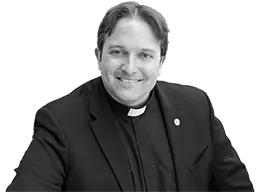
 Fr Matthew Charlesworth SJJesuit PriestSociety of JesusJesuit priest working in Southern AfricaFr. MatthewCharlesworthSJ
 29th Sunday in Ordinary Time
Date: | Season: Ordinary Time after Easter | Year: A
First Reading: Isaiah 45:1, 4–6
Responsorial Psalm: Psalm 96:1, 3–5, 7–10
| Response: Psalm 96:7b
Second Reading: 1 Thessalonians 1:1–5b
Gospel Acclamation: Philippians 2:15d, 16a
Gospel Reading: Matthew 22:15–21
Preached at: the Chapel of Emmaus House in the Archdiocese of Harare, Zimbabwe.
The coin in today’s Gospel bears Caesar’s image. The person holding it bears God’s.
Jesus’ questioners begin with flattery, praising His honesty. Then comes the trap: is it lawful to pay taxes to Caesar?
Refusing the tax could bring Him into conflict with the Roman authorities. Supporting it could discredit Him among people living under occupation.
Jesus asks for a coin. Whose image and inscription does it carry?
Caesar’s.
Then give Caesar what belongs to Caesar, and God what belongs to God.
Genesis tells us that every human being bears God’s image. We might therefore take Jesus’ question further: whose image does Caesar carry? The emperor himself stands before God, answerable for his decisions and treatment of others.
Giving God what belongs to God reaches into every part of life. We honour Him through honesty, service and our treatment of the neighbour who bears His image.
In our first reading, God addresses Cyrus, the Persian king, as His anointed. This ruler does not know Israel’s God, yet through him the way will open for the exiles to return home.
Cyrus is an exmaple of God working through someone outside the community of believers. We should remain ready to recognise truth, courage and justice wherever, and in whomever, they appear.
Cyrus serves God’s liberating purpose. He may open the gates, but the Lord remains God.
The psalm invites every nation to praise the Creator, whose authority embraces every ruler and whose reign is marked by justice.
That gives us a searching measure of leadership: what happens to the people, especially those with little influence, under someone’s rule?
Here in Zimbabwe, exchanges between the President and the Vice-President, and debate about appointments and succession, raise questions about power. At the party conference, the Vice-President appealed to accountability, members’ participation and development that improves ordinary people’s lives.
Those principles provide a measure for every leader, including the person who voices them.
We should distinguish our responsibilities to the country from our loyalties to a party or an individual. The State has a responsibility to serve every citizen, including those who support another party or belong to none. Public office is a trust. Public resources are entrusted for the public good, not one’s private benefit.
A Christian can serve a party honestly and respect its legitimate procedures. Sometimes that service requires asking difficult questions.
But no membership card can make a lie true. No instruction from a powerful person can make cruelty good. No political opponent loses the dignity received from God.
Responsible citizenship means contributing to the common good, paying what we legitimately owe and respecting others’ rights. The Catechism recognises citizens’ right, and at times their duty, to voice just criticism of what harms human dignity and the common good. It also says we must refuse directives that violate the moral order, fundamental rights or the Gospel. We may defend our own and others’ rights against abuses of authority, within the limits of natural law and the Gospel.
That requires a conscience formed through prayer, reliable evidence, honest discussion and attention to those who suffer.
Speaking honestly can threaten a person’s livelihood or safety. Those who bear its cost need solidarity and practical support. It is easy to recommend bravery from a comfortable distance.
Every person bears God’s image. A hungry person has dignity before receiving anyone’s generosity. A young person has worth before acquiring a powerful connection. A citizen’s rights remain rights when that citizen disagrees with those in office.
This Gospel searches our hearts too. In our examen, we can ask what moved us today: love, fear, gratitude, or the desire for approval. We need the freedom to give God our whole selves.
That freedom belongs at the heart of our missionary vocation.
For this hundredth World Mission Sunday, Pope Leo XIV has chosen the theme: “One in Christ, united in mission.” He connects missionary witness with reconciliation within Christian communities, and remembers missionaries such as our own St Francis Xavier who left familiar surroundings to proclaim Christ.
As Jesuits, we are formed to be available for mission, ready to go where the Church’s need calls us. That includes serving wherever we are needed across our much larger Province.
That availability can carry us across a border or deeper into familiar places: towards a language we struggle to learn, a community we misunderstand, a young person whose questions unsettle us, or a wounded person whose experience we have been reluctant to hear.
Whether in a classroom, parish, formation house, office or infirmary, each of us can ask: Lord, how are you asking me to give myself here?
We proclaim Jesus Christ, crucified and risen. His name belongs on our lips, and His compassion must shape our actions. We can ask ourselves: what would Jesus do here? Through our words and actions, people should encounter the God who knows them, loves them and calls them into life.
Mission begins with humility. We approach people with something precious to share, and with much to receive. Zimbabwean Christians have faith, wisdom and gifts to offer the whole Church. Our prayer and practical support for missions express our belonging to that wider communion.
The Pope’s call to unity begins with us. Our common prayer, willingness to listen, fairness towards colleagues and readiness to seek forgiveness all belong to our missionary witness. People learn something about Christ from the way we treat one another in community and in the Society.
The questions we ask about public authority also belong within our communities and institutions. Do people experience our authority as true service? Can they speak honestly to us? Do we listen when their experience challenges our account of ourselves?
Paul thanks God for the Thessalonians’ faith expressed in action, love expressed in labour, and hope expressed in endurance. Like them, we are called to let these virtues shape our lives.
As teachers, we prepare carefully because the children matter. In community, we make room for one another, with all the patience and forgiveness that requires. A citizen tells the truth when exaggeration or silence would be more useful. We seek to accept our missions generously, without needing recognition.
These are places where the Gospel takes flesh in our lives.
Paul’s gratitude also invites us to notice the good already growing around us. We can become so absorbed in failures and rivalries that we overlook faithful people doing demanding work with little recognition. The Holy Spirit is already at work in them. God is there before us. As missionaries, we learn to recognise and cooperate with His work, to proclaim Jesus Christ, and to help people respond to His love. In that encounter, we too are called to deeper faith.
At the beginning of this Mass, we asked God that we might conform our will to His and serve Him in sincerity of heart. That prayer gathers together everything these readings ask of us.
As Christ gives Himself to us in this Eucharist, we ask for the grace to offer Him our whole selves: our loyalties and decisions, our authority and service, our readiness to go where we are sent. We bring him our divided hearts, our fears and our weariness. May He give us the freedom to serve, the courage to speak truthfully, and the charity to recognise His image even in someone we find difficult.
Caesar’s image is stamped on a coin. God’s image lives in the neighbour placed before us. Our mission is to help that neighbour encounter the love of Christ.
As we enter this week, let us carry three questions into prayer.
- Where is fear, comfort or loyalty drawing my heart away from what I know God asks of me?
- Whose dignity is Christ asking me to recognise and defend, especially across a division I would rather avoid?
- What concrete act of faith, love or hope will make me more available for His mission this week?
Let us pray, too, for Pope Leo’s continued recovery, that the Lord may grant him healing, renewed strength and peace as he serves the Church. Amen.
Source: https://sj.mcharlesworth.fr/homilies/2026-10oct-18-ya-ot-29/
This homily is shared for personal and pastoral use. Please attribute the author and do not alter the meaning when quoting. If you wish this homily to be translated - there is an option on the website which will allow you to translate it into the language of your choice.
Licenced under a Creative Commons Attribution-NonCommercial-NoDerivatives 4.0 International (CC BY-NC-ND 4.0) license.
The author does not speak for the Society of Jesus or for the Catholic Church.





In preparing this homily, I consulted various resources to deepen my understanding of today’s readings, including using Magisterium AI for assistance. The final content remains the responsibility of the author.