
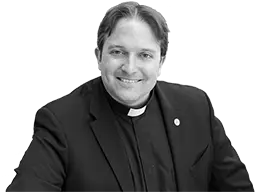
 Fr Matthew Charlesworth SJJesuit PriestSociety of JesusJesuit priest working in Southern AfricaFr. MatthewCharlesworthSJ
 Friday of the 30th Week in Ordinary Time
Date: | Season: Ordinary Time after Easter | Year: A
First Reading: Philippians 1:1–11
Responsorial Psalm: Psalm 111:1–6
| Response: Psalm 111:2
Gospel Acclamation: John 10:27
Gospel Reading: Luke 14:1–6
Preached at: Our Lady of the Wayside Parish, Mount Pleasant in the Archdiocese of Harare, Zimbabwe.
At the Sabbath meal, everyone is watching Jesus. But Jesus is looking at a suffering man. And in that difference lies the heart of today’s readings: we can see what is happening around us and still fail to recognise what really matters.
Jesus has been invited to the house of a leading Pharisee. The guests are watching Him closely. And there, in front of Him, is a man suffering from dropsy, a painful swelling of the body. The question hanging over the meal is whether Jesus will heal on the Sabbath.
Jesus asks whether healing is lawful. They remain silent. So He takes the man, heals him, and sends him away. Then comes His searching question. If your child or your ox fell into a well on the Sabbath, would you not pull it out immediately?
Of course they would. Love would not allow them to wait. And that is precisely the point. If compassion is urgent when someone belongs to us, why should it become optional when the suffering person is a stranger?
Jesus is not rejecting the Sabbath. He is restoring its deepest meaning. God’s law was given to protect life and human dignity, not to provide excuses for withholding mercy. We can be correct about rules and still be wrong in how we treat people.
This is precisely what Paul is praying for in the first reading. Writing from prison to the Christians of Philippi, he asks that their love may grow in knowledge and understanding, so that they may recognise what really matters.
Notice that Paul does not simply ask them to love more. He asks them to love more wisely. Because love needs discernment. We can spend our lives doing good things and still neglect the good that God is asking of us here and now.
Saint Ignatius teaches us to seek and find God in all things. There is a saying often attributed to him: “The good is the evil of the better, which is the evil of the best.” In other words, even good things can become obstacles when they prevent us from choosing the greater good that God is asking of us. Sometimes that greater good comes as an interruption we would rather avoid: a child who needs our attention when we are tired, an elderly neighbour longing for company, a colleague struggling in silence, or a stranger whose need makes us uncomfortable. The question is whether we recognise Christ when He comes to us in an inconvenient form, and whether we are willing to set aside something good for the sake of a greater love.
The psalm reminds us that the Lord is gracious and compassionate, that He remembers His covenant and gives food to those who depend on Him. That compassion must become visible in our own lives. Here in Zimbabwe, where many families struggle to meet their daily needs, mercy cannot remain a fine sentiment. It must become generosity, justice and practical care, especially towards those who have little influence or power.
Today we also remember Blessed Dominic Collins, a Jesuit brother and martyr. Once a successful soldier and cavalry captain, he left military honour behind to serve Christ. He tended the wounded during the siege of Dunboy Castle, and when imprisonment and the threat of death tested his faith, he refused to abandon Christ. He was hanged at Youghal in 1602.
Dominic understood what Paul was praying for. He had learnt to distinguish what mattered from what merely appeared important. His life reminds us that discernment is not simply choosing between good and evil. Often it is choosing between what is good and what love asks of us more urgently.
And there is consolation in Paul’s assurance that the God who began a good work in us will bring it to completion. We are still learning to love. God is still teaching us to see as Jesus sees.
At that Sabbath table, others were watching for a mistake. Jesus was looking for someone to heal. May we learn to look with His eyes, to recognise what matters, and to have the courage to act upon it.
As we pray this evening, let us ask ourselves:
- When I imagine myself at that Sabbath table, am I watching Jesus from a distance, or standing beside the man who needs His compassion?
- Where am I allowing habit, pride or the desire to be right to prevent me from doing what love requires?
- And who is the one person Christ is asking me to notice and care for today?
Source: https://sj.mcharlesworth.fr/homilies/2026-10oct-30-ya-ot-30/
This homily is shared for personal and pastoral use. Please attribute the author and do not alter the meaning when quoting. If you wish this homily to be translated - there is an option on the website which will allow you to translate it into the language of your choice.
Licenced under a Creative Commons Attribution-NonCommercial-NoDerivatives 4.0 International (CC BY-NC-ND 4.0) license.
The author does not speak for the Society of Jesus or for the Catholic Church.





In preparing this homily, I consulted various resources to deepen my understanding of today’s readings, including using Magisterium AI for assistance. The final content remains the responsibility of the author.