
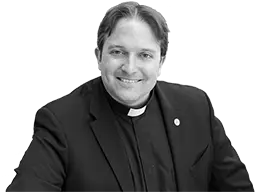
 Fr Matthew Charlesworth SJJesuit PriestSociety of JesusJesuit priest working in Southern AfricaFr. MatthewCharlesworthSJ
 Solemnity of All Saints
Date: | Season: Ordinary Time after Easter | Year: A
First Reading: Revelation 7:2–4, 9–14
Responsorial Psalm: Psalm 24:1b–4b, 5–6
| Response: Psalm 24:6
Second Reading: 1 John 3:1–3
Gospel Acclamation: Matthew 11:28
Gospel Reading: Matthew 5:1–12a
Preached at: the Chapel of Emmaus House in the Archdiocese of Harare, Zimbabwe.
There are saints whose names we know, and saints whose names are known only to God. Today we celebrate both. All Saints reminds us that God calls each of us to become a saint, not through our own strength, but through his grace. He sees not only who we are today, with our strengths and weaknesses, our achievements and regrets, but who we can become. God has not finished with any of us.
In our first reading, St John sees a great multitude that nobody can count, drawn from every nation, tribe, people and language. Among them are the saints whose names fill our calendars, and countless others whose holiness was known only to God: people who quietly fed the hungry, forgave their enemies, cared for the sick and brought peace into troubled homes.
Perhaps you can bring to mind a Jesuit you have lived with whose life seemed to you to have something saintly about it. Perhaps it was his patience, his faithfulness in prayer, or his care for people others overlooked. You knew his weaknesses too. He was not perfect. But something of Christ shone through him. And perhaps that is how we first come to recognise holiness: not in extraordinary achievements, but in ordinary lives transformed by grace.
John tells us that their robes have been washed white in the blood of the Lamb. What a strange image: blood normally stains a garment, yet here it makes it clean. The saints did not save themselves or make themselves holy by their achievements. They were redeemed by Christ. His grace was at work in them, and they welcomed it, allowing it to change their lives.
That is a consoling vision for a community such as ours, where some have travelled a long road in religious life while others are only beginning. The world measures a person’s worth by achievement and recognition. God sees what such measures miss.
The years spent teaching, preaching and accompanying others matter greatly. So do the quieter years, when strength diminishes and prayer, patience and kindness become the gifts we can offer. A word of encouragement given fifty years ago may still be bearing fruit today. Much of that good escapes our notice, but God sees it.
St John reminds us that we are already God’s children, not when we have achieved enough or overcome every weakness, but here, as we are. “What we shall be has not yet been revealed,” he says. Then comes the promise: “We shall be like him.”
That is our destiny: through Christ, to share in the very life of God. So there is still room to grow after many decades of religious life. And for our younger brothers, this journey does not begin after formation or ordination. It begins now, in the way we study, pray, listen and serve.
God does not ask an eighty-year-old Jesuit to become thirty again, nor a young scholastic to possess the wisdom of fifty years of religious life. He asks each of us to respond faithfully to the grace of today.
We may no longer do what we once did, but we can still love. And no life given to love is ever wasted.
That brings us to the question in today’s psalm: “Who shall climb the mountain of the Lord?” The answer is the one with clean hands and a pure heart.
For the psalmist, the heart was more than the place of feelings: it was the place within us where we discern and choose. Clean hands speak of just actions; a pure heart speaks of an undivided desire for God, free from deceit. That does not mean never struggling or making mistakes. It means seeking, in each choice, to listen for God’s will and follow it as best we can.
The psalm asks what a life turned towards God looks like. In the Gospel, Jesus answers by showing us the way: the Beatitudes.
Jesus calls blessed the poor in spirit, those who mourn, the meek, those who hunger and thirst for righteousness, the merciful, the pure in heart, the peacemakers and those persecuted for righteousness. These are not simply promises of happiness in the next life. They show us what it means to live according to God’s Kingdom here and now. The Beatitudes describe the way Jesus lived, and the saints are those who, by his grace, learned to follow him.
Here in Zimbabwe, where so many struggle to make ends meet, the Beatitudes remind us that the poor and vulnerable occupy a special place in Christ’s heart. Feeding the hungry matters. So does working to change the conditions that leave so many people hungry.
For us as Jesuits, that work belongs to our mission of faith and justice. But the way of the Beatitudes begins nearer home, too: in our patience with an ageing brother, in our willingness to listen across generations, and in the kindness we show those who work alongside us. Sometimes the peacemaking Jesus praises begins around our own dining table.
Ignatius invites us to contemplate Jesus in the Gospel. Imagine yourself sitting among the crowd as he speaks. Notice how he looks at those gathered before him, with all their struggles and disappointments. Then imagine him turning towards you with that same loving gaze.
He sees more than your achievements or failures. He sees a beloved child of God, someone whom his grace is still drawing into his likeness.
Perhaps that is the gift of today’s feast. When God looks at our little Jesuit community, he does not see one generation whose work is finished and another whose work has yet to begin. He sees one family, called to the same path and sustained by the same grace.
As we enter this new week, perhaps we can carry three questions into our daily Examen:
- Where have I stopped believing that God’s grace can still change me?
- Who in our community, or among the poor around us, is Christ inviting me to love more generously?
- What must I let go of so that God can continue his work in me?
The saints are not simply people we admire from a distance. They are our brothers and sisters, encouraging us along the same road. They remind us that God’s mercy is greater than our failures, his love stronger than our fears, and his grace more powerful than anything we can accomplish alone.
God has not finished with us. Christ, who has redeemed us, is still at work, making us holy.
Source: https://sj.mcharlesworth.fr/homilies/2026-11nov-01-ya-ot-as/
This homily is shared for personal and pastoral use. Please attribute the author and do not alter the meaning when quoting. If you wish this homily to be translated - there is an option on the website which will allow you to translate it into the language of your choice.
Licenced under a Creative Commons Attribution-NonCommercial-NoDerivatives 4.0 International (CC BY-NC-ND 4.0) license.
The author does not speak for the Society of Jesus or for the Catholic Church.





In preparing this homily, I consulted various resources to deepen my understanding of today’s readings, including using Magisterium AI for assistance. The final content remains the responsibility of the author.