
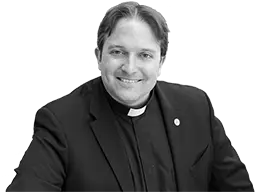
 Fr Matthew Charlesworth SJJesuit PriestSociety of JesusJesuit priest working in Southern AfricaFr. MatthewCharlesworthSJ
 Commemoration of the faithful departed / All Souls’ Day (anticipated)
Date: | Season: Ordinary Time after Easter | Year: A
First Reading: Job 19:1, 23-27a
Responsorial Psalm: Psalm 23:1–6
| Response: Psalm 23:1
Second Reading: Romans 5:5–11
Gospel Acclamation: John 11:25–26
Gospel Reading: John 11:17–27
Preached at: St George’s College in the Archdiocese of Harare, Zimbabwe.
Let me begin by thanking the Catenians here in Harare for inviting me to celebrate this Mass with you this afternoon. I am particularly grateful to be with you on this occasion, when we remember and pray for our departed brothers and friends. We come to thank God for their lives, for their friendship, and for the many ways in which they enriched our own lives.
In a little while, we shall hear their names read aloud. And each name will bring back something different: a face, a voice, a conversation, perhaps a kindness we have never forgotten. For some, especially the wives and families here this afternoon, those names will also awaken the pain of absence. Someone who once shared so much of our life is no longer with us.
And so we gather with gratitude, with sorrow, and above all, with Christian hope.
This morning, the Church celebrated All Saints’ Day. We rejoiced in those who now live in the fullness of God’s presence, the great saints whose names we know, and the countless ordinary men and women whose holiness was known perhaps only to God.
On All Souls’ Day, we remember and pray for those who have died. We commend them to God’s mercy, asking him to forgive whatever needs forgiveness, to complete whatever purification is needed, and to bring them into the joy of heaven.
The Church places these two days together for a reason. All Saints reminds us of the destiny to which God calls us. All Souls reminds us that our love and our prayers for one another do not end with death. We remain one family in Christ, united in the communion of saints.
And why do we pray for the dead? Because we believe in the mercy of God. St Paul tells us today that “while we were still sinners Christ died for us.” Our departed brothers were good men, but they were also human, with their generosity and their failings, just like ourselves. We do not entrust them to a God who must be persuaded to love them. We entrust them to the God who has already shown how much he loves them, through the death of his Son.
And so Paul can say with confidence, “Hope does not disappoint.”
That same hope runs through all our readings.
Job, a man who has lost almost everything, cries out, “I know that my Redeemer lives.” His suffering has not ended. His questions have not all been answered. But he believes that God will not abandon him. And he longs for the day when, as he says, “my own eyes, not another’s, shall behold him.”
The psalmist gives that hope a beautiful image: “Though I should walk in the valley of the shadow of death, no evil would I fear, for you are with me.” Notice, the Shepherd does not promise to keep us out of that valley. He promises to walk through it with us.
And then, in the Gospel, we meet Martha. Her brother Lazarus has died. When she sees Jesus, she says, “Lord, if you had been here, my brother would not have died.”
How human those words are! How often we have felt something similar when someone dear to us has died.
Jesus does not rebuke Martha for her grief. Instead, he gives her the greatest promise in the Gospel: “I am the resurrection and the life; whoever believes in me, even if he dies, will live.”
Jesus does not simply promise that Lazarus will be remembered. He promises life beyond death. Our Christian hope is not merely that our loved ones will live on in our memories, precious as those memories are. Our hope is that Christ will raise us to share in his own risen life.
And that is why we are here this afternoon.
The Catenian Association began in Manchester in 1908, when Catholic men came together to support one another in their faith and in their daily lives. Its name comes from the Latin word catena, meaning a chain. Each brother is a link in that chain, contributing to its strength.
That chain has reached us here in Harare. And today we give thanks for the men who helped to strengthen it through their friendship, their faith, and their service to others.
But remembering them also places a responsibility upon us. We cannot honour the friendship of those who have died while forgetting the people they loved. A visit to a widow, a telephone call, practical help when life becomes difficult: these are ways in which our faith becomes visible. They are ways of keeping faith with our brothers.
And now, as we prepare to remember them by name, let me invite you to do something in the spirit of St Ignatius of Loyola.
For a moment, bring to mind the face of someone who has died. Perhaps one of our Catenian brothers. Perhaps your husband, your father, or a dear friend.
Remember his voice. Recall something good he did, some kindness he showed, some wisdom he shared. Perhaps remember a moment when his friendship helped you through a difficult time, or when his faith helped you to recognise God’s presence in your own life.
And then, quietly, say to God:
“Lord, thank you for the gift of this person. Thank you for the good I received through him. Forgive his failings, receive him in your mercy, and help me to carry forward what was good and generous in his life.”
Let us keep a few moments of silence.
And perhaps, as we leave here this afternoon, after our braai together, we might carry three simple questions with us.
- What have I received from those who have gone before me, for which I still need to thank God?
- What did their lives teach me about knowing God and trusting his promises?
- And whose life can I make better, here and now, through my friendship, my faith and my love?
Jesus asked Martha, “Do you believe this?”
Today, he asks us the same question.
May our prayers for our departed brothers, our gratitude for their lives, and our love for those they have left behind become our answer.
Yes, Lord, we believe. We believe that you are the resurrection and the life. Amen.
Source: https://sj.mcharlesworth.fr/homilies/2026-11nov-02-ya-ot-as/
This homily is shared for personal and pastoral use. Please attribute the author and do not alter the meaning when quoting. If you wish this homily to be translated - there is an option on the website which will allow you to translate it into the language of your choice.
Licenced under a Creative Commons Attribution-NonCommercial-NoDerivatives 4.0 International (CC BY-NC-ND 4.0) license.
The author does not speak for the Society of Jesus or for the Catholic Church.





In preparing this homily, I consulted various resources to deepen my understanding of today’s readings, including using Magisterium AI for assistance. The final content remains the responsibility of the author.