
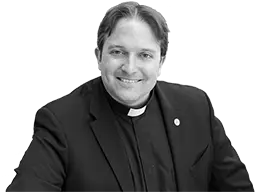
 Fr Matthew Charlesworth SJJesuit PriestSociety of JesusJesuit priest working in Southern AfricaFr. MatthewCharlesworthSJ
 Requiem Mass for the repose of the soul of Conçeição das Dores Mendes Machado
Date: | Season: Ordinary Time after Easter | Year: A
First Reading: Ecclesiastes 3:1-11
Responsorial Psalm: Psalm 23:1–6
| Response: Psalm 23:1
Second Reading: Romans 8:31-35, 37–39
Gospel Acclamation: Matthew 11:28
Gospel Reading: Matthew 11:25-30
Preached at: Our Lady of the Wayside Parish, Mount Pleasant in the Archdiocese of Harare, Zimbabwe.
Conceição is a beautiful Portuguese name, although I fear my pronunciation may not do it justice. Many of her English-speaking friends knew her simply as Connie, and I shall follow their affectionate example.
Her son has spoken movingly of the life she lived and the love she gave. I would like to remember one quiet part of that life: Connie praying the Rosary.
I picture the familiar beads passing through her fingers, the words repeated, and the people she loved carried in her prayers. Children, grandchildren, great-grandchildren, relatives and friends. I suspect Connie never ran out of people to pray for. And from what her son has told us about her love for her family, I wouldn’t be surprised if some of those prayers came with a little motherly advice, not all of it requested!
Connie has already been laid to rest in Portugal. Today, here in Zimbabwe, we gather as family and friends, many of us through our friendship with her son and his family. We come to remember Connie with affection, to give thanks for her life, and above all to commend her to God. There is distance between Zimbabwe and Portugal, but there is no distance in the prayer we offer together today.
Our first reading, from Ecclesiastes, reminds us that “there is a time for everything, and a season for every activity under heaven.”
A time to be born and a time to die. A time to weep and a time to laugh. A time to embrace and a time to refrain from embracing.
These words speak honestly about life. We cannot hold on to every season we cherish, and we cannot prevent sorrow from entering our homes. There are beginnings we welcome with joy and endings we would gladly postpone.
Connie knew something about those changing seasons. She knew the happiness of marriage and family life, and the satisfaction of building something lasting with her husband, Antonio Machado Senior. And when Antonio died on 16 May 2018, she entered another season, one in which the person who had shared so much of her life was no longer beside her. Later came her own illness and the suffering it brought.
Ecclesiastes reminds us that we cannot choose every season of our lives. We cannot see the whole story from beginning to end. Yet we believe that no season, however painful, lies beyond God’s care.
And that is the assurance of today’s Psalm:
“The Lord is my shepherd; there is nothing I shall want.”
Psalm 23 does not promise that life will be free from suffering. It speaks openly of the valley of darkness. But it assures us that we do not walk through that valley alone.
“Even though I walk through the valley of the shadow of death, I fear no evil, for you are with me.”
Notice something beautiful here. At first, the psalmist speaks about God: “He leads me beside restful waters. He restores my soul.” But when he enters the valley of darkness, he begins speaking to God: “You are with me.”
In times of sorrow, faith becomes something deeply personal. It is no longer simply what we believe about God. It becomes the trust with which we turn to him and say, “Lord, stay with me.”
Perhaps that is what Connie discovered in the simple faithfulness of her daily Rosary: that prayer is not always about finding the right words, but about knowing whom to turn to.
The Rosary is a wonderfully humble prayer. Its words are simple and familiar, but through its mysteries we return again and again to the life, death and resurrection of Christ. We contemplate that life in the company of Mary, a mother who knew both the joy and the sorrow of loving a family.
We can see in Connie’s Rosary one way of carrying those she loved before God. Many parents know the ache of loving their children without being able to protect them from every sorrow. Prayer becomes a way of placing them in God’s care, trusting that the love of the Good Shepherd can reach where our own love cannot.
And today something rather beautiful happens. Connie, who so often carried others in prayer, is herself being carried in the prayers of those who loved her.
That brings us to St Paul’s magnificent words in the Letter to the Romans:
“Who shall separate us from the love of Christ?”
Paul names the hardships and suffering of life, the dangers we face, and finally death itself. And then he declares that neither death nor life, neither the present nor the future, nor anything else in all creation can separate us from the love of God in Christ Jesus our Lord.
This is the foundation of Christian hope.
We do not believe that death is unimportant, or that grief is somehow a failure of faith. We grieve because we have loved. Our grief bears witness to how precious that love has been.
But our hope rests on what Christ has done. He did not stand at a distance from human suffering. He entered it. He suffered, he died, and he rose again.
We grieve because Connie is no longer with us as she was. We hope because Christ has entered death and conquered it.
There is a beautiful line in the Church’s funeral liturgy which expresses this hope: “For your faithful, Lord, life is changed, not ended.”
Those words do not deny the reality of death or the pain of separation. They proclaim that the life God gives us is greater than the years we spend on earth. What death takes from our sight is not lost to the love of God. Christ has risen, and in him we dare to hope that the lives we entrust to his mercy will be transformed and brought to their fulfilment in him.
And so, while we do not pretend to know everything that lies between a person’s heart and God, we entrust Connie to the mercy of the One who knew her completely, who heard her prayers, and whose love is greater than death.
Then, in today’s Gospel, we hear one of the gentlest invitations Jesus ever offered:
“Come to me, all you who labour and are overburdened, and I will give you rest.”
What beautiful words for someone who spent so much of her life working, caring for others and carrying the responsibilities of family life.
Jesus does not say, “Come to me only when you have everything settled, when you have made no mistakes, when your life is complete.” He simply says, “Come to me.”
There comes a time when even those who have spent their lives caring for others must allow themselves to be cared for. The Good Shepherd, who accompanies us through the changing seasons of life, invites us to place everything into his hands.
That invitation is also for those who mourn Connie: for her son and daughter, her grandchildren and great-grandchildren, and all who loved her.
We remember, too, her husband Antonio, and give thanks for the life and love they shared. We entrust them both to God’s mercy, praying that each may find rest in him.
And for those who grieve, our presence today matters. We cannot remove the pain of parting, but we can help one another carry it. Sometimes that means simply being present, remembering, listening, and continuing our friendship long after the formal expressions of sympathy have ended.
As we celebrate this Eucharist, we bring Connie’s life before God, with all its joys and sorrows, achievements and imperfections. Here, in the mystery of Christ’s death and resurrection made present in the Eucharist, we ask that Connie may share in the promise of eternal life.
And perhaps we might ask ourselves whom God is calling us to carry in prayer and care while we still have the opportunity.
I would like to finish with the image with which we began: Connie, with her Rosary in her hands.
For years she prayed those familiar words:
“Holy Mary, Mother of God, pray for us sinners, now and at the hour of our death.”
How many thousands of times must she have said them?
Now and at the hour of our death.
Most days, that final hour seems far away. But one day it comes for each of us.
Connie spent so many years placing those she loved into God’s hands. Today, it is our turn to place Connie into those same loving hands. We ask Mary to pray for her, and we commend her to the mercy of her Son.
May the Good Shepherd lead Connie beside restful waters. May Christ welcome her into the peace of his Father’s house. And may the woman who spent so much of her life caring for those she loved now find her rest in the infinite love of God.
Eternal rest grant unto her, O Lord, and let perpetual light shine upon her.
May she rest in peace. Amen.
Source: https://sj.mcharlesworth.fr/homilies/2026-11nov-06-ya-ot-31/
This homily is shared for personal and pastoral use. Please attribute the author and do not alter the meaning when quoting. If you wish this homily to be translated - there is an option on the website which will allow you to translate it into the language of your choice.
Licenced under a Creative Commons Attribution-NonCommercial-NoDerivatives 4.0 International (CC BY-NC-ND 4.0) license.
The author does not speak for the Society of Jesus or for the Catholic Church.





In preparing this homily, I consulted various resources to deepen my understanding of today’s readings, including using Magisterium AI for assistance. The final content remains the responsibility of the author.