
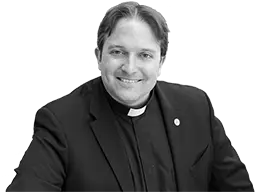
 Fr Matthew Charlesworth SJJesuit PriestSociety of JesusJesuit priest working in Southern AfricaFr. MatthewCharlesworthSJ
 Memorial of the Presentation of the Blessed Virgin Mary
Date: | Season: Ordinary Time after Easter | Year: A
First Reading: Revelation 11:4–12
Responsorial Psalm: Psalm 144:1–2, 9–10
| Response: Psalm 144:1b
Gospel Acclamation: 2 Timothy 1:10
Gospel Reading: Luke 20:27–40
Preached at: the Jesuit Institute in the Archdiocese of Johannesburg, South Africa.
To give our lives to God is not to lose them. It is to discover what they are truly for.
While we hear the readings appointed for this weekday, the Church also keeps the Memorial of the Presentation of the Blessed Virgin Mary.
An ancient Christian tradition tells us that Mary’s parents, Joachim and Anne, brought her as a young child to the Temple and dedicated her to God. Though this story is not found in Scripture, the Church sees in it a sign of Mary’s belonging to God from her earliest days. At the Annunciation, that dedication becomes personal and active in her own yes.
Although today’s readings do not recount Mary’s presentation, they help us reflect on what a life entrusted to God means: faithful witness in the face of suffering, and hope in the God whose love is stronger than death.
For Mary’s yes did not spare her suffering. The woman who welcomed the angel’s message would one day stand beneath her Son’s cross. Her faithfulness did not mean that everything would be easy. It meant trusting that God would remain faithful, even when she could not understand what was happening.
That same conviction runs through our first reading from Revelation. Two witnesses proclaim God’s truth. They are opposed, attacked and eventually killed. Their enemies celebrate, believing they have finally silenced them.
But then something remarkable happens. God’s breath of life enters them, and they stand again.
The message is not that those who serve God will escape suffering or defeat. It is that the world may silence a witness, but it cannot silence God. What appears to be the end is not necessarily the end of God’s work.
Perhaps we need to hear that in our own lives. We give ourselves to ministries, communities and people. We invest our time, our energy and sometimes our very hearts in work we believe God has entrusted to us. Sometimes we see the fruit of our labour. Sometimes we encounter disappointment, opposition or apparent failure. We may even wonder whether our efforts have made any difference.
Revelation does not promise that faithful people will always see their work succeed. The witnesses are killed after completing their testimony. But their apparent defeat is not the last word. God gives them life. Faithfulness cannot always be measured by visible results, because its final meaning rests with God.
The psalmist calls God his rock, fortress and deliverer. He does not speak as someone untouched by struggle, but as someone who looks to God for refuge. And from that confidence comes a new song of praise. His hope rests not in his own strength, but in the God who sustains him.
And in the Gospel, Jesus takes this trust a step further.
The Sadducees, who deny the resurrection, challenge Jesus with the example of a woman who has married seven brothers. Whose wife, they ask, will she be in the life to come?
Jesus refuses to accept their assumption that eternal life must simply reproduce the arrangements of this world.
Resurrection is not merely a continuation of the life we already know. It is life transformed by God.
And then Jesus gives us one of the most beautiful assurances in the Gospel: “He is God, not of the dead, but of the living; for to him all are alive.”
Those words change how we understand our lives and our relationships. Our earthly commitments matter deeply, but they do not exhaust who we are. Our deepest identity is not defined by a title, a position, a marriage or an achievement. It is that we belong to God, whose love reaches beyond the limits of this life.
That is particularly important in religious life, but it is true for everyone. We can become so attached to our work, our responsibilities, our families or the contribution we believe we must make, that we forget who we are when those things change or are taken away.
We may cease to hold an office. We may grow old and find that we can no longer do what we once did. We may have to surrender a ministry we loved, or accept that something to which we gave years of our lives has not turned out as we hoped.
But our worth in God’s eyes does not diminish when our work comes to an end. We are loved not simply because of what we accomplish, but because we belong to him.
Mary teaches us this through the simplicity of her response to God. She did not know everything that lay ahead. She could not foresee Bethlehem, Calvary or the empty tomb. But she made herself available, and she continued to trust. Her life reminds us that giving ourselves to God is not a single decision made once and for all. It is a daily willingness to place ourselves in his hands, especially when we cannot see where he is leading us.
As we celebrate her Presentation, perhaps we might bring three questions into our prayer today.
- Where am I being invited to trust God, even when I cannot see the fruit of my efforts?
- What am I holding on to, perhaps a responsibility, an expectation or a fear, that prevents me from giving myself more freely to God?
- And how might I live today as someone who truly believes that God is the God of the living, and that his promises are stronger than death?
In this Eucharist, we place our lives once again in God’s hands, remembering Mary’s life of trust and dedication. We bring our hopes, our disappointments, our unfinished work and the people entrusted to our care.
And we ask, through Mary’s intercession, for the grace to offer ourselves generously, to remain faithful when the way is difficult, and to trust that nothing given to God in love is finally lost.
Source: https://sj.mcharlesworth.fr/homilies/2026-11nov-21-ya-ot-33/
This homily is shared for personal and pastoral use. Please attribute the author and do not alter the meaning when quoting. If you wish this homily to be translated - there is an option on the website which will allow you to translate it into the language of your choice.
Licenced under a Creative Commons Attribution-NonCommercial-NoDerivatives 4.0 International (CC BY-NC-ND 4.0) license.
The author does not speak for the Society of Jesus or for the Catholic Church.




In preparing this homily, I consulted various resources to deepen my understanding of today’s readings, including using Magisterium AI for assistance. The final content remains the responsibility of the author.