
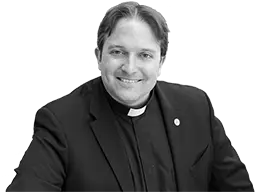
 Fr Matthew Charlesworth SJJesuit PriestSociety of JesusJesuit priest working in Southern AfricaFr. MatthewCharlesworthSJ
 34th Sunday in Ordinary Time (Christ the King)
Date: | Season: Ordinary Time after Easter | Year: A
First Reading: Ezekiel 34:11–12, 15–17
Responsorial Psalm: Psalm 23:1–6
| Response: Psalm 23:1
Second Reading: 1 Corinthians 15:20–26, 28
Gospel Acclamation: Mark 11:9–10
Gospel Reading: Matthew 25:31–46
Preached at: the Jesuit Institute in the Archdiocese of Johannesburg, South Africa.
Most kings expect people to come to them. Jesus tells us about a King who comes looking for us, and then asks us to recognise him in the people we might otherwise pass by.
That is the extraordinary picture of kingship which the Church gives us today, as we celebrate the Solemnity of Christ the King.
We might expect this feast to be about power, glory and majesty. Certainly, the Gospel speaks of Christ coming in glory, seated upon his throne, with all the nations gathered before him. But when Jesus tells us what matters to this King, he speaks of something remarkably ordinary: feeding the hungry, welcoming strangers, caring for the sick and visiting prisoners.
The King of the universe is concerned with how we treat the people right in front of us.
To understand why, we begin with the prophet Ezekiel.
Ezekiel speaks to a people who have suffered enormously. Jerusalem has fallen, many have been carried into exile, and their leaders, whom Scripture calls shepherds, have failed to protect them.
Into this suffering, God makes a remarkable promise: I myself will search for my sheep.
God does not simply promise better shepherds. He promises to become their shepherd himself, seeking the lost, bringing back those who have strayed, binding up the injured and strengthening the weak.
There is something deeply consoling here. We do not belong to Christ because we have made ourselves worthy of him. We belong to him because he loves us and has come searching for us.
That is the confidence of Psalm 23: The Lord is my shepherd. The psalm does not promise that we will never suffer, but that we will not be abandoned. The shepherd guides us, restores our strength and prepares a table for us.
St Paul takes that promise further. Christ has been raised as the first fruits of those who have died. His Resurrection begins the new life God will bring to completion, when even death, the final enemy, will be destroyed.
This is why we call him King. Not because he has conquered other peoples, but because, through his death and Resurrection, he has broken death’s power.
His kingdom is not built upon the defeat of others, but upon the gift of himself.
And then we come to the Gospel.
The shepherd who seeks the lost is also the King who judges. Indeed, Ezekiel has already told us that God will judge between the sheep, the rams and the goats. The one who cares for his people now asks how they have cared for one another.
And there is something striking about this judgement.
Both groups are surprised.
Those who fed the hungry, welcomed strangers and cared for the sick ask, Lord, when did we see you?
Those who failed to do these things ask essentially the same question.
Neither group recognised Christ in the people before them. Yet their responses were very different.
It is as though mercy had become a habit for the righteous. They saw someone in need and responded, without calculating what they might gain. The others saw the same needs, but failed to respond.
That is a challenging thought.
We can spend our lives looking for God in extraordinary experiences while failing to recognise him in ordinary encounters.
Think of the person waiting for hours at a clinic. The family struggling to afford food or school fees. The elderly neighbour who has not had a visitor. The young person unable to find work.
These are not interruptions to our Christian lives. They are among the places where Christ asks to be encountered.
And our response must go beyond individual charity. Feeding someone matters, but so does asking why people are hungry. Welcoming a stranger matters, but so does building a society in which everyone is treated with dignity.
The kingdom of Christ concerns both the kindness of our hearts and the justice of the world we are helping to build.
Today, as the Church celebrates the 41st World Youth Day in dioceses throughout the world, we also look forward to the international gathering in Seoul next year.
The theme Pope Leo XIV has given young people is Jesus’ promise: “Take courage! I have overcome the world.”
As Pope Leo reminds us, Christian courage does not arise primarily from our own strength; it comes from Christ’s presence. And he makes a beautiful observation: Christ is already searching for us, even before we begin searching for him.
There is Ezekiel’s promise again: I myself will search for my sheep.
This matters particularly for young people facing uncertainty about their futures or pressure to measure their worth by their achievements.
Their dignity does not depend upon their success. Nor does ours. We are loved by God before we have accomplished anything.
And that love gives us courage: to defend someone treated unjustly, to welcome someone excluded, or to respond to suffering when it would be easier to turn away.
St Ignatius invites us, in the Spiritual Exercises, to contemplate the call of Christ the eternal King. Christ invites us not simply to admire his kingdom, but to labour alongside him.
And the question becomes personal: If this is the kind of King I follow, what kind of life must I live?
We can be busy with good and worthy things, fulfil our duties and participate in the life of the Church, yet overlook the person who needs our attention. We may become so concerned with doing things for God that we fail to recognise God in the person before us.
Today’s Gospel reminds us that our treatment of others is inseparable from our relationship with Christ.
And its warning of judgement is serious. Our choices matter. Love cannot remain merely a good intention; it must become visible in how we live.
But the warning is also an invitation. We still have time to change. The shepherd has not stopped searching for us, and his mercy gives us the possibility of beginning again.
And that brings us to the Eucharist.
In Psalm 23, the shepherd prepares a table for his people. Here, at this altar, Christ prepares that table for us, giving us not simply bread, but himself.
In today’s Collect, we ask God to restore all things in Christ. And in the Prayer over the Offerings, we ask that Christ may bestow upon all nations the gifts of unity and peace.
His kingdom is not merely a distant hope. It must begin to take shape here and now, in our relationships, our communities and our care for one another.
For the King who feeds us at this table is the same King who waits to be recognised in the hungry, the lonely, the wounded and the forgotten.
As this liturgical year comes to its close, perhaps we can carry three questions into our prayer:
- Where has Christ the Good Shepherd been searching for me, especially where I have wandered, struggled or become wounded?
- Whom have I encountered recently without truly seeing them, and how might Christ be inviting me to recognise his presence in that person?
- And what one concrete act of courage and love can I offer this week, so that Christ may reign more fully in my life and, through me, in the lives of others?
Source: https://sj.mcharlesworth.fr/homilies/2026-11nov-22-ya-ot-34/
This homily is shared for personal and pastoral use. Please attribute the author and do not alter the meaning when quoting. If you wish this homily to be translated - there is an option on the website which will allow you to translate it into the language of your choice.
Licenced under a Creative Commons Attribution-NonCommercial-NoDerivatives 4.0 International (CC BY-NC-ND 4.0) license.
The author does not speak for the Society of Jesus or for the Catholic Church.





In preparing this homily, I consulted various resources to deepen my understanding of today’s readings, including using Magisterium AI for assistance. The final content remains the responsibility of the author.