
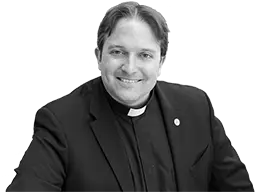
 Fr Matthew Charlesworth SJJesuit PriestSociety of JesusJesuit priest working in Southern AfricaFr. MatthewCharlesworthSJ
 1st Sunday of Advent
Date: | Season: Advent | Year: B
First Reading: Isaiah 63:16b–17, 19b; 64:2–7
Responsorial Psalm: Psalm 80:2–3, 15–16, 18–19
| Response: Psalm 80:4
Second Reading: 1 Corinthians 1:3–9
Gospel Acclamation: Psalm 85:8
Gospel Reading: Mark 13:33–37
Preached at: the Jesuit Institute in the Archdiocese of Johannesburg, South Africa.
Happy New Year, my brothers!
We all know what it is to wait. We have stood at an airport arrivals gate, searching the faces of people coming through the doors. We have waited for the results of a medical examination. We have left a light burning for someone who has not yet come home.
An hour spent waiting for medical results feels very different from an hour spent waiting for an old friend. Much depends on what we are waiting for, and on who is coming.
Advent reminds us that we are waiting for someone.
The word Advent simply means ‘coming’. St Bernard of Clairvaux speaks of three comings of Christ: in history, in mystery and in glory. He came among us at Bethlehem; he comes into our lives each day; and he will come again at the end of time.
In our first reading, Isaiah speaks on behalf of a people who have lost their way. They long for God to come among them, but they also acknowledge their own responsibility for what has gone wrong. They recognise that they cannot put everything right by themselves.
Perhaps we recognise something of ourselves in their prayer. After years of religious life, prayer, study and ministry, we can still find ourselves struggling with the same fears, the same prejudices, the same reluctance to forgive.
And Isaiah reminds us that God is our Father, that we are the clay and he is the potter.
A potter can feel beneath his fingers where the clay is uneven, where it needs further work. He knows what it can become.
We spend much of our lives trying to change circumstances, institutions and other people. How much freedom do we give God to change us?
The psalmist shares Isaiah’s longing. He asks God to visit his wounded vine, to restore his people and let his face shine upon them.
At Bethlehem, that ancient prayer receives an unexpected answer. God shows us his face in the face of a child.
Humanity longs for God to come down, and God comes so far down that he must be lifted into the arms of his mother.
But there is something remarkable about Christian waiting. The very person we are waiting for is already among us.
Notice how Paul addresses the Corinthians. This was a community troubled by rivalries and divisions. Paul knew their faults well enough, yet he began by thanking God for the grace they had received. He assures them that they lack no spiritual gift as they await the coming of Christ.
He could see their shortcomings without losing sight of what God was doing among them.
That is a particularly Ignatian way of looking at people.
There is a reason why Ignatius begins the Examen with thanksgiving. Gratitude teaches us to see. It helps us recognise how much God has already given us without our being aware of it.
Even the cup of coffee we drink in the morning connects us to people whose names we will never know and whose labour we rarely consider. Finding God in all things must include an awareness of these people, their dignity and the conditions under which they live and work.
Christ comes to us in the brother who needs someone to listen to him, and in the young person who has applied for job after job and is beginning to doubt his own worth.
What does our encounter with Christ mean for them? Does it make us more generous with our time, more willing to listen, more courageous in confronting injustice?
We cannot prepare a place for Christ in our Christmas crib and deny him a place in our daily lives.
And then there is his final coming.
In today’s Gospel, Jesus describes a man who goes away on a journey, entrusting his household to his servants and giving each one a particular task.
They are not told when he will return. They are told what to do while he is away.
The world is not a waiting room in which we sit until Christ returns. It is a household entrusted to our care.
When Jesus says that we do not know when the time will come, Mark uses the Greek word kairos, a time or occasion. The point is not that we can identify in advance which moments are significant, but that we must be awake to the moment when it comes.
We spend much of our lives measuring time, consulting our diaries, meeting deadlines and counting our years in the Society.
Yet a ten-minute conversation may change the course of someone’s life. A moment of prayer may help us recognise something we have avoided for years. An unexpected encounter may reveal what God is asking of us.
We cannot schedule such moments. But we can learn to recognise them.
That is part of what Jesus means when he tells us to stay awake.
For the opposite of spiritual wakefulness is not necessarily sleep. It is indifference.
We can celebrate Mass every morning and still know very little about what is troubling the brother sitting across the table. We can hear so much about poverty and injustice that eventually we stop listening. We can become so familiar with the Gospel that we no longer expect it to ask anything new of us.
Yet Christian watchfulness is not a life of anxiety. Paul assures the Corinthians that Christ himself will strengthen them to the end. And he gives us perhaps the most reassuring words in all of today’s readings:
‘God is faithful.’
In the contemplation on the Incarnation, Ignatius invites us to imagine the Trinity looking upon the earth, seeing people being born and dying, laughing and weeping, living in peace and at war.
God sees what we are doing to one another. He sees what we are doing to ourselves. And still, he chooses to enter our lives and become one of us.
That is the God for whom we wait.
Think again of what we asked of God in the opening prayer of this Mass: the resolve ‘to run forth to meet your Christ with righteous deeds at his coming’.
We are not hiding from God. We are running out to meet him.
And we begin to meet him now, whenever we forgive someone, whenever we defend another person’s dignity, whenever we give someone the time and attention they need.
My brothers, the Christ whose birth we will celebrate at Christmas, and whose return we await at the end of time, comes to us now in this Eucharist.
In a few moments, we will receive the very person for whom we are waiting.
And when we leave this chapel, our task will be to recognise him in the people we encounter.
Christ has come.
Christ comes among us today.
Christ will come again.
May he find the light still burning, and may he find that we have loved those he entrusted to our care.
As we begin this Advent, let us take three questions into our prayer:
- What have I become reluctant to let God change in me?
- Where might Christ already be coming into my life without my recognising him?
- Who has been entrusted to my care, and what might love require of me this Advent?
Amen.
Source: https://sj.mcharlesworth.fr/homilies/2026-11nov-29-yb-at-01/
This homily is shared for personal and pastoral use. Please attribute the author and do not alter the meaning when quoting. If you wish this homily to be translated - there is an option on the website which will allow you to translate it into the language of your choice.
Licenced under a Creative Commons Attribution-NonCommercial-NoDerivatives 4.0 International (CC BY-NC-ND 4.0) license.
The author does not speak for the Society of Jesus or for the Catholic Church.




In preparing this homily, I consulted various resources to deepen my understanding of today’s readings, including using Magisterium AI for assistance. The final content remains the responsibility of the author.