
The Jesuit Institute South Africa hosted a dialogue this evening between Fr David Neuhaus SJ and Fr Christopher Clohessy asking “What the hell is going on in Iran?”. It was a very popular talk, and I’m putting the recording below and a draft transcript of the conversation. (All mistakes are mine!)
Video
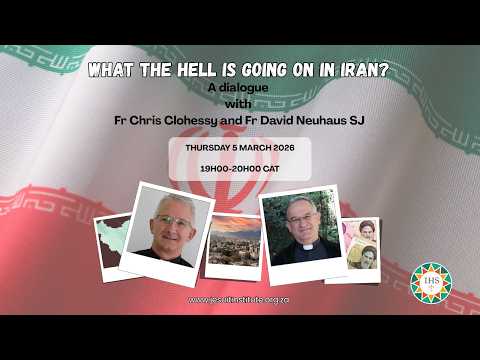
Fr Christopher Clohessy is a South African-born Catholic priest with a PhD in Islamic Studies from the Pontifical Institute for Arabic and Islamic Studies (PISAI) in Rome, and the winner of the 2021 Islamic Republic of Iran’s Book Award for Distinguished Researcher of Shia Studies. He is at present a resident faculty member of PISAI, lecturing there in Shīʿī Islamic studies, Qurʾān and Islamic Ethics, and is visiting lecturer at the Pontifical Beda College in Rome, where he lectures in Fundamental Theology, Ecclesiology and Mariology.
Fr David Neuhaus SJ is a member of the Jesuit community in the Holy Land. Born in South Africa during the apartheid era, he has lived most of his life in Israel and is an Israeli citizen. He teaches Scripture in various institutions in Israel and Palestine, including the Latin Patriarchate Seminary in Beit Jala, Bethlehem University, and the Salesian Theological Institute in Jerusalem. He completed a BA, MA and PhD (Political Science) at Hebrew University, Jerusalem. He then completed pontifical degrees in theology and Scripture in Paris (Centre Sevres) and Rome (Pontifical Biblical Institute). He is the author of numerous books and articles. In November 2025, he published the book, Conquest or Leaven: Reflections of a Catholic Priest in Palestine/Israel, which is available from the Jesuit Institute South Africa.
The Moderator was Fr Bonaventure Mashata MAfr, the Coordinating Secretary for the Department of Ecumenism, Interreligious Dialogue, and Dialogue with the Secular World at the Southern African Catholic Bishops’ Conference (SACBC).
Transcript
Historical Background: Iran from the Shah to the Islamic Republic
Fr Bonaventure Mashata MAfr:
Before we begin to explore the dynamics in detail, it would be useful to take a step back and get some context.
But David, would you be able to tell us a little more about the history of Iran in the last fifty years? You have five minutes.
Fr David Neuhaus SJ:
Thank you very much for that question. I’m not sure I can do it in five minutes, but I’m going to try my utmost.
When I was told that I should go back to 1976, I did something that I think is quite interesting, and that is that I looked up a video from 1976: an interview with the Shah of Iran. I recommend that everybody watch it — 60 Minutes with Mike Wallace and the Shah of Iran. It takes us back to that time when the Shah of Iran was in power.
The Pahlavi dynasty, which was his dynasty, had come into power in 1921, supported by the British. Of course, the big interest — and this is a major part of what’s going on in Iran — was oil. He came in with strong support from the West. He put into practice a very violent process of modernization. For instance, in 1936 he passed a law that forbade women from wearing the veil. I think it’s interesting in terms of what we’ve heard about what has gone on in Iran since then. It was enforced until 1941, when he was replaced by his son, who remained the Shah of Iran until 1979.
Interestingly — and I think again we should remember this — the Iranian people tried to depose the Shah of Iran through what was known as the Mossadegh regime. Mossadegh was a popular politician. But President Eisenhower and the CIA made sure that the Shah was reinstated. He was brought back into Iran. The CIA helped the Shah to form the secret police, the savage SAVAK, which was an instrument of repression throughout Iran.
This would finally lead to the major uprising of the Iranian people in 1978, and the Shah, in January 1979, fled the country, went to Morocco, and later traveled around the world, eventually dying in Egypt. He was a very sick man at the time.
1979 sees the entry of the figure that is probably the most important figure in the Islamic Republic of Iran, returning to Iran after having been exiled since 1964, and that was Ayatollah Khomeini, who comes in on a chartered Air France flight. He had been staying for a short time — after having been expelled from Iraq — he was living in France. And he proclaims an Islamic Republic in Iran.
In the beginning there is chaos, different factions fighting against each other. But he soon manages to get control and organizes a referendum. The official result of the referendum was that 98.2% of the Iranian population demanded an Islamic republic. Of course, some people say that was played with, but certainly a majority wanted to reject the heritage of the Pahlavis, their forced modernization, and their total enslavement to the West. This was also done with a strong sense not only of Islamic but also Iranian nationalism.
And so that’s where the Islamic Republic of Iran begins. Khomeini remained the spiritual guide of the republic, the Supreme Leader, until he died at the age of 89 in 1989. He was succeeded by the then president of the Iranian Republic, and that was Ali Khamenei, who, as has just been said, was murdered by the bombings of Tehran. He was the Supreme Leader from 1989 until now. It has been announced that his son has taken over.
What would be the major problems that it seems we’ve been having in the West — or that the West is having — with Iran? I’m going to mention a few.
One, of course, that has received a lot of publicity in recent years is the nuclear program. Let’s remember that the nuclear program began with US support under the Shah. Khamenei actually brought out a fatwa against developing nuclear arms, and the Iranians have always claimed that the nuclear program was to develop nuclear energy. Whatever we think of that claim.
Two, and again this would be a big problem: exporting the revolution, the Shiite revolution, particularly into Iraq, into Lebanon, but also elsewhere, seen as a destabilizing factor.
Three, becoming a leader in what was known as the Axis of Resistance, particularly to United States hegemony, and to what is seen as Israeli settler colonialism in the Middle East. Of course, that resistance — that axis of resistance — was defined as the Axis of Evil, and we associate it also with those organizations that have been defined by the US and by Israel as terrorist organizations (Hezbollah and Hamas).
And four: support for the Palestinians — very, very strong support for the Palestinians. Interestingly, the Shah had supported Israel and was in close connection with Israel. One of the scenes of the revolution when the Shah was chased out was the looting and sabotaging of Israeli offices of El Al in Tehran.
Five, the introduction of a strict Islamic society. Of course, that seems to be represented for many by the veil that was imposed. Interesting to note, just as a little anecdote, neckties have also been banned as a symbol of Western decadence.
And then six: yes, Iran is a totalitarian regime with a very troubling record of human rights violations, like so many other countries around the world — among them the US and Israel’s best friends. And let’s really remember that the human rights violations under the Shah — the Shah supported to the hilt by both the US and Israel — also formed a very, very terrible record.
So I think that’s what I’ll say. Let me just add that these problems provoked reactions, and these reactions have been sanctions on Iran and attacks, military attacks from time to time. Of course, the underlying desire of the US, Israel, and their allies is to promote regime change — to get rid of the Islamic Republic of Iran. So I think that’s what I’ll say for the meantime.
Religious Context: Iran’s Shia Identity in the Muslim World
Fr Bonaventure Mashata MAfr:
Thank you very much, Fr David, for giving us that relevant history of Iran. I will turn now back to Fr Chris.
Fr Chris, having explored a bit of the historical point, can you help us to understand more about the religious specificity of Iran and how it fits into the Muslim world? Please.
Fr Christopher Clohessy:
Thank you.
So, I’m like Fr David: I’m going to try and do it very quickly and get it all in. I think, firstly, most people forget the size of Iran. Iran is bigger than France, Germany, the United Kingdom, and Italy combined. It’s still bigger than those four countries combined. You’re talking about a massive area, and you’re talking about a population of about 92 million people, of whom 87 million are Shia Muslims.
So the Shia Muslims are the heirs of those Muslims right at the beginning who supported a man called Ali, who was the son-in-law and cousin of the Prophet Muhammad. After the death of Muhammad, this small group was convinced that Muhammad had delegated his son-in-law as the future leader — not as the future prophet, but as the future leader. This small group eventually became known as the Shia, or the partisans of Ali. We call them the Shia today.
It’s important to understand that academically they’re not a sect or some small subgroup. They are part of the totality of the Islamic family. But their value, especially for us in terms of Western studies, is not in terms of their numbers. They’re about 10%, maybe 12%, of the Islamic world. Their value is in their geopolitical situation, the places where you find the Shia, but also the richness that their texts, their spirituality, and their theology have added to Islam.
So right at the beginning, at a terrible event called Karbala in Iraq, the grandson of Muhammad and the son of Ali was killed as he tried to lead a revolt against the Sunni caliph. After that battle — which was not understood by the Shia as a defeat, but as a spiritual and moral victory, that is, of the small group who stand for justice even at the cost of their blood — after that loss, the Shia of Ali began to realize that power had been denied them, and they entered into what could be called a sort of quietism, where they didn’t involve themselves too much in the political realm but much more in the spiritual realm. And I think it’s true to say that that spirit of quietism has lasted in Iran until about the 1960s.
And so the Shia in Iran are not quite the same as other Shia, and I’ll explain that now. The Shia leadership — that is, the jurists in Iran — from the beginning, under the Qajar dynasty and then the Pahlavi dynasty that took over, had this curious sort of relationship with the government, a sort of separation really between, let’s say, church and state. So they weren’t particularly concerned that the Shah was not a good Muslim. They were much more concerned that his job was to safeguard the country and to safeguard Shia Islam and the creed of Shia Islam. The mosque — that was sacrosanct — that was out of his control. But they looked to him to rule the country and to make sure that the country and its religion were protected.
Then in the 1960s there was a fascinating man called Ali Shariati, who was an Iranian Shia but also a Marxist and also French-educated. He began to propose that Shia Islam needed to move out of this quietism: that if you wanted to honor al-Husayn, who was killed at Karbala, and honor the memory of his stand for justice, then you needed not only to have what he called black Shi’ism — that is, the Shi’ism of mourning and weeping — but you also needed red Shi’ism: activism. The best way to remember Husayn, he would say, would be to stand for justice.
The Ayatollah Khomeini was greatly influenced, as were many Iranians, by the writings of Ali Shariati, and so took this on board as part of his revolution. His revolution, as Fr David has explained, was quite a simple thing. He was a philosopher, Khomeini — a highly intelligent man, whether one agrees with his political views or not — and he basically was trying to implement a Platonic view, that is, the philosopher-king. He was saying: it is a problem if the Shah is not a good Muslim, because if God wants a truly Islamic state, then the leader needs to be a true Muslim. He needs to know the Islamic law, he needs to know the Islamic jurisprudence. And what would be better, said Khomeini, than if an Islamic jurist who was an expert in the law should be the leader of the country? Then the leader wouldn’t have to keep consulting the religious hierarchy; he could himself make decisions.
And so an Islamic state was created, which is in fact a theocracy. It’s the only theocracy in the world. Even the Vatican isn’t a theocracy. A theocracy is a state that is based really upon the Islamic texts, especially the Qur’an, as its sort of basic constitution.
And so when you’re talking about the Shia in Iran, you’re not just talking about any Shia. You’re talking about the Shia who live in this theocracy and whose lifeblood is the fact that they will stand for justice even as a minority group, at the cost of their blood if need be, because that’s what al-Husayn did. Even if they’re the persecuted minority, they will fight to the end. And that drives Iranian Shia, so that even if people disagreed with the regime, they will still fight for their country and fight for their love of all things Iranian. So I think that’s the basis of the Shia there.
Fr Bonaventure Mashata MAfr:
Thank you very much.
Fr David Neuhaus SJ:
Sorry, Fr — I’m just going to interject. Chris, it’s true that Ali Shariati was murdered, no? Was he not murdered by the police of the Shah?
Fr Christopher Clohessy:
I think he was. And of course, the point about Shariati, as you pointed out, was that the revolutionary movement in Iran to get rid of the Shah was a huge mix of Marxists and atheists and Muslims and all kinds of other people, which was why Khomeini then had to shape it into something better. And as far as I remember, Shariati — who was very popular in the 1960s, now maybe less so; we read him occasionally — as far as I remember, yes, he came to a rather sad end.
Iran, Israel, and the United States: Roots of the Present Conflict
Fr Bonaventure Mashata MAfr:
Thank you very much, Fr Chris, for giving us that religious context of Iran.
I would like to go back to Fr David. Understanding a bit more of the religious context of Iran, we could explore a bit more the particular relationship between Iran and Israel and the USA.
Can you please unpack this relationship and how it is impacting this war today?
Fr David Neuhaus SJ:
Okay. So, I think that we can start with the US attempt to impose its hegemony on the Middle East, and the resistance of national and religious ideologies to that imposition of hegemony. Of course, the hegemony was being imposed right from the beginning. We’re talking from the 1920s, when the Americans were working together with the British because of oil in Iran. Iran is an oil-rich country. And not only that, but also the position of Iran. Chris mentioned how big Iran is, but it’s also got a very important strategic place right there in Asia, a point of passage back and forth.
So the US is struggling for control, okay, and combating opponents and competitors like the USSR in history, now Russia, and of course also China.
Israel’s interest is to dominate the neighborhood. Israel wants to dominate the neighborhood, and its main mantra is security. So everything is done in the name of that security. I would say that now we’re at this very terrifying convergence of a United States president who is very taken with his own capacities and powers, and an Israeli prime minister who believes, I think, that he can use the American president for his own interests. Both of them, of course, have a whole personal agenda that I’m not going to go into, but what we’ve seen is that Israel is really setting out on the destruction of the neighborhood.
And so, yes, we’ve been witnessing for more than two years a genocide, an ongoing genocide, in Gaza. We’ve been witnessing the brutalization of the West Bank. But far beyond there are the constant attacks against Lebanon — again the excuse being security. In Lebanon there is a so-called proxy of Iran, Hezbollah, which has now joined in the hostilities. And then, of course, what happened in Syria, where Israel was deeply involved and continues to be deeply involved in attempting to break up what might be a strong Syrian state, and had that as an interest for decades.
And further afield we see Israeli activities in Sudan, in Somalia, and other places. So yes, either destroy the neighborhood or neutralize the neighborhood. And that was done again in strong collaboration with the Trump regime the first time he was there, and now again bringing this back through the Abraham Accords, having certain Arab countries buy into a massive American-Israeli plan to push the Palestinians off the map and create a new kind of economic-security alliance that, of course, has at its very center Saudi Arabia, that has not signed on yet. Netanyahu just said a few days ago they’re about to sign on, because now we have a common enemy.
Some say that Israel wants territorial domination — you know, from the Euphrates to the Nile, biblical promises. I’m not sure that Israel is interested in ruling that territory, but certainly in economically dominating the region and ruining the possibility of any strong society emerging in that whole territory from the Euphrates to the Nile.
And so Israel speaks a language of dividing everything up, talking about different kinds of ethnicities and religions, how they certainly cannot get on, and how each one needs their own rights, their own privileges. So, for example, we saw Israeli support in Syria of separatists. We saw Israeli support of demonstrators in Iran. We’ve seen Israeli support in Lebanon to really break up these societies. And again, I repeat, Trump is an asset.
I would say that the nuclear arms argument, which is the main argument used to argue for this war, is perhaps a subterfuge in order to plan this attack. Rubio, close to Trump, said that Israel was about to attack, so the US joined in the attack because otherwise the US would have been attacked. This is a war about not only regime change but really the dismantlement of Iranian society.
And I add finally: religion is being mobilized in all of this. Religion was mobilized in Gaza: this is a war against the Amalekites. Now it’s a war against Haman. Interestingly, Purim, the Jewish feast of Purim, the Book of Esther, was just celebrated now. And so this all is being promoted in almost mythological terms, with biblical language, so that people who want to participate in a kind of end-of-time scenario can do that with biblical vocabulary.
I would really ask all viewers: while they’re watching Iran, do not forget Gaza, do not forget the West Bank, because as usual, behind the smoke screen of all the big events that are going on, the Gazans are being wiped out and the West Bank is being totally brutalized.
Final point: I’m not a prophet and I don’t pretend to be a prophet, but I think people are wondering who’s next on the list, and it might indeed be Türkiye, because Türkiye would then be the remaining very strong state in the region.
Regional Actors: Iran’s Proxies and American Allies
Fr Bonaventure Mashata MAfr:
Thank you, Fr David. Before I ask a question, I would like to tell the viewers that this is being recorded, and the second point is: if you have any question, put it in the chat and we will pick it up later.
Thanks, Fr David. This gives us some insight into some of the complex political reasons for this war.
Fr Chris, could you explain who some of Iran’s proxies are and what their agency is in the present conflict? Could you also identify the USA’s proxies and why they are being implicated in this war?
Fr Christopher Clohessy:
So, I just want to jump in. Firstly, somebody raised a question about whether it is not a fundamental tenet of Iranian government to destroy Israel and eliminate the Jews. No, it’s not. There are Jewish communities in Iran and Christian communities as well. Both Iraq and Iran have longstanding Jewish communities who have lived out their faith there. So it’s not, in terms of the State of Israel - yes there’s certainly a conflict, but in terms of the destruction of the Jews, no, certainly not!
So poor Iran, in many cases, stands alone, partly because as a Shia-majority country with its specific form of Shia religion, it does not have very good relations with the Sunni community. I mean, that’s just a political reality. I suppose its primary proxy is Lebanon, partly because of the presence in Lebanon of Hezbollah, the Shia militia, who I know have been condemned as terrorists by the West — but then the West also thought Mandela and the ANC were terrorists, so I’m not utterly convinced that the West understands what terrorism means. Like the ANC Hezbollah has a military, but it also does all kinds of other things. It’s a whole party rather than just a group of soldiers. So certainly, because of Hezbollah in Lebanon, they are a proxy to Iran.
Followed by Iraq, which has a majority Shia population, although the Iraqi Shia don’t necessarily follow the full implications of the Khamenei vision. Nonetheless, there are lots of Iraqi Shia militia groups tied to Iran.
And then Syria. Even though the Assad regime fell, Bashar al-Assad was not a Shia. He was a sort of loosely connected Shia by being a member of the Alawi religion, who are sort of secularized. But nonetheless, the Syrian regime was very close to Iran, and Iran still uses Syria as a sort of a bridge to Lebanon and as a forward base for some of its missiles and networks.
Yemen is a proxy because Yemen has a Shia community, a Zaydi Shia community, and Iran supports the Houthis, whose real name is Ansar Allah, the Helpers of God. Iran also, of course, has Gaza as a proxy, home to groups that Iran backs politically and militarily, and has given a great extent of help to. To a lesser degree, Bahrain, because Bahrain has a large Shia community, although it doesn’t have a Shia government. Iran supports a variety of Shia groups in Bahrain.
In terms of non-Muslim proxies, Iran for political and ideological reasons doesn’t really have any, but it is strongly supported by Russia, by China, by Venezuela, by North Korea, by Cuba, Belarus, and of course South Africa is also one of its most important non-Muslim-majority supporters. And it’s a relationship that I think has increased and developed significantly from 2025–2026 especially, in that South Africa has not just been a neutral bystander but has played an increasingly active political role in terms of Gaza, certainly.
In terms of the American proxies, it’s not my field and I’m not sure, and I don’t want to name countries and get it completely wrong. But it’s interesting to see that a quavering, wimpish Britain doesn’t quite know what to do. They want to be friends with America, but they’re terrified of also getting on the wrong side of Iran and maybe even being bombed. So they certainly would regard themselves as part of that axis.
Here in Italy, the Italians under Meloni are certainly supportive of Trump, but they won’t get involved in this sort of conflict because they can’t actually get involved in it. So, in terms of the American proxies, I suppose the American-Israeli relationship is at the moment the most obvious and glaring one.
International Law: Nuclear Non-Proliferation, War, and Civilian Protection
Fr Bonaventure Mashata MAfr:
Thank you, Fr Chris. Having got a context of the complex relationship in the region, let’s now talk a bit more about international law.
Fr David, could you highlight Iran’s relationship to the Vienna Accord on nuclear non-proliferation, and why Trump feels that he needs to police this international accord, which is in fact the duty of the IAEA? What does the Geneva Accord say about avoiding harm to civilian targets?
Fr David Neuhaus SJ:
Okay, so I’d like to make five points when I talk about international law in the context of what’s going on right now in Iran.
Point number one: of course, everybody’s asking that question, and that is: is this a defensive war? In other words, is it a war that might be classified as just? And of course we know only too well that what is defensive and what is not defensive can be made up with fake news and everything else that we are hearing. I’m very dubious about these arguments. I would go back to the teaching of the Catholic Church, and particularly the paragraph of Pope Francis in Fratelli Tutti talking about wars and pointing out what a terrible, terrible human catastrophe all wars always are.
Point number two: nuclear weapons. This is, of course, a major argument for saying that this is a defensive war, because Iran is on the point of getting nuclear arms. I do want to note that my own prime minister — I’m an Israeli citizen, so I have the honor of having Benjamin Netanyahu as my prime minister — has been claiming since the 1990s that Iran, within a few months, will have nuclear arms.
Of course, I will also point out that the Israelis have never admitted to having nuclear arms, although everyone would be quite certain that they have a huge stockpile of nuclear arms.
So, let’s talk a bit about this treaty for non-proliferation of nuclear weapons that dates back to 1968. The treaty offered to all countries — and many, many countries, the vast majority of countries in the world, have signed onto the treaty — that in return for not developing nuclear weapons, they would be helped to develop nuclear energy.
The five countries that are exempt from the Treaty on the Non-Proliferation of Nuclear Weapons are the US, what was then the USSR and is now Russia, the UK, France, and China. Please notice three countries that have never signed the non-proliferation treaty: India — dear, dear friend of Israel; we just had the visit of the Indian president Modi — Pakistan, and Israel, which never signed the treaty.
So we have one country that signed the treaty, then was helped to develop nuclear energy, and then withdrew in order to develop nuclear arms: that’s North Korea.
Iran has signed onto the treaty, and in fact it is interesting to note that the nuclear program began in Iran with US promotion under the Shah. When Ayatollah Khomeini took over, he passed a fatwa saying that it was forbidden to develop nuclear weapons. He had big questions about nuclear energy altogether.
Of course, we can doubt. We don’t need to trust the Iranians on that. And they have been accused of developing nuclear weapons. So a process began that led to the signing of the 2015 Vienna Accord on nuclear weapons. The agreement was that the Iranians would reduce their stockpile of uranium — from which, of course, we make both nuclear energy and nuclear weapons — by 97%, and limit their enrichment of Iranian uranium to 3.67%, which would be enough to provide nuclear energy for Iran. The estimates are between 3% and 5% for what you need. In addition, there would be regular inspections of their facilities, reduced to one place, and regular inspections.
And then began all of the back and forth: are they respecting this or not respecting this? There were major, major questions. The United Nations, in fact, accused Iran of not respecting it, and finally the US abandoned the deal, then re-entered negotiations — new negotiations which seemed only time to plan what is happening now in this war with Netanyahu.
Again, let’s face the reality: Netanyahu has been planning this war for decades, decades. Some people say forty or more years he would like to see Iran destroyed. So that’s a second point with regard to international law.Third point: can you, according to international law, promote regime change? Can one country go into another country and change the regime? And the answer is overwhelmingly no. You cannot do that. Of course, there always need to be exceptions. So the exceptions are interesting. If there is a danger to peace, then you can promote regime change. And of course that’s why we need to argue that Iran is a danger to peace. But is it, or is this a lot of fake news?
And if there are severe humanitarian violations — well, I’m not getting into that because I don’t know. I imagine that yes, there have been terrible humanitarian violations in Iran. I don’t think it’s a free and democratic country. But at the same time, during the time of the Shah, with horrific human-rights violations, the regime was protected — anything but regime change. And we look at a place like Saudi Arabia — well, I think their prisons are full and torture is very much in use. And we know of one person who was lured into a Saudi embassy and carved up and his body dissolved in acid, but he remains a very, very close friend of both Israel and the United States.Point number four: what about non-compliance with UN resolutions when it comes to International Law? So once again, has Iran not complied with UN resolutions? Perhaps. But we certainly know that the list of Israeli non-compliance with UN resolutions is long and loud.
And finally: President Trump is undermining the rule of international law. This is very, very clear. By watching his antics within the international community, he’s undermining international organizations by condemning them, withdrawing funding, withdrawing membership. He’s shifting trade and economic agreements are in absolute violation of international law. And what he’s doing is basically putting America first — engaging in bilateral deals and avoiding any kind of multilateral dialogue and resolution in terms of reaching resolutions to the problems of the world.
So again: complicated, short time.
Leadership and Succession: Iran after Khamenei
Fr Bonaventure Mashata MAfr:
Thank you, Fr David.
Back to you, Fr Chris. The Ayatollah Ali Hosseini Khamenei has been assassinated along with dozens of members of his government. How will the transition play out in Iran? Will Iran become more oppressive or a more free society? We have five minutes, Father, please.
Fr Christopher Clohessy:
Okay, I’ll go very quickly, and stop me if I have to be stopped.
Firstly, a reminder that Ayatollah Khamenei was not just a statesman but primarily a religious leader. The name “Ayatollah” — sign of God — is not a political title. It’s an earned rank within the clerical hierarchy, and it’s always a sign of great scholarship and recognition of public piety and public morals.
And so, you know, it’s exceptionally difficult for us to understand Shia Islam just from what I’m saying, a kind of academic or historical point of view. It has passion and ritual and emotion. One has to step into Shia shoes and walk around a little bit to understand, for example, the depth of emotion that a Shia Muslim would feel at the murdering of an Ayatollah, a religious leader. It would be like killing the archbishop or killing the Pope. It would just be an extraordinary act of degradation towards a world religion.
I would imagine that there are probably millions of Iranians who don’t particularly support the regime. You’re talking about 94 million people. There are probably millions who are not great supporters of the regime, but you’re also talking about millions who are supporters of the regime. But the killing of a religious leader — that would unite them, not divide them more than they’re already divided.
I think it’s an odd question to speak of oppression and freedom, because when we use those words, we’re using them in a contemporary Western sense. What we regard perhaps as oppression may not necessarily be regarded as oppression by a Shia woman. I was in Tehran two years ago, and I can assure you there are plenty of unveiled women in the streets of Tehran. I myself saw them. But speaking to Iranian women, it was interesting to hear their point of view. The ones I spoke to don’t regard themselves as oppressed. Instead, they look at a scantily dressed Western woman on a beach who is perhaps a slave to fashion and a slave to physical beauty and youth, and they wonder if she’s not the oppressed one, who’s slaving all her life to stay young and to be attractive and to dress in such a way that might attract attention. Some might say that that’s the lack of freedom and the oppression.
So it’s relative to where you’re working from and where you come from. In Islam there’s no concept of human rights in the Western sense of human rights based on the individual person in a secular setting. Islam thinks that freedom belongs to the whole community and is more important for the whole community than for each individual. You certainly have rights in Islam, but they’re in relationship to your obligations towards God and your obligations towards other human beings. And if you follow those obligations, you certainly win certain rights and freedoms.
Will Iran become a different society? The answer is: not by bombing it and not by invading it. That does not change societies, particularly because now you’re dealing with people who will stand with the model of al-Husayn and say, “We will stand to the last man fighting against this aggression.” The BBC would have us believe that Iranians are dancing in the streets because they’re being bombed and it’s the end of the regime. This is a lot of BBC nonsense. They’re not dancing in the streets at all. Their cities are being destroyed.
If we’re going to talk about regime change, then maybe Iran is not the place we need to begin with changing some regimes, because there are some awful regimes in the world at the moment. Just because they wear suits and ties rather than Islamic dress doesn’t mean that they’re better or more educated regimes.
So I would hope that Iran becomes a healthy, happy society, but it’s not going to be achieved by shooting as many Iranians as possible.
Global Consequences: Economics and Interreligious Relations
Fr Bonaventure Mashata MAfr:
Thank you, Fr Chris. We have now our last question to both of you.
This is having a huge global impact. What impact will this war have in the areas of economics and Christian, Jewish, Muslim relationships? Five minutes each.
Fr David Neuhaus SJ:
Chris, why don’t you go first this time?
Fr Christopher Clohessy:
Okay, I’ll go first.
The fact that the American administration — or at least many of its key members — who are gloating over war also insist that they are fervent Christians is not helping any form of dialogue, whether it be Christian-Jewish or Christian-Muslim. Unfortunately, this brand of Christianity has become a key part of the American political narrative. And it’s a continuation of what I regarded as the rather foolish response that George Bush made after 9/11 when he spoke of the “crusade” that we need. To use the word “crusade” was a huge mistake, because it conjured up images of “we need to kill the infidel.” And I worry that such an ideology might still be part — even a subconscious one — of the many members around the American regime who support this war.
It’s not helping any form of dialogue, and the Catholic-Christian-Shia dialogue happens to be quite a strong one.
I also think the truth is, whether we like it or not, the Jewish-Muslim conflict goes back to the time of Muhammad. It began during the time of Muhammad in Medina. And I don’t know where the solution to that conflict lies, because it’s been going on for 1,400 years or more.
So I think a strongly convinced Jewish-Christian alliance against an Islamic country — this is not useful. However, people like you and I, ordinary people, Jewish, Christian, and Muslim, actually involved in ongoing interreligious dialogue, we know this and we’re not blinded by this narrative and this rhetoric.
I think the Iranians, for example, would take into strong consideration not only the visit not so long ago of Pope Francis to Iraq and to visit the Ayatollah there, but also the words that Pope Leo has spoken of late condemning war. They understand that the American system doesn’t represent the whole Christian world any more than the Israeli system represents the whole Jewish world, any more than the Iranian system represents the whole Islamic world.
I’ll stop there.
Fr David Neuhaus SJ:
Yeah, I’m going to challenge you, Chris, about your saying that the Jewish-Muslim conflict goes back to the beginning of Islam. I know what you’re referring to — the tribes, the political tribes that opposed Muhammad, the feeling by the Muslims that some of them betrayed agreements. “Khaybar, Khaybar, yā Yahūd,…” I know what you’re referring to. But I think that that’s only one part of the long, long, long Jewish-Muslim story, because one of the most amazing things that happened — and it happened also in Iran to some extent — was a Jewish-Muslim symbiosis, where Judaism was absolutely transfigured by its encounter with Islam, and Islam at certain periods was very, very conscious of a certain kind of Jewish heritage.
I think that the way that we look at it after 1948 — when the Muslim world feels aggressed by a state they see as a settler-colonial state introduced into their midst, and by the brutalization of the Palestinian people — this has led us to dwell again upon the threat of hostility.
But my belief is that we need now to form an interreligious dialogue that is not only escaping into spirituality and the beauty of our festivals and our foods, but very, very much focused on the values that we share. And one of the most supreme values is the value of the human person as created by God.
I think again this can revitalize a socially, politically, economically conscious dialogue with those Muslims, those Jews, and those Christians that are horrified by what maybe the majority of our brothers and sisters as Jews, Christians, and Muslims are doing with our religious traditions — turning them into ideologies of war and destruction.
Israel-Palestine: Two States or One Shared Future?
Fr Bonaventure Mashata MAfr:
Thank you very much, Fr David and Fr Chris. There is a question in the chat.
It is about your opinion: is it a two-state solution, or some other possible solution to the Palestine war, the Israel-Palestine question?
Fr Christopher Clohessy:
Yeah, I’ll leave that to Fr David, because I think that refers to the Gaza-Palestine rather than to the Iranian situation — the viability of the two-state situation, which has been greatly discussed. But I think Fr David probably is a much greater expert on that than I would be.
Fr David Neuhaus SJ:
So, I was really hoping that two states would be a state for the good guys and a state for the bad guys.
No, I know what the questioner is asking. I think it’s Ronnie who’s posing the question. I think that if it had once been possible — and that means the two-state solution was for the first time formulated in 1937 by the Peel Commission, and then became part of an international consensus in 1947 with the partition plan — if it had been possible back then, perhaps it would have worked.
But the problem is that the successive Israeli governments have so colonized whatever land might have become a Palestinian state that now it seems to be impossible.
I think also talking about a two-state solution does not solve the basic problems of the ideologies that have dehumanized the people in the area. And I’m speaking about, one, Jewish Zionism and Christian Zionism, which are responsible for massive dehumanization, which would then be the ideology of one of those two states — the Jewish state — which would continue with ethnic supremacy, racism, and the continuing victimization of anyone in that state who is not Jewish, particularly Palestinian Arabs who might become citizens of that state, on the one side.
And as a reaction to that, are the types of Islamic ideologies — radical Islamic ideologies — that we have seen, that also tend to caricature and stereotype the good and the bad.
So I would say that today we really need to think much more — even though it seems to be most unlikely that this will happen in the near future — about a unitary state where people would have equality. I really insist: the most central word for our future, whether it’s in Palestine-Israel or whether it’s in the rest of the Middle East, is the word equality. To really recognize that each person is created with equal rights, equal privileges, equal obligations, and that should be the basis of a civic state.
Fr Bonaventure Mashata MAfr:
Thank you, Fr David. We are approaching the end of our dialogue. I would ask you to have your last word, but before that I have my last question. Would you mind, or would you be prepared, for another dialogue?
Fr Christopher Clohessy:
Sorry, I didn’t understand your question.
Fr Bonaventure Mashata MAfr:
Go ahead, Fr Chris.
Fr Christopher Clohessy:
I think we’re being invited to do this again. Yes, of course. I would be perfectly happy at any time.
Fr David Neuhaus SJ:
Sure, of course. If it can be helpful to be informed. I think that one of the biggest problems in our present time is that we are formed by people on social media who don’t have very much information, have a lot of opinions and a lot of prejudices, and who pour out onto social media stuff that we even unconsciously, unknowingly take into ourselves. So we become spokespeople of ideologies of hatred, of antisemitism, of Islamophobia, of racism, whatever you want.
And I think that if in any way our talking together can help people to think beyond the language that is being served up by cheap social media, I think it can be very helpful, very interesting, and a learning experience.
Looking Ahead: The End Game in Iran
Fr Bonaventure Mashata MAfr:
Thank you very much for that. Fr David, I will pick one [last question]: what is the end game in Iran? What will we be able to tolerate?
Fr Christopher Clohessy:
Oh, it’s a very difficult question to answer. I think that the Iranians are going to hold out because there is a pride in their country, and they’re not going to tolerate certainly a land invasion especially. That would be a real problem.
I don’t know what the future is. I was in Tehran two years ago. It’s quite a thing for me because I have an Iranian Muslim student, and I guided his doctorate. I was the first Catholic priest ever to guide a doctorate at an Iranian Shia university in Tehran. But while I was there, I met his family — his father, who’s in his nineties, sitting on the floor of his house in Qom, with no technology, just a book, teaching eight or nine students.
So my heart breaks for these gentle Persians, educated, kind people who welcomed me, and I can’t imagine what they’re going through. But I don’t understand or know from day to day where this goes, because the narrative just seems to change every day, and it’s hard to know which news broadcaster to follow — certainly few of the Western ones.
So I think that we need to genuinely pray for God to raise up peacemakers — not to pray for peace as though that were some magical thing, but to raise up men and women who are able to begin to create peace. I think that is very important.
Fr David Neuhaus SJ:
So I would say, Fr Chris, that living in Israel, my view is very much formed by living in Israel. I’m living in a society — and perhaps this is rare outside — where people are really mobilized behind the idea that we are going to destroy Iran, that we are going to bomb it to the ground, that we’re going to leave it looking like what Gaza looks like right now. And this is a terrifying thought.
And so my prayer is not only to raise up peacemakers, but to raise up an international community that can stand up to this ideology of warmongering.
Really, we are in desperate need of leaders who will tell Trump not to allow Netanyahu to get away with what he’s doing. And of course I say Netanyahu, but the problem is with an Israeli state that does not see integration into the region as an aim, but rather the destruction of the region so that it can remain.
Netanyahu has used this language: we can be a Sparta — a Sparta meaning a besieged city, strong and existing by our military might. We really need an international community to say “No!”. And there I think that South Africa again plays a role, an important role. Unfortunately, it’s not the leader of the world community. But I think that South Africa must remain very faithful.
I know that there are cracks appearing in the South African community about the stand of the South African government with regard to Palestine and with regard to the Middle East. I pray that you stay steadfast in speaking out loud and clear about the crimes that are unfolding before our eyes.
Fr Bonaventure Mashata MAfr:
Amen. And this has been a popular dialogue organized very quickly. The next one will have a longer notice period, and we will look at expanding the numbers to include more participants.
Thank you, Fr Chris. Thank you, Fr David.