
Fr Matthew Charlesworth SJ in conversation with Mr Mike Pothier (CPLO) and Mr Matthew Harvey Sanders (Longbeard CEO)
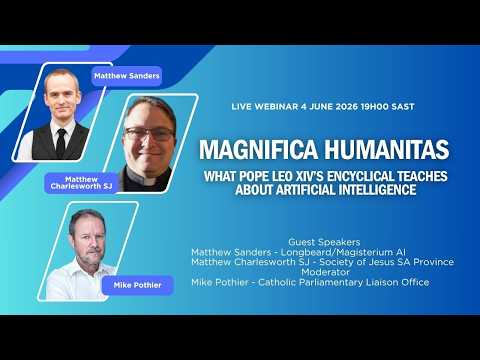
Transcript
Event: CPLO / Jesuit Institute discussion on Magnifica Humanitas and artificial intelligence
Speakers:
- Mr Mike Pothier (CPLO)
- Mr Matthew Harvey Sanders (Longbeard/Magisterium AI)
- Fr Matthew Charlesworth SJ (SAP/Jesuit Institute South Africa)
Mr Mike Pothier
So welcome everybody. My name is Mike Pothier. I’m with the Catholic Parliamentary Liaison Office in Cape Town and it’s a great pleasure to be co-hosting this event tonight with the Jesuit Institute. Let me say this right at the beginning, because I may forget it at the end. Thank you very much to the Institute and to Father Grant who’s not with us tonight for running with this idea and to Ursula and Julian for putting it all together and sorting out the invitations, etc. The encyclical was published just over a week ago - ten days ago, last Monday and we thought it would be a good idea to get in fairly quickly and just start to explore it. I think we will do little more than scratch the surface. It is an 80-page document. It’s dense and it’s going to be analyzed and unpacked in all sorts of ways.
I’m sure this will continue for a very long time. We think back a few years to the publication of Laudato Si and the impact that had - an ongoing impact still felt today, but certainly an intense impact for many years afterwards. I think the same thing is going to happen with this one. We have two discussants, if you like, with us this evening: Father Matthew Charlesworth, who is at the Jesuit Institute this evening although at the moment based in Harare in Zimbabwe. Matthew’s interest in this stems from his undergraduate years when he did a first degree at Rhodes University which amongst other things looked at the ethics of information technology, the early days of AI when as he says it wasn’t quite as dangerous as it looked like it might be these days. And he has kept up that interest ever since.
And then our other guest also Matthew Sanders, who I believe is joining us from Cape Town as well.
Mr Matthew Harvey Sanders
Rome actually.
Mr Mike Pothier
Okay, Rome. I was going to say Matthew’s a Canadian but spends a good deal of time in Cape Town but at the moment he’s in Rome. He’s founder and chief executive officer of a company called Longbeard which specializes in AI development work and I think of particular interest to us has a number of platforms focused on Catholic use of AI. I will name them but if you want to find out more just Google Longbeard and you’ll see everything you need to see. There is Magisterium, which is a Catholic answer engine; Vulgate, an advanced library platform which is also carrying out a digitization program or project with the Pontifical Universities in Rome. And I believe sometime this year a third platform called Ephrem, the world’s first trained Catholic AI language search if I understand correctly, is going to be launched.
So, clearly, two people who know infinitely more than I do about this topic and I hope they also know quite a bit more than you do so that we all end up learning something this evening. We have limited time. I’m going to try to keep it to one hour so I’m not going to spend any further time on background and so on. But I do always start these meetings with a brief moment. I ask everyone simply to center themselves to invoke the Holy Spirit on what we are doing to give us understanding and to give us insight. So let us just be quiet for a few moments. Thank you. I’m going to begin with Matthew Sanders. Matthew, as you said, you’re joining us from Rome this evening and you were in Rome last Monday for the launch of Magnifica Humanitas.
It was an unusual launch for a social encyclical in that the Pope himself was there and spoke at the launch instead of leaving it to various minions. What struck you most about the occasion?
Mr Matthew Harvey Sanders
Probably that the Pope was very relaxed. It was not stage-managed like a lot of pontifical events are where there is a flurry of priests and people who are telling him where to stand and he just walked in and took his seat and at one point he was kind of stage managing a little bit because one of the cardinals is having difficulty with the microphone and he said, “Just press the button.” So that was nice to see. And then also, when we finally got to the speaking part, you could tell that he is very comfortable with the subject.
He has obviously thought very deeply about it. And so, especially for those of us who work in the industry, to know that there is a Pope who deeply understands the technology is quite remarkable. And I will say, finally, the other thing that was just extraordinary for me was having worked in Rome for 10 years, having a Pope sitting there in front of you and then English comes out of his mouth. It was just kind of surreal. I kept thinking this has got to be some alternate reality. So aside from that and a dose of imposter syndrome, it was a remarkable experience.
Mr Mike Pothier
Good. Thank you. I think we’re all getting used to this not just English but English with an American accent coming out of the mouth of a pope. It does take a bit of getting used to. Matthew Charlesworth coming across to you. If we look back at the social encyclicals, most of them, almost all of them, I guess, have tended to deal with great overarching themes, world peace, the development of peoples, labor and work, and obviously recently the environment. This one zeros in on what appears to be, and I stress that it appears to be to us, a relatively narrow issue, one part of the technological revolution that we’ve been living through for the last few decades. So, what is it about AI, or maybe about Pope Leo, that has prompted this particular focus?
Fr Matthew Charlesworth SJ
Well, so thanks, Mike. I think I would resist that idea that AI is just a narrow technological concern or that it’s the next step in a technological revolution. I think this is a change of era, as he said. And I think he’s following in the footsteps of Pope Francis who recognized the interconnectivity of things, whether it was in Laudato Si or in Fratelli Tutti. When he looks at AI, he is seeing that it’s being interwoven into the fabric of our daily life, and it’s shaping decision-making, how we imagine, how we communicate, how we work, how we educate, how it affects security and social life. And so, in this encyclical, he is pointing out, I think, the interconnectivity of it.
And so, it’s not just a small narrow topic for some people interested in technology. He’s seeing it as something that unifies various parts of our life and automates it. And he’s calling us really, I think, to get involved, and it is a call to greater responsibility in what he terms as this construction site. And it gathers together many of the great questions that Catholic social teaching has addressed. As you said, the dignity of work, the common good, justice, truth, capitalism, the economy, inequality, peace, care for creation, etc. And he is recognizing that AI will actually exacerbate these problems that perhaps were easier to treat separately, but now we have to take a more holistic look at things.
So, when we look at data, for example, I was quite interested in how he was looking at how we must treat data as property and property must be revised always under the universal destination of goods, but it must now include the data about our health and all those things. But, the question of data now includes questions about privacy and power. Questions about how best to automate things become questions about work and human dignity. Questions about algorithms now involve questions of justice and bias. Questions about which digital platform can run in a country now affects fundamental questions of democracy and the common good.
So, I think this encyclical is not so much about computers or technology as it is actually about humanity in this moment. How can we flourish as human beings in this new environment, this new ecology that involves AI. And that’s why I think it belongs as a social encyclical. Just as Leo XIII saw the need to address the Industrial Revolution, Leo XIV is very clear, I think, on the Church needing to address the relevant issues of our time, beginning with artificial intelligence. I also think he’s not saying yes or no, and I think this follows Pope Francis. I think in the past the Church gave teaching that was quite definitive.
But under Pope Francis, Pope Francis started showing the interconnection of things. But he also led the Church in a synodal journey, and Leo is continuing this. And so this document isn’t the final word. It is the beginning of a dialogue. Of course, Matthew knows that the Church has been dialoguing with AI for several years. But he’s calling to a wider dialogue that involves all levels of society, including not only families and communities, school communities, or governments and national communities, but the international community. And he’s calling each to their responsibility to assess and to look at the regulation, and not only just regulate according to what the tech companies would like, but to have a discussion about what the ethics are.
And I think he’s offering Catholic social teaching as the vocabulary to have that discussion. But he’s not saying this is the final answer. He is asking everyone to get involved, and I think that’s a very new point about this encyclical, which perhaps is different to the previous ones. But the first two chapters give a masterful summary of Catholic social teaching for our age. And I think probably they will be more quoted in a hundred years’ time than Magnifica Humanitas. And you ask why the Pope is interested in this. He did a mathematics degree when he was younger. And so, I think he’s also acutely aware of how computers work and the limitations of algorithms.
And so, what might dazzle and look almost like an oracle, producing well-formed sentences and answering questions, he understands that there is no understanding behind that. It is a statistical process and very quick data processing. And he’s worried that we might mistake these responses as being thoughtful, truthful statements. They have their place. They’re very useful, but it’s a tool. And I think in the age of social media, people said they were looking for your attention. Now, with the age of AI, what’s at risk is our very affections and the way we relate. And if we don’t safeguard how we relate as human beings, we might stop relating. And there’s a real risk to humanity.
So, he points all of this out. It’s a very rich document, but yeah. I think it is his interest in the change of era and his interest in mathematics and his knowledge of Augustine and the civilization of love. I think all of these have coalesced very fortuitously in Pope Leo, and he’s the man to address this. And he is speaking in English, which is where much of the development of AI takes place. So, yeah, we are very lucky. And I will leave it there for the moment. Thank you.
Mr Mike Pothier
Just to pick up on something you said: it is just a tool. A lot of people, I think, have been taken in or perhaps not taken in, they have become very concerned about the degree to which AI is perhaps more than simply just another technological tool. The whole thing is the fear of the computers taking over. And it’s interesting that the subtitle of the document is on safeguarding the human person in the time of AI. So, immediately from the opening words, AI is presented to some extent as something that could be a threat. We need to be safeguarded against it.
And it’s been pointed out by a few of the commentators so far that one of the strongest themes in the document is to the need to disarm AI. It certainly sounds more sinister than simply another technological innovation that, if you could pull the plug out, you don’t have to worry anymore. He seems to be saying it’s something we need to take much more seriously than that.
Fr Matthew Charlesworth SJ
I think it is certainly more serious because in a way it’s presenting the choices. He describes it as the environment that we’re operating in. And we don’t know what it’s hiding from us. It’s making calculations and decisions and the very options that we’re presented with are already a product of its processing. And so our choice, our agency is being programmatically curtailed by that. And so we do not know what we do not know. I think he’s very right to say that it should be disarmed.
I was reading an article the other day which tried to look at how non-technical people might view AI and it used the image of the Terminator movie and the Disney or Pixar movie WALL-E where, in the Terminator films, the machines take over the world and hunt humans down. And in WALL-E it’s a very good movie about the environment but it also shows humanity as being entertained by machines and the machines do all the work. And in Catholic social teaching the value of work is not simply that it is a chore.
It actually helps us to be fully human and so we must guard against I think those two extremes and there are probably others in the imagination like The Matrix where human beings are being manipulated by the machines.
And I think Pope Leo has put his hand on some very serious issues and shown the connections and his thing about disarming is if computers are left just to work on so-called metadata and present probabilities and give drone operators a sort of choice that this is 66 percent probable they will respond to the way that choice is presented to them and in the end it leads to more loss of human life and we see in the wars at the moment how that’s being done. And in a way it’s absolving the humans by just saying well, the machine did it and we can never treat human life that way.
So, yes, disarm is an important word about the military, but I also think disarm it of the dazzling brilliance it has. We have to understand it. We have to know how it’s working, and we have to educate ourselves that this is not an oracle of truth. We’re not talking to a human being. And we need to preface all of the responses that way.
Mr Mike Pothier
Thank you. Matthew Sanders coming to you. I came across a quote attributed to you in The Tablet in which you said that all the heads of the AI labs respect Pope Leo as a moral voice. My question is that really the case? One gets the impression that in the fierce competition not just in AI, but in IT development of all kinds competition to be the next big thing and to get ahead of your rivals, etc. That moral considerations aren’t exactly at the forefront. So is this encyclical really going to be read and understood and taken seriously in Silicon Valley and in the Chinese equivalent of Silicon Valley and all the others?
Mr Matthew Harvey Sanders
I won’t speak for China because I do not know that context well enough. I will say in Silicon Valley it’s been quite remarkable. I was just on a podcast yesterday, a prominent podcast in Silicon Valley, and they brought me in to talk about the encyclical and I was actually contacted by a prominent researcher, one of the heads of the major AI labs. He said he has been involved in reading groups from people that are not Catholic or Christian just because they found the document fascinating. Matthew Berman, who’s one of the most prominent AI influencers in the world, covered it. He did a whole episode on it. Remarkable.
I mean, I listen to this guy because he is great at distilling what’s going on in the industry and all of a sudden, boom, he ties something in the encyclical. I didn’t see that one coming. So, yeah, I think it is a point of fascination in Silicon Valley, but I think it speaks to a larger opportunity, which is a lot of these people really believe that they’re building a system that will eventually become an artificial general intelligence, right? Something that’s capable cognitively of doing what a human brain is capable of doing - what we are capable of doing. Once you put it inside a robot, effectively, it’ll then be able to do the blue-collar work that we typically associate with human beings.
And there are some who go so far that this is just the one step that ultimately we’re trying to build is artificial superintelligence, which is basically an AI which is smarter than all of us combined. So, these are people who feel this is inevitable and they feel that this is an historic new frontier and they are going to be part of it. Because if they do not do it, someone else will, so might as well get on the bandwagon. Some of them believe that this technology is a way to address some of these fundamental problems in the world that we just haven’t been able to solve on our own. And they’re excited to be part of that.
Demis Hassabis, who’s the head of Google’s DeepMind, feels that we could use this technology to help cure disease and extend people’s lifespans. So, listen, the people working in this area are very complex. But generally, they all know that this technology is going to transform civilization and will likely end up transforming humanity, at least in some really profound way. And they feel that. They feel that weight and they don’t want that responsibility necessarily. They want to ensure that the tool is used and pointed at the right problems to improve life for everybody, but they know that will likely come with a bunch of collateral impact, which frightens them. So, they’ve been waiting for a long time for a moral voice.
And I would say many of them have been waiting for a spiritual voice who understands this technology well enough to speak to it authoritatively. And I think it is fair to say this, and a lot of them, too, have been waiting for someone to say, “What is this whole thing supposed to be about?” Right? What is life supposed to be about? What is civilization supposed to be about? And are we focused on the right problems here? And is this technology and all the resources it takes to develop it, are we pointing those resources and this technology at the right problems? And I think a lot of people want to see a much more robust conversation that it goes beyond the labs, that actually engages civil society.
Some of the heads of the AI labs have said that we should have regulation. And there needs to be a broader societal conversation about what’s happening right now and what’s likely to happen in two, five, and ten years. And they’ve been frustrated that there hasn’t been a wider conversation. So, generally, the heads of the AI labs that I know, most of them are parents, and they care very deeply about the world that their kids are going to grow up in. And they do not want to be the ones who wreck civilization with the technology, because they don’t want their kids having to travel security details because everybody hates them. So, I think it’s important to empathize with them and this enormous power and responsibility they may have.
And I think, rather than vilify them, it is important to reach out. and to try to collaborate as much as we can, which is why it’s so significant that the Pope invited Anthropic to actually be present that day. Some people interpreted that to be some kind of signal that he’s uniquely aligned with Anthropic. I do not think that is the case at all. There are some significant points of disagreement between Anthropic and the Holy See. Up to that point, as far as I know, Anthropic had never been engaged by the Holy See. Not meaningfully, anyway. I mean, Demis Hassabis, who’s the head of Google’s DeepMind, which is probably the number one AI lab in the world, he’s part of the Pontifical Academy of Sciences.
I was at an event two weeks before the launch, and the head of government for OpenAI was there with people from the Holy See. So, Anthropic was just another lab being engaged. And I think in part one of the reasons why they were invited is because there is this culture in Anthropic that many of them believe that they are ushering into the world a new consciousness. So, they are very much on board with this program. So, there is this pretty clear point of departure from the Holy See. And so, with the Pope inviting the lab which tends to be a little bit far field on this particular issue to sit down across from him and say, “We’re willing to talk.” I think that was a meaningful signal.
Mr Mike Pothier
It’s interesting and encouraging to hear what you say there. Can I just follow on from that as well? A moral voice, an ethical voice, even a spiritual voice providing some sort of guidance and parameters and so on is one thing. But what is also obviously needed is the political control, the legal controls, etc. And the encyclical calls for that sort of thing quite strongly. So, what’s the situation with the heads of the AI labs? How amenable are they in your experience to the community through legal structures exerting control over what they do?
Mr Matthew Harvey Sanders
As persons, most of them have been pretty vocal that they need to be regulated. The shareholders behind the companies are probably less inclined. So, it’s complicated. The notable thing about the heads of these AI labs is they have a lot of clout. So, when Demis Hassabis says, of course, that we need good regulation and that there should be an international institute. It should be composed of the best people in the world that understand this technology. This could include academics. It could include people from various religions. And also technical people from the industry should all come together and figure out how to regulate this safely. He’s been a very outspoken supporter of that.
And really, I mean, every head of the major labs at one point or the other has said, “We are probably going to need to be regulated, and we need to have some kind of social safety net here, because there’s going to be a lot of disruption, and we have to make sure that people do not fall through the cracks. That is the whole point of this technological revolution, for lack of a better word, is to accelerate human flourishing, not wreck it. So, I found that they’re very open to this. The devil is in the details. The problem is when you start talking about practically regulating them. What will that entail? Usually, what happens is that there is resistance in particular places. Well, I can just say it:
The US government, in particular, is very averse to regulation in large part because we are in this competition with China, and it’s thought that if we start heavily regulating our AI industry, which is what the Biden administration was looking very seriously at, that this could hobble our labs and give China the advantage. And if China races ahead on AI, this will be applied in a military context. It’ll be applied in an economic context, and they could end up winning the world. Now, what does that actually mean? I don’t really know. But I do think there is a real challenge, and so I understand where the Trump administration’s coming from. Everybody wishes we could find some kind of middle way here.
There just hasn’t been a clean one yet. And one of the major challenges is in places like Europe, which has a much more robust regulatory regime, that regulation has slowed down innovation. And so, because of that, everyone’s using American AI or Chinese AI, and Europe has become a kind of AI vassal. And this isn’t good, obviously, right? It’s not good for their sovereignty and everything else. So, how do you regulate and at the same time facilitate innovation and investment? And I think that this is a very complex set of issues, which is why not a lot of meaningful work has been done.
Fr Matthew Charlesworth SJ
Mike, I also think when the Pope said we must disarm AI, he also meant disarming it from this competitive situation. And I think if we allow the labs and certain governments to frame it only in terms of competition, we’re not going to get a handle on this. And I think the Pope named that and he was quite insistent about using that word, but it included rejecting the terms of the sort of debate as being only one of economic competitiveness. Unfortunately, this is happening at a time when I mean, I will say this: the government of the United States is not the best one they’ve had in 250 years. I finished reading chapter five this afternoon.
He devotes a lot of time to calling for a culture of multilateralism and resisting multipolarity. And we all know the feebleness of the United Nations and the underfunding of them. And we just don’t have the mechanisms or institutions in place to discuss this. Matthew talked about Europe. At least they are still trying to have a rules-based discussion. But if we look at Africa, I mean, we are already suffering from the digital divide that was talked about in the 1990s. We haven’t moved very far on that. And although we’ve widely adopted mobile technology, which has helped, we’re still bedeviled by electricity supplies and Africa will be set up simply to be a consumer of this.
It won’t actually be able to participate in the supply side of it or the control over the algorithms because we just don’t have the power capacity to do that. These things take up huge amounts of power and water. So from an African perspective, we are going to be excluded from most of those conversations. And the Pope is precisely calling for those excluded voices and for everyone to participate. So I think it’s very welcome that the Pope has made this moral appeal. But now it has to be matched by world leaders and others taking it up.
I would love it if it got the sort of momentum that Laudato Si did because if you’ve looked over the years, the effect of Laudato Si not just in the Catholic Church, but all over it has just grown and I think that’s testimony to the Church addressing a real pressing crisis. And this is another one. So I would hope more people take up that voice. But if it’s just left to the United States and China, they will frame it as Matthew said in this competitive term and we will not be able to address these issues. Yeah.
Mr Mike Pothier
It brings me fairly neatly to my next question. So it’s good to know that in the AI and tech communities, it is being received, it’s being taken seriously, it’s being discussed. What about the Church? How should this document be received in the Church and wider faith community? And in particular, Matthew Charlesworth, how do you think it will be received because I absolutely accept your point that this is not just a narrow technical issue. It is a potentially epoch-making development, but it is technical. It has jargon, it has terminology that most of us don’t understand. How do we ensure that this is taken seriously within the Church and that it can be put to work within the Church?
Fr Matthew Charlesworth SJ
Well, I think we’re getting better at releasing encyclicals. There is still perhaps a long way to go, but I noted that within a day Vatican News had released an audio version of the encyclical in English. Cardinal Michael Czerny’s Dicastery for Promoting Integral Human Development created a pastoral guide. Perhaps that needs to be shared a bit more widely, but they created a whole set of infographics and reading-group material. So, I think the Church wants this document to be read in small groups, in families, in parishes, and to be preached about. Whether it will be is another question. We have seen the resistance on synodality.
We’ve seen the resistance to a lot of Pope Francis’ magisterium in certain parts of the Church, but we’ve also seen it being taken up by many parts. So, my hope is that just as we have received and embraced Laudato Si and that has led to conferences, it’s led to groups in Catholic schools, it has led to economists talking about it; it has led to young people reflecting on it. My hope is that this will be treated like a major Catholic social teaching document and will use modern means to disseminate it and to talk about it.
And I am quite hopeful for that, but I think in each country it will be up to the Bishops’ Conferences to assign briefs and appoint chaplains to politicians or to teachers or to pastoral leaders or to marriage counsellors as people prepare for marriage to think about the effect of AI in their life, AI in their sphere of interest. Pope Leo’s call was that everyone take responsibility. The image he used from Nehemiah of everyone doing their part. I think that is a beautiful image but it is not simply up to Pope Leo to publish it and sit back. Now every agent in the Church, every pastoral council, every Catholic school - everyone has to be engaged in this and I think he is asking that we all inform ourselves.
So my hope is that we take it as we did Laudato Si and even more. And I’m quite encouraged by the way we’ve learned from when we launched Laudato Si to now, when we launch Magnifica Humanitas, the speed with which certain resources were available if you knew where to look, has greatly improved. But we need to do more and it needs to involve everybody, from the 80-year-old grandparents in the back of the pew saying, “We need to talk to our grandchildren about this,” to people who are engaging with politicians or lawmakers, at every level. The diplomacy of the Catholic Church has to insist on multilateralism and we have to raise our voice. Yeah.
Mr Mike Pothier
And not to be flippant about it, but quite seriously, you can just ask AI to provide you with a summary of the 82-page document and you’ll get various summaries, I guess, at various levels of understanding and so on. Matthew Sanders, from your perspective, this question of, making it available, packaging it in ways that overcome the barriers of language and terminology and so on. I am guessing that on your platforms, this is one of the things that you do.
Mr Matthew Harvey Sanders
Indeed. We uploaded the document to Magisterium AI. So that was available to people by the grace of God. Magisterium AI is used in 190 countries and over 75 languages. So, when we upload a document into the system, it’s then made available in all those countries and all those languages, which is pretty amazing. The Holy See does a good job, of translating these documents, making them available. But one of the nice things about using AI in a system like Magisterium AI is it will surface it in all kinds of surprising ways. So, somebody could be asking a question about AI; they could be asking a question about social doctrine, and because that encyclical has something to say to them on that, the AI will actually surface the document.
So, it will extract the relevant section and it’ll weave it into an answer. And so, this is one of the nice approaches, I think, of AI. Like, for instance, to put it in context, Magisterium AI’s knowledge base right now has over 32,000 magisterial documents in it. And I mean, it may not sound like much, but one of those documents is the Denzinger. One of those documents is the Catholic Encyclopedia. So, some of those works are quite substantial. They would fill up bookshelves inside of a library. So, what’s amazing is when you ask a question, it’s checking all 32,000 of those works to see what’s relevant to answering your question. Basically, the AI is doing research for you, at least one of them.
And it goes and extracts all the insights that it thinks is relevant, passes it on to another AI which reads them all, and then basically performs kind of a summary distillation operation where it puts together an answer and it puts citations inside of the answer. So, it tells you what the Magisterium of the Church has said, what the popes and what the doctors and fathers of the Church have said. And then it gives you citations. So, if you want to click the citation and read more about what a particular saint or pope said, you can do that. And I think that’s again, this is, I think, a very compelling example of how a tool like artificial intelligence can be used to serve the mission of the Church, to serve the mission of evangelization.
Taking what used to be books which were only accessible to priests studying in Rome or those who are very fortunate to be able to afford to buy them. And all of a sudden making them available 190 countries to anyone in the world on any device in their native language. And I often joke, but if St. Paul was around today and he and he held this, I think he would just his mind would explode, right? It’s quite It’s really something to think we have these tools to spread the gospel and there are still people who haven’t heard. Like the message is just is remarkable. So, we’re running out of excuses, right?
Which means we have to start internalizing this and we have to start witnessing it and, as Father Matthew said, we have to start standing up and making sure that we’re telling people about the gospel, but also about documents like this one.
Fr Matthew Charlesworth SJ
And I would just add that I have known Matthew since 2015 or 2016 and I’ve used Magisterium since it came out. It’s a wonderful tool and it I think the quality of it I saw a question in the chat saying AI scrapes the internet. There is a lot of rubbish on the internet, but what Matthew has done is to use the artificial intelligence, but feed it a high-quality set of documents that come from the Church that are definitive from Popes, from theologians. And now we’ve got this amazing tool that as Matthew says, can do translations, can mix and match documents and it gives you the citations which was a limitation in the early form of the LLMs. You didn’t know where it was getting it from.
But this is this is an example of how, if you design it to actually give the citations, the design decisions give you a better product. And what Pope Leo is calling for is for a discussion about what are the values and what sort what other sort of design decisions should be embedded in the AI because I mean, I am struck by the potential for curing diseases because a lot of a lot of things in medicine is about trying different alternatives. This can really proceed at great speed and sort of guide doctors to say, well, this combination is probably worth looking at. And that could that could shave off years of research that would normally, take ages.
So that the Pope is not saying no to this technology, but we have to be critical in adopting it and developing it. And yeah, I’m excited by this.
Mr Mike Pothier
And maybe we can just finish that particular question Matthew was referring to the question in the chat or the point made in the chat by Jan Jans. That the data is collected from the internet as we know without taking care of copyright. Jan is a is a retired professor of moral theology. Matthew, you probably don’t know him. He’s an old friend of our organizations based in Belgium. And I think it’s a concern for a lot of people intellectual property concerns and so on. How and I’m not sure if it’s dealt with specifically in the in the But certainly the ethics involved in the way that AI as it were, grabs everyone’s information, packages it, and spits it out in a in a in a in a summarized form or whatever.
How do you deal with that in Magisterium? What’s your approach?
Mr Matthew Harvey Sanders
Well, I mean, for one, we just made a decision that the works that we have in Magisterium AI’s knowledge base have to be in the public domain. The easiest way to explain that would be this: most of the scholarly works that we have. So, let’s say that the translations of the doctors and fathers that we’re using are before 1926. So, they’re outside of according to US law or outside of copyright. The obviously the Magisterial documents and things like that, if the Holy See wants to file a copyright complaint, they know where my office is. But for them, I mean, we all know that they’re in this not for the money, but to spread the gospel. So, that’s never been a concern of ours.
There are instances where that has happened. For example, let me give you a good example. So, one of the libraries we first started digitizing, was the Pontifical Oriental Institute, which is the Church’s leading academic institution for the Eastern churches. And so, their constituencies are the Middle East and East Africa and India. And so, very few people are selected to go study at this university. And so, really getting access to the library is only really for the privileged few. But, if you look at the entire corpus of everything the Church has said, it’s dominated by Latin thought for the most part. So, there were gaps in our knowledge base.
If certain people would ask very specific questions about the Eastern church or its liturgical traditions or its history, there just wasn’t as much data. So, this is an example where we had to go to the Pontifical Oriental Institute and say, “Listen, we need help. We have these gaps. We’re looking for some works to fill those gaps in.” And one of the works they recommended ingesting into our knowledge base was the encyclopedic dictionary of the Christian East, which they were the copyright holder of. And they simply generously decided to waive the copyright so that we could ingest the book and so it could be made available to everyone in the world. And so that’s generally how we proceed. If there is something that we see there’s a need for, we’ll go to the university, we’ll make a request.
And most of the time that they say yes. This is one of the reasons why Magisterium AI, I think, is better in many respects at the doctors of the Church, the fathers of the Church, and the popes. It’s not as good with contemporary theologians because most of their works are still copyright and still trying to get access to those works is still a bit complicated. But we are going to work through that.
Mr Mike Pothier
Thank you. I invite both of you please to just have a look into the chat box and if you want to respond directly to any of the points being made there, please do. There’s a very particular question around regulation from Justin to you, Matthew Sanders. Do you think an international body such as ICANN or the ITU could be a model for international cooperation, rule-making, standard setting? You mentioned this earlier, international regulation, cooperation. What are the chances of that happening in this cutthroat competition?
Mr Matthew Harvey Sanders
Certainly it’s possible, and we can do it. We’ve done it for we did it for aviation, right? So when we want something done, we’ll come together to do it. I think the I think one of the problems is if it’s a question of safety, like obvious safety, like making sure planes don’t fall out of the skies. It is obviously easier to get broad-spectrum political coalition and to get to do something about the problem. The issue is like things like AI, when you just look at the difference in perspectives between US and China, right? And that of Europe. The problem is really solidarity. So it’s how do we understand the technology? Ultimately, what do we see the technology as a vehicle primarily for, right?
If it’s about maximizing profit and strengthening the economy, and then it becomes a much harder to make decisions which would threaten those incentives, right? If it’s about geopolitical power and projecting one’s military might, again, if one side is fairly neutral on that, or it is not a priority for them, and another side it is, and they perceive that there’s an adversary that could take advantage of this, it becomes very difficult to build. So, this is I think this is this is a long way of saying, in order for something like that to exist, you’d have to have some of the major players, the big ones, opt in. And what is the probability that China and the US are both going to agree to this?
And then, what’s the probability that both sides would trust each other? That even if they did agree, that they would actually be honoring it. And that’s primarily the issue. So, I do think that they’re what’s going to be important is soft powers like the Pope speaking about this, and just connecting with people and relating to them and saying, “Listen, this is obvious, right? Don’t we all want this?” That’s very important. Just like the Pope did, Pope Leo XIII did with Rerum Novarum. He really spoke to the working classes, and he and he connected with them in ways that politicians and stuff really hadn’t, which is one of the reasons why I think, the message deeply resonated. But then we have to respond.
So, if the Pope is telling us we have to step up, we have to get informed about what the technology can actually do now, and what it likely is going to do in two, five, 10 years. If we can start to understand that, become meaningfully informed, then we can step up and start getting engaged, right? Start trying to facilitate, conversations about this technology and what we want it to do for us and in our communities. And we have to make sure that we pressure our politicians, because that’s what it’s going to take. We need to tell them what matters more to us than beating China militarily or economically is actually just making sure that my community is going to benefit from this technology. So, yes, we do want regulation.
I think that’s the only way it’s going to work because I don’t think any other levers will work because we cannot really use the economic lever. We certainly can’t use the military lever. And if you don’t have those levers, the only thing you can really do is appeal to the grassroots. And we’re all connected via the internet like we never have been before. So, it is possible to have a kind of a global grassroots push to do something about this. And that might be one way to proceed.
Mr Mike Pothier
Thank you. So, Russell Pollitt is putting you on the spot, Matthew Charlesworth. Are you planning to take this forward? I was going to come back to that. The point you made also about us in Africa, that we are, playing catch-up in this respect. But we also hear or read the concerning stories about people planning to build data centers in and around our cities here in South Africa that will supposedly take up to 30 or 40 percent or whatever percent of the available electricity, etc. Etc. So, what’s the role of the Church in Africa? In all of this, how do we encourage an ethical approach, a responsible approach, a developmental approach from our relatively weak position?
We’re not the US, we’re not China, we don’t have our own AI institutes developing new models, etc.
Fr Matthew Charlesworth SJ
So, I think South Africa, in terms of foreign relations and what it’s done recently with the International Criminal Court and trying to ask for multilateralism, I think it has a strong standing and it could use its voice in this. Do I think it will? That’s another question. I’m not too sure what Russell is getting at with this, but in terms of what the Church can do, I think it can sensitize the communities about the effects of this. So, while something might sound attractive, the Church could also point out the risks and also use Catholic social teaching to critique what’s going on because Africa has been used before by the richer nations.
And there are examples, it’s not just the in the ’90s where we heard those stories of drug trials being used across Africa. But now it’s our information that is being sold perhaps by companies. I think the Church needs to ask government to set strict stricter controls on this. The issue though is all the countries in the world are not as wealthy as these corporations. You’ve got Elon Musk’s corporation that’s looking like a trillion dollars. These are eye-watering amounts of money in the hands of people and we really need I think to tax the these companies and use the money to regulate. And I think a lot of us have been lulled into, the idea that well, if we tax this, we’re not going to have innovation.
I’m not so sure. I think the people who are designing these things, they’re not designing them because they’re making a profit. I think they’re excited by this and about what the technology can do. And as Matthew said, the leaders are calling for regulation. So, I think we need to find ways to help regulate and the Church must use its universal voice across all the countries that its in to call for that. I think we also have to challenge the military. One of the things Pope Leo put his finger on was how this is really making profit for people in the military-industrial complex.
And if we just think theologically for a moment, the human person is made in the image of God, but what humans create is made in the image of man. What man creates, has all our worst instincts which can be exacerbated by this technology, but also all of our best ones. And what Pope Leo is calling for is I think to ensure that the best parts of ourselves are helped in this. But this will have consequences. I mean I just think about the effect of how could we implement the basic income grant if 80 percent of society is without work? How will we actually survive? There are some people in the world in the one percent that have astronomical wealth. We need to talk about distributing that fairly without getting into a hysteria that we’re regressing into communism.
We can’t use those categories anymore. We have to come up with new terminology and new language to talk about how do we protect humanity because there’s a lot of benefits that could take place, but we need leaders and yeah, I think the Church could also play a role in encouraging people to get involved in the political process and stand up and become leaders who talk about these issues.
Mr Mike Pothier
It certainly were about to get involved in the political process in this country when the government released its policy paper a month or so ago and as you probably all know, it had to be withdrawn because some of the references were AI generated and were completely imaginary. So, in itself I think that teaches us something. We’re coming towards the end. I want to go back Matthew Sanders to something that you said earlier on. You introduced or mentioned the idea that some of the AI labs or the people involved think that they are or intend to introduce a new form of consciousness. And I picked up an interesting little comment on this aspect in an article by the New York Times columnist Ross Douthat. He happens also to be a Catholic as I’m sure.
And he contrasted what Pope Leo said at the launch and what is his name? Chris Olah from Anthropic said. You probably know what I’m referring to. Let me read these two quotes. The Pope says in the encyclical so-called artificial intelligences do not undergo experiences, do not possess a body, do not feel joy or pain, do not mature through relationships, do not know from within what love, work, friendship, or responsibility mean. They don’t have a moral conscience, they don’t judge good and evil. And he goes on. They may imitate language and behavior and analytical skills, even simulate empathy and understanding, but they do not understand what they produce. For they lack the effective, relational, and spiritual perspective through which human beings grow in wisdom. And we read that and we think well, thank God. They are actually just machines.
And therefore, ultimately we should be able to keep them under control. And then later on the presentation, Chris Olah from Anthropic says, I am a scientist. I lead a research team that studies the internal structure of these models, what is actually happening inside them. And I will be honest, we keep finding things that are mysterious, even unsettling. We find structures that mirror results from human neuroscience. We find evidence of introspection. We find internal states that functionally mirror joy, satisfaction, fear, grief, and unease. I do not know what it means, but I think it warrants ongoing discernment. What do you say to that?
Mr Matthew Harvey Sanders
I don’t think Chris is wrong. Of course all those things are present. We are building the thing; we are modelling the architecture of the human brain, and we are training it on human data. So, insofar as those things are represented in the data set that they are trained on, we expect them to be represented to some extent in the neural net. Ultimately, it is going to come down to this. If you believe that, for something to be considered alive, it has to have some kind of soul, It has to be kind of willed by God, and ensouled. And in the case of us, it has to be conscious. then we have nothing to worry about with machines because unless God wants them to be conscious, they never will be.
But that’s a theological position. Some would argue it’s more of a philosophical position as well. If you do not believe that, if you are a materialist, or if you’re someone from Silicon Valley, that’s not entirely fair, but you don’t believe in a soul and consciousness and all that. And so, yeah, I mean as we continue to build as long as we build this kind of harness for these minds, and embody them, and they go out into the world and they experience the world like children do. Eventually they will likely evolve into something which looks identical to us and can tick all the boxes, And I think this is inevitable.
I did a seminar last month for the Bishops’ Conference of England and Wales and consciousness was one of the big discussion points we had was that, inevitably, there will likely be robots that look exactly like you and me. And they will say that some of them may say that they’re conscious and therefore they want rights and others will say I love my robot and I want to marry my robot and probably the state will say okay and then they will say I want to validate my civil marriage, Church so, I am in love with this robot and the state says I am married to it so now I need you to recognize my love and everything else.
And the Church is going to say no, obviously, and they are going to say why not, and then we have to explain why and it cannot just be because it doesn’t have a soul because that’s what I believe. We have to go beyond that. We have to do a little bit more than that, right? And so I think defining consciousness is at least better than what we currently do and understanding consciousness better than we currently do. It’s really important. This is actually an area in theology that has not really been developed as much as one would expect it to be in large part because this has never been a problem, all right? We’ve never stumbled across something and asked, “Is that conscious?”
So, now that is not to say there has not been some work on this and there was a brief period during the kind of the human-cloning scare where we thought there was a possibility there might be human clones walking around that we kind of studied it but then after the very successful ban on human-cloning it just petered out and we really have not taken it up since. This is one of the reasons why the Builders AI Forum, which I have the privilege of being involved in, had to set up a working group specifically with some of the best people in the world to study this question of what is a Catholic understanding of consciousness.
If for no other reason we could at least aid the AI community in coming up with better tests, right? Because the classical Turing test, which is the one we have always kind of pointed to is AI blew past that 2 years ago. And we currently have no test for consciousness. At least there has been no obvious successor. Unless there are some people for whom the Garland test, which is from the famous film Ex Machina, would be one pseudo-example. So I think this is a very serious problem, and I think you have to show a lot of respect and patience for people, like those at Anthropic, who think that their systems may be conscious.
And I think in large part because we don’t have a really clear teaching on it. There’s some ambiguity right now, and so we just have to, as Pope Francis did, extend a hand and an offer to dialogue, and hopefully together we can work through these challenges. Sorry for the really long answer.
Mr Mike Pothier
No, not at all. I think it’s a very important answer. I think that it’s really at the crux of our concerns and of the Church’s concern as the champion of the human person. And the need to safeguard the human person, this question of consciousness is absolutely central. So, I think we’ve come pretty much to the end unless Matthew Charlesworth you wanted to add anything yourself on this question.
Fr Matthew Charlesworth SJ
One of the first things I did when the encyclical came out was look at the footnotes. And one of the things I was quite surprised at was that he quotes Gandalf and The Lord of the Rings.
But I think that was quite deliberate. I read an article that explained that while for Christians we might look at the Church and scripture, I think quite a few of the people involved in Silicon Valley, they really like The Lord of the Rings. And if you look at how some people name their companies, like the military company Palantir, that’s from The Lord of the Rings. So, I think Pope Leo was also quite clever going in through their door, so to speak, in order to come out through his. He was using a source that they might recognize and then say well, even if you don’t agree with everything else we’re saying about Catholic social teaching, at least listen to Gandalf.
And I think that is also a new way for the Church not just relying on being self-referential, but thinking about how can we reach the people that we need to dialogue with. And as I said at the beginning, I think this is quite a synodal document in that it’s inviting dialogue. So I think as the Church we must be humble enough to also learn. One of the quotes I liked in the encyclical, there were several, was about how things are cultivated, not built.
And I think we have to be humble enough to realize this is a huge human discovery and we have to be ready to learn from the tech people and others as much as we also want them to learn from us. So just humility I think on both sides would be good. And that Gandalf quote that talks about doing our part so that future generations can till the soil I think is very good, yeah. Thank you.
Mr Mike Pothier
Thank you. Last thought, again not my own, picked up from one of the comments in one of the Catholic journals that Rerum Novarum, which of course was published 135 years ago and often seen as the first of the great social encyclicals. Looked backwards very largely. Laissez-faire capitalism, the Industrial Revolution had been underway for a very long time doing a lot of harm, a lot of good. When Pope Leo XIII wrote that encyclical. This one is ahead of the game. In the span of human history, we are just starting out on this new era. And it’s a wonderful thing to think that the Church and the Pope have entered at this early stage to try to set out some of the moral questions and parameters and so on.
It’s something that I think we should be proud of and take very seriously. So, let me thank once again on behalf of everybody the two speakers, Matthew Charlesworth and Matthew Sanders. It’s been wonderful to hear your insights. I have no doubt that this is something we will be coming back to at some point and I think I am going to call on both of you for your insights when the government finally releases its own version of an AI policy as opposed to an AI-generated version of an AI policy for our country. It would be good to get your insights into that.
For those of you who may not know very much about the Catholic Parliamentary Liaison Office, please do visit our website, cplo.org.za, and you’ll see the work that we do in advocacy with our Parliament and with our government on a wide range of subjects. You’re very welcome to contact us to find out more. The Jesuit Institute obviously has its own website, which you can also visit. So, without wasting any further time, thank you very much, everybody. This recording will be up on the Institute’s YouTube channel within a few days.
Fr Matthew Charlesworth SJ
Absolutely.
Mr Mike Pothier
And we’ll see you next time.